

Your daily commute is a wasted opportunity; parkour transforms it from a monotonous chore into a dynamic, skill-building training session.
- Master fundamental safety, like the parkour roll, to dissipate impact before attempting any complex movements.
- Adopt an “Ambassador Mindset” to train respectfully and avoid legal trouble by understanding your environment and interacting positively with the public.
Recommendation: Start by systematically ‘hacking’ your commute. Dedicate each day to a specific micro-skill—like balance on curbs or safety vaults on benches—to build a complex movement vocabulary over time.
The morning alarm blares. You drag yourself through the same routine, onto the same crowded train or into the same line of traffic. Your body is a passenger, your mind is numb, and your fitness goals feel a million miles away, trapped behind the walls of a sterile, uninspiring gym. You’ve tried the typical advice—take the stairs, walk an extra block—but it feels like a hollow gesture. It doesn’t spark any joy or challenge. This daily grind isn’t just boring; it’s a rebellion waiting to happen.
Most people see the urban landscape as a set of rigid rules and designated paths. But what if the city itself wasn’t the obstacle, but the apparatus? What if you could reprogram your brain to see a playground where others see concrete, a training lab where others see a bus stop? This is the core of parkour. It’s not just about flashy jumps seen in movies, which often gets confused with its cousin, freerunning—where expression and aesthetics are key. Parkour, at its heart, is the art of efficient, effective movement. It’s a discipline of problem-solving with your body.
This is where the real rebellion begins: adopting the Traceur’s Mindset. It’s a conscious decision to transform your mundane commute into an active, engaging, and powerful workout. Forget the treadmill; the world is your course. This guide isn’t a list of dangerous stunts. It’s a blueprint for deconstructing your environment, understanding the fundamental principles of safe movement, and building a practical system to integrate this powerful discipline into your daily life, turning wasted time into a journey of physical and mental mastery.
In the following sections, we will explore this philosophy in detail. We’ll start with the mental shift required, move to the non-negotiable safety techniques and essential gear, address the legal and social aspects of urban training, and finally, provide you with a concrete system for hacking your skills on your way to work.
Summary: Reclaiming Your Commute with Parkour
- Why Parkour Requires more Focus Than Treadmill Running?
- How to Roll on Concrete Without Bruising Your Spine?
- Running Shoes vs. Skate Shoes: Which Has Better Grip on Walls?
- The Trespassing Mistake That Gets Traceurs Arrested
- When to Attempt Your First Precision Jump at Height?
- How to Read the Ground and Spot Hidden Hazards
- How to Hack the ‘10,000 Hour Rule’ in Complex Skills?
- How to Master the Handstand for Total Body Awareness?
Why Parkour Requires more Focus Than Treadmill Running?
A treadmill demands one thing: endurance. You can zone out, watch TV, or listen to a podcast. Your environment is predictable, unchanging, and ultimately, mindless. Parkour demands the exact opposite. It requires your absolute presence. Every surface has a different texture, every gap a different distance, every obstacle a unique problem to solve. Your brain must constantly calculate, adapt, and execute. This intense engagement is not a bug; it’s the core feature. It’s a direct path to achieving a flow state, a mental space of energized focus and total immersion in an activity.
This isn’t just a feeling; it’s a neurological reality. When you’re running on a treadmill, your brain can operate on autopilot. When you’re calculating the force needed to vault a railing, your prefrontal cortex is firing on all cylinders, assessing risk and planning movement. This is active meditation. As parkour founder Dan Edwardes explains, this deep engagement is a powerful tool for personal growth. He notes:
Parkour forces the practitioner to engage in challenges that cannot be overcome without total focus. The problem-solving aspects, the control of fear and the sheer physicality combine to fast-track the individual to a flow state.
– Dan Edwardes, Finding Flow: Parkour, Risk and Optimal Experience
This is why turning your commute into a parkour session is more than a workout; it’s a mental upgrade. You arrive at your destination not just physically warmer, but mentally sharper and more present. You’re not just moving through the city; you’re having a dynamic, focused conversation with it. This is the first step in developing the “Traceur’s Vision”—seeing the world not just as it is, but for its movement potential. Start by consciously scanning your path for three options at every obstacle: a way over, a way under, and a way around.
How to Roll on Concrete Without Bruising Your Spine?
Before you even think about jumping off anything, you must master landing. The single most important safety technique in parkour is the safety roll. It’s not a clumsy forward somersault; it’s a sophisticated method for dissipating impact forces across your body, preventing the jarring shock that can lead to injury. For a traceur, the roll is as fundamental as braking is for a driver. In fact, research shows over 54.4% of traceurs utilize the roll for drops equivalent to their own body height, highlighting its universal importance.
The goal of the roll is to convert downward momentum into forward, rotational momentum. You should never, ever roll directly over your spine. The correct technique involves landing on the balls of your feet, absorbing as much impact as possible with your legs, and then tucking your chin and rolling diagonally across your back, from one shoulder to the opposite hip. Imagine a sash worn by a pageant winner—that is the line of contact.

The Physics of Force Dissipation
A scientific analysis of parkour rolls reveals exactly why they work. By extending the duration of the impact and distributing the force over a larger surface area (the back) instead of a single point (the feet and ankles), traceurs can safely manage drops from significant heights. Mastering this allows an athlete to redirect the force in a direction that causes the least harm, turning a potentially dangerous impact into a controlled, flowing movement. The difference between a bruised heel and a seamless escape is entirely in the quality of your roll.
Practice this on grass or mats first. Start from a squatting position, then from a low step, and only then from a standing jump. Your goal is a silent, smooth motion that allows you to pop back up onto your feet, ready for your next move. A bruised spine means you’re doing it wrong—you’re either rolling straight or not tucking enough. Film yourself to check your form. The roll is your armor; never go into the city without it.
Running Shoes vs. Skate Shoes: Which Has Better Grip on Walls?
Your shoes are your interface with the urban environment. The wrong choice can lead to a disastrous slip, while the right pair provides the confidence needed to commit to a movement. The debate often boils down to two common types: running shoes and skate shoes. While running shoes offer superior cushioning for absorbing impact on flat ground, their thick, often heavily treaded soles can be a liability in parkour. The high sole height makes you less stable and more prone to rolling an ankle, and the tread patterns are designed for forward motion, not for gripping a wall with the side of your foot.
Skate shoes, on the other hand, are designed with board-feel and grip in mind. They typically feature flatter, wider soles made of a single piece of sticky rubber, which provides a large, consistent contact patch. This is ideal for movements like wall runs or cat leaps where you need maximum surface area to stick to a vertical or awkward surface. However, they offer minimal impact protection, which can be brutal on your heels during drops. This leads to the ultimate question: what’s the best compromise?
The following table, based on insights from a comprehensive parkour shoe guide, breaks down the trade-offs.
| Shoe Type | Grip Rating | Durability | Impact Protection | Best Surface |
|---|---|---|---|---|
| Running Shoes | 3/5 | 2/5 | 5/5 | Dry pavement |
| Skate Shoes | 4/5 | 4/5 | 2/5 | Smooth walls |
| Parkour-Specific | 5/5 | 5/5 | 3/5 | All urban surfaces |
| Minimalist | 3/5 | 3/5 | 1/5 | Technical precision |
For a beginner, a good starting point is often a minimalist cross-trainer or a specific parkour shoe that balances grip, durability, and a moderate level of cushioning. Before you trust a shoe, test it. Press your thumb into the sole; stickier rubber will have more give. Find a low, painted brick wall and practice a small wall-run to feel how the sole behaves. Remember, grip is situational. A shoe that excels on rough concrete might fail on polished marble, especially when wet.
The Trespassing Mistake That Gets Traceurs Arrested
One of the biggest anxieties for an aspiring traceur isn’t a difficult jump; it’s the confrontation with a security guard or police officer. Is parkour illegal? The answer is nuanced. The act of movement itself is not illegal, but where you do it can be. The critical mistake isn’t the jump, it’s the trespass. Training on private property without permission, ignoring “No Entry” signs, or moving through areas after closing hours is a fast track to getting a ticket, or worse, arrested. This not only ends your training session but also gives the entire discipline a bad name.
To navigate this, you must shift from a “rebel” to an “ambassador.” You are not an intruder; you are an athlete practicing your discipline. This means being hyper-aware of your surroundings, both physically and socially. It means respecting property, people, and the law. Many parkour communities have adopted an urban version of the “Leave No Trace” ethic, a philosophy that emphasizes training in a way that is respectful and sustainable. As noted by a detailed overview of the sport on Wikipedia, this initiative, first created by Parkour Visions, is a cornerstone of responsible practice. It’s about leaving a place better than you found it and ensuring traceurs are welcome back.
The “Ambassador Mindset” is a practical protocol for interaction and de-escalation. If confronted, the first step is to stop training immediately, smile, and be respectful. Explain what you’re doing in simple terms: “I’m practicing parkour, it’s a form of fitness like gymnastics.” This reframes your activity from vandalism to exercise. Being polite, compliant, and educated about your rights and responsibilities is your best tool for ensuring a positive outcome.
Your Action Plan: The Ambassador Mindset Protocol
- Scout Locations: Before training, visit potential spots during normal hours. Look for security cameras, “No Trespassing” signs, and the general flow of people.
- Initiate Calm Contact: If approached, immediately stop all movement. Make your hands visible, remove headphones, and adopt open, non-threatening body language.
- Use a De-escalation Script: Have a simple explanation ready. “I apologize if I caused any concern. I’m practicing a fitness discipline called parkour. If you’d prefer I train somewhere else, I’m happy to leave.”
- Comply and Thank: If asked to leave, do so immediately and without argument. Thank the person for their time. This positive interaction makes it easier for the next traceur.
- Build Community: Share your positive interaction stories with your local parkour community. Building a reputation as respectful athletes opens more training spots over time.
Ultimately, the goal is to be invisible in a good way. Train during off-peak hours, avoid drawing large crowds, and never argue. Your long-term ability to train in your city depends on the reputation you and other traceurs build.
When to Attempt Your First Precision Jump at Height?
The precision jump, or “precis,” is an iconic parkour movement: a static jump from one point to another, landing on the balls of the feet with perfect balance. It’s a test of power, accuracy, and control. It’s also where many beginners make a catastrophic mistake: taking it to height too soon. The psychological pressure of a drop, no matter how small, fundamentally changes the jump. A jump you can stick 100 times on a painted line on the ground becomes terrifying when it’s between two waist-high walls with a gap in between. So, when are you ready?
The answer has nothing to do with distance and everything to do with consistency. You are not ready to add height until you have achieved near-perfect mastery at ground level. This means thousands of repetitions. You should be able to land silently, without stumbling, on a target the size of your shoe, every single time. Silent landings are a key indicator of control; noise means you are failing to absorb the impact correctly. A study of 180 parkour practitioners confirmed that 95.6% use a forefoot landing technique for this very reason, as it’s critical for shock absorption and injury prevention.
The research emphasizes a crucial point: psychological readiness is just as important as physical capability. Athletes who followed a progressive training regimen—starting at ground level and only increasing height in small increments after mastering the previous level—showed significantly lower injury rates. Don’t let your ego write checks your body can’t cash. The fear you feel at height is a survival instinct; don’t ignore it, train to overcome it gradually.
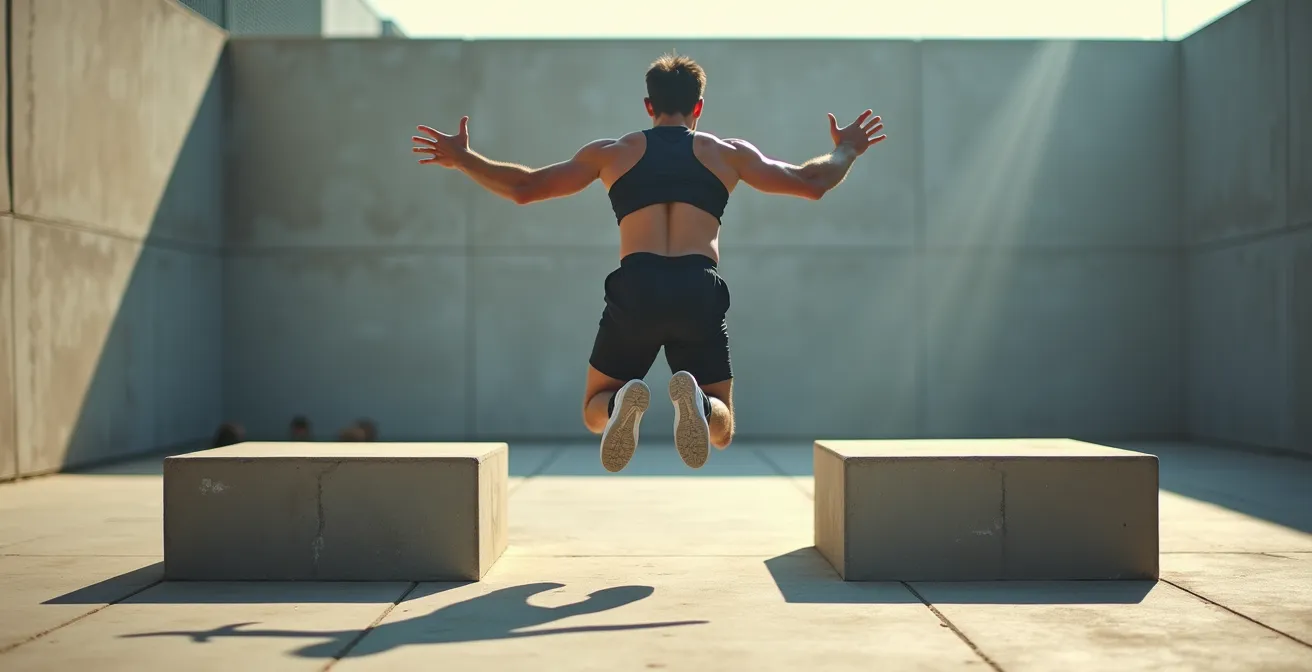
A proven method is the “1,000 Rep Progression.” Practice hundreds of reps on the ground between two lines. Then, add a tiny bit of elevation, like a single curb, and do hundreds more. Then, increase the distance slightly back on the ground. Only after you have logged these reps and can land consistently and silently should you even consider a jump between two stable, waist-high obstacles. Your first precision jump at height should feel boringly easy, because you’ve already done the hard work on the ground.
How to Read the Ground and Spot Hidden Hazards
As you begin to move more dynamically through your environment, your perception must evolve. It’s no longer enough to just look where you’re going; you must learn to read the terrain like a language. A smooth-looking patch of concrete could be hiding a thin layer of sand or fine gravel, a veritable death trap for a traceur moving at speed. A seemingly solid metal grate could be loose. This advanced level of “Traceur’s Vision” is about actively scanning for and identifying these hidden hazards before you commit your weight to a surface.
This isn’t a mystical ability; it’s a trainable, multi-sensory skill. Your eyes are your first line of defense. Look for subtle changes in color or texture on the pavement that might indicate debris. Pay attention to how shadows fall; irregular shadows can reveal bumps, dips, or loose objects that are invisible in direct light. Don’t just look at your takeoff and landing spots; scan the entire path between them. Your commute becomes a constant drill in active observation.
But your eyes are only part of the system. Your ears can detect the grinding sound of loose gravel under another pedestrian’s feet. Your own feet can provide crucial data. Before sprinting across a new surface, perform a quick, controlled “test step” or foot slide to feel the level of grip. This is especially critical after it rains, as previously safe surfaces like painted lines or manhole covers can become treacherously slick. Developing this habit of constant surface analysis is what separates a seasoned traceur from an accident-prone beginner. You must cultivate a healthy paranoia about the ground you move on.
Key Takeaways
- Focus is paramount: Parkour demands a ‘flow state’ that passive exercise cannot replicate, turning your commute into a form of active meditation.
- Safety through skill: Mastering the parkour roll to dissipate impact is non-negotiable and must be perfected before attempting drops or jumps.
- Progression over ambition: Never attempt skills at height without first achieving mastery and consistency on the ground to build both physical and psychological readiness.
How to Hack the ‘10,000 Hour Rule’ in Complex Skills?
The “10,000 Hour Rule” suggests that mastery requires an enormous volume of practice. For someone with a job and a daily commute, logging that kind of time seems impossible. But traceurs have intuitively found a way to “hack” this principle: skill-stacking and high-frequency, low-intensity practice. Instead of dedicating huge, infrequent blocks of time to training, you can use your daily commute to layer micro-skills on top of each other, leading to rapid and robust skill acquisition.
The commute becomes your laboratory. An analysis of parkour training methods reveals that practitioners who focus on combining simple movements into fluid sequences (skill-stacking) progress far faster than those who only practice isolated techniques. By treating the commute as a series of small challenges, you gamify the process and build complex motor patterns through daily reinforcement. The key is to have a structured plan, dedicating each day of the week to a specific aspect of your training. This prevents you from just repeating what you’re already good at and ensures a well-rounded development.
Imagine your week structured like this:
- Monday – Balance Focus: Walk every curb and railing you encounter. Don’t just walk; try to do it at different speeds, or stop and turn around.
- Tuesday – Vault Day: Identify all the hip-high benches and walls on your route. Practice simple safety vaults, focusing on fluid, quiet movement.
- Wednesday – Precision Day: The ground is your canvas. Practice jumping precisely onto painted lines, cracks in the pavement, or manhole covers.
- Thursday – Flow Day: Now, connect the skills. Try a balance on a curb, into a small precision jump, into a safety vault over a low wall. Link 3-4 movements together smoothly.
- Friday – Challenge Day: Attempt one slightly harder variation of a skill you practiced during the week or try a new combination you’ve been visualizing.
This system turns your 30-minute commute into 30 minutes of deliberate practice. It’s not about getting exhausted; it’s about making thousands of small, quality repetitions over time. You are hacking the 10,000-hour rule by transforming dead time into focused, consistent training.
How to Master the Handstand for Total Body Awareness?
While vaults and jumps are about moving through the environment, the handstand is about mastering your body within it. It may seem like a purely gymnastic skill, but for a traceur, it is a powerful tool for developing total body awareness, core strength, and balance. The ability to hold your own bodyweight upside down requires an immense amount of tension, control, and proprioceptive feedback. This directly translates to more complex movements; the pushing strength built in a handstand is the same strength used in a climb-up or to push off a wall in a vault.
As Ryan Ford of Apex School of Movement, a leading figure in parkour strength training, states, “A strong handstand is a useful tool for building ground/air awareness. Wall handstands are an effective way to fine-tune technique and build upper body pushing strength needed for movements like vaults and climb-ups.” The wall is your best friend when learning. Start with chest-to-wall handstands, where you walk your feet up the wall. This forces you into a straight body line and builds strength safely, unlike the banana-backed, stomach-to-wall version many people attempt first.
Like everything in parkour, you can integrate this into your daily life with a “guerilla” approach. You don’t need a gym; you need a wall. While waiting for the crosswalk light, find a solid wall and kick up for a 15-second hold. On the train platform (well away from the edge!), practice a few sets. Before you leave for work, do a few hollow body rocks on the floor to activate the core muscles essential for a stable handstand. This consistent, distributed practice builds strength and awareness far more effectively than one exhausting session per week. The handstand isn’t the end goal; it’s a diagnostic tool. Your ability to hold a straight, stable line upside down is a direct reflection of your total-body control—the ultimate foundation for any advanced movement.
The city is waiting. It is not a static collection of concrete and steel; it is a dynamic landscape of opportunity. Stop being a passive passenger in your own life and start a conversation with your environment. Your next commute is your first training session. The choice to see the world differently is yours. Begin today.
Frequently Asked Questions about Parkour for Commuters
Is parkour illegal?
The act of parkour itself is not illegal. However, you can be charged with trespassing if you are on private property without permission, or if you enter areas with clear “No Entry” signs. The key is to practice the “Ambassador Mindset”: be respectful, understand local laws, and leave a space immediately if asked by property owners or law enforcement.
What is the difference between parkour and freerunning?
While often used interchangeably, there is a philosophical difference. Traditional parkour emphasizes efficiency, strength, and getting from point A to point B as quickly and effectively as possible. Freerunning incorporates more aesthetic and acrobatic movements, like flips and spins, focusing on freedom of expression as much as efficiency.
What muscles does parkour work?
Parkour is a full-body workout. Jumps and landings build explosive power in your legs and glutes. Vaults and climb-ups develop strength in your chest, shoulders, arms, and back. Maintaining balance and control, especially in skills like the handstand, requires immense core strength. It is one of the most comprehensive functional fitness disciplines.