
Stop thinking heavy squats are the only path to massive thighs. The brutal truth is, they might be what’s holding you back.
- True quad growth is unlocked by maximizing time-under-tension and metabolic stress, not just the weight on the bar.
- Targeting specific quad heads like the VMO (teardrop) and Vastus Lateralis (sweep) requires surgical precision in exercise selection and stance.
Recommendation: Shift your focus from ‘brute force’ lifting to ‘anatomical targeting’ and pre-exhaustion techniques to finally force new growth.
You’ve been loyal to the iron. You live in the squat rack, chasing bigger numbers, believing that strength is size. Yet, your quads remain stubbornly average. The heavy sets leave your lower back and glutes screaming, but your thighs have hit a frustrating plateau. You see others with sweeping, detailed quads and wonder what secret they possess. The common advice is always the same: “squat heavier,” “eat more,” “be patient.” But patience runs out when progress grinds to a halt.
This isn’t about abandoning hard work. It’s about redirecting it. What if the key to unlocking new growth isn’t more brute force, but more intelligence? What if the relentless pursuit of one-rep maxes is actually preventing you from achieving the aesthetic you crave? The secret isn’t in lifting more weight, but in creating more effective tension. It’s time to move past the one-size-fits-all dogma and embrace a more surgical approach to hypertrophy—one that focuses on anatomical targeting, metabolic stress, and flawless execution.
This guide is your new blueprint. We will dissect the specific muscles that create an impressive quad, starting with the often-neglected “teardrop.” We’ll explore techniques like tempo training and pre-exhaustion to maximize every single rep. You’ll learn how to select the right machines and stances to sculpt your outer sweep, correct the form mistakes that are holding you back, and understand the science behind why looking “smaller” can sometimes mean you’re building denser, higher-quality muscle. Finally, we’ll cover the critical role of recovery in cementing your hard-earned gains.
Table of Contents: A Blueprint for Forging New Quad Mass
- Why the ‘Teardrop’ Muscle Is the Key to Knee Stability and Aesthetics?
- How to Use Tempo Reps to Torture Your Quads with Lighter Weights?
- Leg Press vs. Hack Squat: Which Builds Outer Sweep Faster?
- The Stance Mistake That Shifts Tension from Quads to Glutes
- In What Order Should You Perform Extensions for Pre-Exhaustion?
- High Bar vs. Low Bar: Which Squat Style Suits Long Femurs Better?
- Why You Can Look Smaller but Weigh the Same?
- How to Accelerate Muscle Repair While You Sleep?
Why the ‘Teardrop’ Muscle Is the Key to Knee Stability and Aesthetics?
The quest for legendary quads isn’t just about overall mass; it’s about shape, separation, and detail. The hallmark of a truly developed lower body is the prominent vastus medialis oblique (VMO), better known as the “teardrop” muscle just above the inside of the knee. This muscle is not just for show. It’s a critical stabilizer for the patella (kneecap), and a well-developed VMO is your first line of defense against knee pain, providing the structural integrity needed for heavy lifts. A weak VMO leads to tracking issues and instability, sabotaging both your performance and your long-term joint health.
Aesthetically, the teardrop provides a dramatic flare that separates the quads from the hamstrings and adductors, creating a more complete and three-dimensional look. Without it, even large thighs can appear blocky and undefined. The problem is that traditional heavy squats, especially if form falters, don’t always give the VMO the specific stimulus it needs to grow. It requires targeted work that focuses on the final degrees of knee extension.
To force the VMO into submission, you must incorporate exercises that emphasize this terminal extension. This is where anatomical targeting begins. Research on muscle activation patterns confirms that the VMO is most active during the last part of knee extension, a range of motion often missed in fast, explosive squats. Therefore, movements that allow you to consciously squeeze and hold at the top of the rep, like specific step-up variations or terminal knee extensions with a band, are non-negotiable. It’s about feeling that specific muscle burn and contract, a sensation that heavy, compound-focused training often overlooks.
How to Use Tempo Reps to Torture Your Quads with Lighter Weights?
The ego tells you to load the bar. Science, however, tells you to control the weight. The single most powerful tool you’re likely ignoring is tempo. Tempo training, or controlling the speed of each phase of a repetition, is the key to maximizing time under tension (TUT)—the true driver of metabolic stress and muscular hypertrophy. When you lift heavy with explosive intent, you’re primarily training your nervous system and fast-twitch fibers. But by slowing down, you force every muscle fiber, including the endurance-oriented ones, to engage, creating a deeper level of fatigue and a more powerful growth signal.
A typical tempo is written as a series of four numbers, such as 4-1-2-1. This represents a 4-second eccentric (lowering), a 1-second pause at the bottom, a 2-second concentric (lifting), and a 1-second squeeze at the top. For quads, a slow, agonizing eccentric phase is where the magic happens. It creates microscopic tears in the muscle that signal the body to rebuild them bigger and stronger. The idea is to make a lighter weight feel brutally heavy, torturing the muscle with constant tension rather than just moving a load from A to B.
This method is not just a theory; it’s backed by science. According to new research, reps with a duration of 2-8 seconds and sets lasting 20-70 seconds optimize the conditions for muscle growth. This extended duration floods the muscle with blood and metabolic byproducts, triggering sarcoplasmic hypertrophy—the “pump” that increases cell volume and creates a fuller, rounder look. This is the very dimension that heavy, low-rep training often fails to deliver. Applying a 4-second negative on a leg press or hack squat will force your quads to work in a way they never have before, igniting new gains where there was once a plateau.
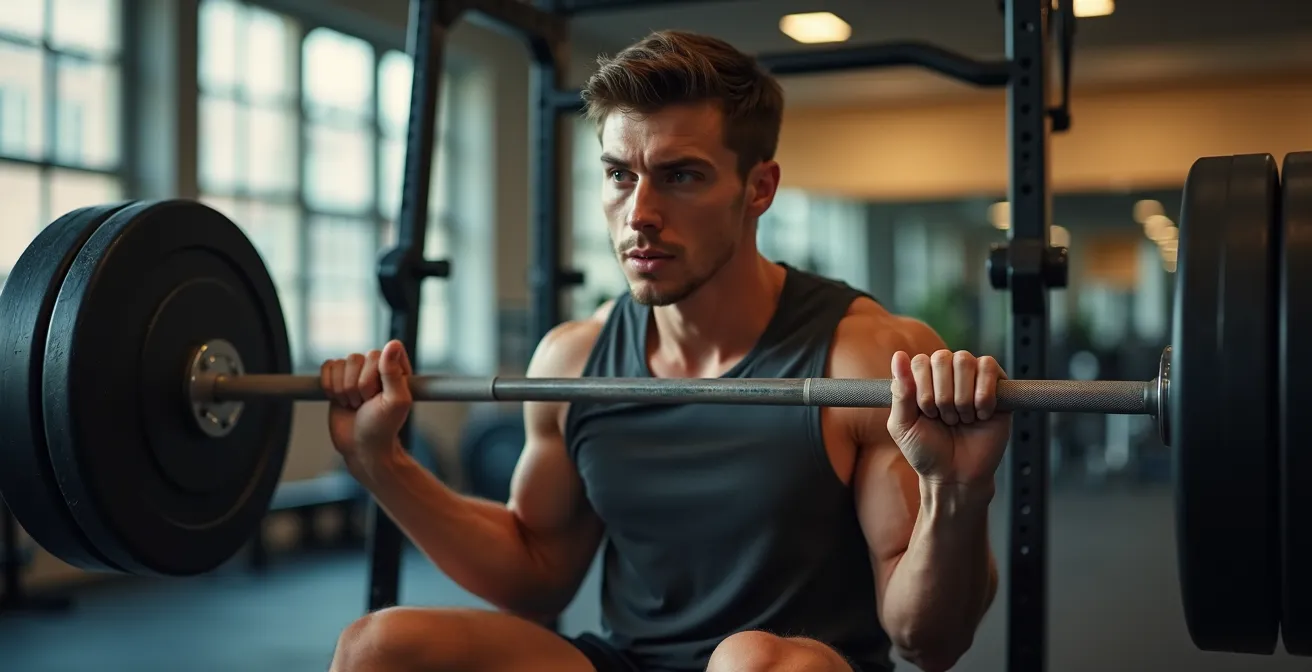
As you can see, the focus required for controlled tempo is immense. It’s a mental battle as much as a physical one, demanding complete concentration on the working muscle. This deliberate control ensures that the quads, not momentum or other muscle groups, are performing 100% of the work. It is the definition of a surgical strike on the muscle fibers.
Leg Press vs. Hack Squat: Which Builds Outer Sweep Faster?
Once you’ve embraced tension over pure weight, your exercise selection becomes a strategic choice. For sculpting a dramatic outer quad sweep—the hallmark of powerful thighs created by the vastus lateralis—the leg press and hack squat are your primary weapons. While both are superior to free-weight squats for isolating the quads, they offer distinct advantages. The choice between them depends on your goal: progressive overload for density or high-rep sets for metabolic stress.
The hack squat is arguably the king of quad isolation. As one expert source notes, its design is uniquely suited for targeting the outer sweep.
The hack squat’s fixed path and angled platform forces a more upright torso, isolating the quads especially the Vastus Lateralis or ‘outer sweep’ by minimizing glute and hamstring involvement.
This fixed path allows you to push to absolute failure with a greater degree of safety, making it ideal for mechanical overload. A narrow, feet-low stance on the platform will further emphasize the vastus lateralis, forcing it to carry the load and stimulating immense growth.
The leg press, on the other hand, offers more versatility. While a low and narrow foot placement also targets the quads, the seated position can sometimes allow for more glute involvement if form falters. However, its strength lies in its capacity for high-rep, pump-focused sets. The stability of the machine makes it perfect for implementing advanced techniques like tempo training, rest-pause sets, or drop sets to create incredible metabolic stress without the systemic fatigue of a free-weight squat. The following table breaks down the key differences for targeting your quads.
| Factor | Hack Squat | Leg Press |
|---|---|---|
| Vastus Lateralis Activation | Maximum with narrow stance | High with low foot placement |
| Body Position | Fixed path, upright torso | Seated/reclined position |
| Glute Involvement | Minimal | Variable based on foot position |
| Best Use | Progressive overload for outer sweep | High-rep pump sets |
| Recommended Stance | Narrow, feet straight | Low and narrow placement |
The verdict? Use both. Start your workout with heavy, controlled hack squats to build dense, powerful muscle in the outer quad. Then, move to the leg press for higher-rep, tempo-focused sets to flood the muscle with blood and stimulate sarcoplasmic growth. This two-pronged attack is the key to building both size and shape.
The Stance Mistake That Shifts Tension from Quads to Glutes
You can have the perfect exercise selection and tempo, but one subtle mistake can derail all your efforts: letting your hips rise faster than your shoulders during a squat or leg press. This common error, often a result of poor ankle mobility or an improper mental cue, immediately shifts tension from your quads to your more powerful glutes and lower back. Your body is smart; it will always find the path of least resistance. If your quads are the weak link, your body will instinctively recruit the posterior chain to move the weight. This is why your glutes might be growing while your quads are stuck.
The root cause is often a limitation in ankle dorsiflexion—the ability to move your knee forward over your toes while keeping your heel on the ground. When this is limited, you can’t achieve the upright torso necessary for a quad-dominant squat. Instead, your hips are forced to shoot back and up, turning the movement into a hip-dominant “good morning” squat. Unsurprisingly, biomechanical analysis reveals that greater dorsiflexion is required for lifters to maintain an upright posture and keep the tension where it belongs: on the quads. This is especially true for those with long femurs.
Correcting this requires a conscious, multi-step approach. First, you must improve your mechanics. Elevating your heels on small plates or wearing weightlifting shoes is an immediate fix that allows for greater forward knee travel, instantly making the movement more quad-centric. Second, you need to re-pattern the movement with exercises that force an upright torso, like goblet squats or front squats. Finally, you need to change your internal cue. Instead of thinking “stand up,” which encourages hip drive, think “push the floor away” with the balls of your feet. This simple mental switch helps maintain constant tension on the quadriceps throughout the entire lift.
Your Action Plan: Reclaiming Quad Dominance
- Points of contact: Test your current ankle mobility using the wall test. Your knee must touch the wall from 4 inches away without your heel lifting.
- Collecte: Inventory your current squat form. Film yourself to see if your hips shoot up first, indicating a shift of tension away from the quads.
- Cohérence: Confront your pattern with a quad-dominant movement. Practice heels-elevated goblet squats, forcing your knees to travel forward over your toes.
- Mémorabilité/émotion: Internalize the new primary cue. Instead of thinking ‘stand up,’ focus entirely on ‘pushing the floor away’ to keep tension on the quads.
- Plan d’intégration: Systematically replace your current squat style with front squats or heels-elevated back squats for the next 4-6 weeks to build the new motor pattern.
In What Order Should You Perform Extensions for Pre-Exhaustion?
Forcing a stubborn muscle to grow often requires unconventional tactics. Pre-exhaustion is one of the most brutal and effective techniques in a bodybuilder’s arsenal. The principle is simple: you fatigue a target muscle with a single-joint isolation exercise immediately before performing a multi-joint compound exercise that also involves that muscle. For quads, this means performing a set of leg extensions to failure right before launching into a set of squats or leg presses with no rest in between. This strategic ordering creates a level of muscular fatigue that is impossible to achieve with traditional training.
Why is this so effective? The leg extension almost exclusively targets the quadriceps, particularly the rectus femoris, which is a two-joint muscle that often doesn’t get fully stimulated in deep squats. By pre-fatiguing the quads, you enter the compound movement with your primary target muscle already compromised. This forces the secondary muscles within the quadriceps group (the vasti muscles) to work overtime, recruiting deeper muscle fibers that would normally remain dormant. It’s a way to ensure the quads are the absolute limiting factor in the set, not your cardiovascular system or smaller stabilizing muscles.
Case Study: The Power of Pre-Exhaustion Supersets
The effectiveness of this method is well-documented. For instance, research examining pre-exhaustion techniques found that performing leg extensions immediately before squats creates a unique training stimulus. When the Rectus Femoris is pre-fatigued from the isolation work, the Vasti muscles (like the teardrop and outer sweep) must work significantly harder during the compound movement. This leads to a greater overall quad activation and a more potent growth signal than what can be achieved with traditional set ordering, where fresh quads can rely on their strongest fibers.
The key to successful pre-exhaustion is the setup and the mindset. The transition between the leg extension and the squat or leg press must be immediate—zero rest. This means having your equipment set up and ready to go before you even start the first rep of the extension. The weight on the compound movement will have to be significantly lighter than what you would normally use. This is where you must swallow your ego. The goal is not to lift heavy weight; the goal is to annihilate the target muscle with overwhelming metabolic stress and tension. One or two of these pre-exhaust supersets is all it takes to feel your quads in a way you never have before.
High Bar vs. Low Bar: Which Squat Style Suits Long Femurs Better?
Even when moving beyond a reliance on heavy squats, the movement itself remains a foundational tool—if applied correctly. The “just squat” mantra is useless without context. The choice between a high-bar and low-bar position is not a matter of preference; it’s a critical biomechanical decision that dictates which muscles do the work. For a lifter with long femurs relative to their torso, this choice is everything. It’s often the hidden reason why squats build their glutes and back but leave their quads underdeveloped.
The low-bar squat, favored in powerlifting, places the barbell across the rear deltoids. This position forces a significant forward lean of the torso to keep the bar over the mid-foot. For a long-femured lifter, this lean becomes extreme, turning the movement into a hip-dominant exercise. The glutes and hamstrings take over, while the quads are left with a minimal role. This is the classic “good morning” squat pattern that builds a strong posterior chain but fails to deliver quad mass.
The high-bar squat, common in Olympic weightlifting, places the bar directly on the trapezius muscles. This allows for a much more upright torso, which in turn allows the knees to travel further forward. This forward knee travel is the key to quad activation. It lengthens the quadriceps under load, placing them under significantly more tension. For the long-femur lifter, the high-bar position is not just an option; it’s a necessity for making the squat a quad-building exercise. To take it a step further, the front squat is the ultimate quad-builder for this body type, as it makes an upright torso non-negotiable.
If you have long legs and struggle to feel your quads working in a squat, the solution is clear. Ditch the low-bar position. Switch to a high-bar setup and focus on keeping your chest up and allowing your knees to track over your toes. Elevating your heels can further assist in achieving the correct mechanics. It’s not about abandoning the king of exercises; it’s about customizing it to fit your unique anatomy and force the tension where you want it to be.
Why You Can Look Smaller but Weigh the Same?
Here is one of the most confusing paradoxes in bodybuilding: you’ve been training with intensity, your diet is on point, the number on the scale isn’t changing, yet you feel you look smaller in clothes. This frustrating experience is not in your head. It’s a real phenomenon rooted in the two different types of muscle hypertrophy, and it often occurs when lifters transition from “brute force” heavy lifting to more targeted, tension-driven work.
The first type is myofibrillar hypertrophy. This is an increase in the size and number of the contractile proteins (myofibrils) within the muscle fibers. It’s primarily stimulated by mechanical tension—lifting heavy weights for low reps. This type of growth creates dense, strong muscle. It increases your strength dramatically but doesn’t necessarily add a lot of “volume” to the muscle. This is the growth you get from heavy powerlifting-style squats.
The second type is sarcoplasmic hypertrophy. This is an increase in the volume of the fluid, or sarcoplasm, within the muscle cell. This fluid contains glycogen, water, and other non-contractile elements. It’s stimulated by metabolic stress—the “pump” you get from higher-rep, shorter-rest training that pushes a muscle to its metabolic limit. This type of growth adds significant volume and roundness to a muscle, creating the “full” look that bodybuilders chase. Because this growth is largely composed of fluid, it is less dense than myofibrillar tissue.
The Science of Density vs. Volume
When you shift your training to include more tempo work, pre-exhaustion, and high-rep pump sets, you are stimulating more sarcoplasmic growth. At the same time, if you reduce your ultra-heavy lifting, your body may be building new, voluminous sarcoplasmic tissue while simultaneously losing some of the ultra-dense myofibrillar tissue. Body composition research confirms that muscle is approximately 18% denser than fat tissue, and a similar principle applies within muscle itself; myofibrillar tissue is denser than sarcoplasmic tissue. So, you could be replacing a small amount of dense tissue with a larger volume of less-dense tissue, resulting in no net change on the scale but a different, often fuller and rounder, appearance.
Don’t be discouraged by the scale. If you are implementing tension-focused techniques, you are building the type of muscle that contributes to an aesthetic, three-dimensional physique. The scale is a liar; the mirror and the tape measure are your truth.
To Remember
- Quad growth plateaus are broken by shifting focus from maximal weight to maximal time-under-tension.
- Surgical targeting of individual quad heads (VMO, Vastus Lateralis) is non-negotiable for aesthetic development.
- Techniques like tempo reps, pre-exhaustion, and precise stance adjustments are more critical than simply adding plates to the bar.
How to Accelerate Muscle Repair While You Sleep?
You can have the most brutal, intelligent, and surgically precise workout in the world, but growth doesn’t happen in the gym. It happens when you recover. The most critical and anabolic window you have is the 7-9 hours you spend sleeping each night. During deep sleep, your body releases a cascade of hormones, including growth hormone (GH), which are essential for repairing the muscle tissue you’ve spent so much effort breaking down. Skimping on sleep is like throwing your hard work in the trash.
Accelerating muscle repair during sleep is not a passive process; it’s an active strategy. It begins with optimizing your sleep environment and pre-bed rituals, a concept known as sleep hygiene. The goal is to maximize the time spent in the deepest, most restorative stages of sleep. This means creating a pitch-black, cool, and quiet environment. A room temperature around 18°C (65°F) has been shown to be optimal for promoting deep sleep cycles. Equally important is managing your light exposure. The blue light emitted from phones, TVs, and computers suppresses melatonin production, the hormone that signals your body it’s time to sleep. Eliminating all screen time at least 90 minutes before bed is non-negotiable.
Your pre-sleep nutrition also plays a pivotal role. Consuming a large meal or intense training too close to bedtime can elevate cortisol and body temperature, disrupting sleep architecture. However, a strategic pre-bed protein snack can provide your muscles with a slow, steady stream of amino acids for repair throughout the night. A serving of 30-40g of casein protein or cottage cheese about 30 minutes before bed is an ideal strategy to promote an anti-catabolic state while you sleep. Combining this with supplements like ZMA (Zinc, Magnesium Aspartate) can further support hormonal function and enhance sleep quality. Your dedication to growth cannot end when you leave the gym; it must extend to the discipline you apply to your recovery.
Stop guessing and start growing. Implement these surgical hypertrophy principles into your next leg day and command your quads to grow. The path to adding inches to your thighs is paved with intelligent effort, not just blind intensity.