

Adding inches to your vertical isn’t about more reps; it’s about better physics.
- Your body is a spring system. Explosiveness comes from stiffness and rapid force transfer, not slow, grinding muscle contractions.
- Most injuries are not from jumping too high, but from landing incorrectly. Force absorption is a trainable skill.
Recommendation: Stop chasing fatigue and start engineering your jump. Focus on technique, nervous system efficiency, and joint integrity to build a leap that’s both powerful and sustainable.
Every aspiring basketball player has the same dream: to soar above the rim for a thunderous dunk. You’ve likely spent hours in the gym, doing countless calf raises and leg presses, chasing that elusive extra inch. You see progress, but it’s slow, and worse, your knees are starting to ache. This is the frustrating cycle for so many dedicated athletes. You’re putting in the work, but you’re not getting the explosive results you crave, and you’re putting your body at risk.
The common advice—”just jump more” or “squat heavy”—is dangerously incomplete. It treats your body like a hydraulic press, assuming more force in equals more height out. But that’s not how elite athletes fly. They don’t just generate force; they channel it. They understand that a massive vertical leap is a feat of engineering, not just brute strength. It’s about optimizing the entire kinetic chain, from your toes to your fingertips, to function as a powerful, coordinated spring.
What if the key wasn’t in building bigger muscles, but in training your tendons to be more elastic and your nervous system to be more efficient? This guide will break that down. We’re not just giving you a list of exercises. We are going to deconstruct the jump. We’ll dismantle common myths that are wasting your time and hurting your knees, rebuild your technique from the ground up, and show you how to safely convert your gym strength into game-changing athletic power. This is your 8-week blueprint to not only jumping higher, but jumping smarter.
This comprehensive guide will walk you through the critical components of elite vertical jump training. You’ll learn the science, master the techniques, and receive a clear, progressive plan to elevate your game safely.
Summary: A Specialist’s Blueprint for a Safer, Higher Vertical Jump
- Why Calf Raises Are Useless for Explosive Vertical Power?
- How to Fix Your Approach Steps to Maximize Lift-Off?
- Ankle Braces or Tape: Which Provides Better Proprioception?
- The Volume Mistake That Inflames Patellar Tendons in Teenagers
- In What Order Should You Progress from Box Jumps to Depth Jumps?
- In What Order Should You Pair Heavy Lifts and Jumps?
- Why Poor Landing Mechanics Cause 70% of Handball Knee Injuries?
- How to Convert Gym Strength into Athletic Power for Contact Sports?
Why Calf Raises Are Useless for Explosive Vertical Power?
Let’s start by dismantling the single biggest myth in vertical jump training: the calf raise. While it feels like you’re working the right muscles, the calf raise is training your body for the exact opposite of what an explosive jump requires. The goal of a jump is to generate maximum force in minimum time. This is a function of the stretch-shortening cycle (SSC), where your tendons act like a biological spring, storing and releasing elastic energy. A slow, grinding calf raise does nothing to train this quality.
The science is clear on this. True explosive movements happen in a flash. In fact, research shows that explosive jumps require a sub-200 millisecond ground contact time. Compare that to the 500+ milliseconds it takes to perform a single calf raise. You’re training your nervous system to be slow. Instead of building a powerful spring, you’re building a slow, inefficient hydraulic press. The key to unlocking vertical power lies not in your calf *muscle*, but in your Achilles *tendon* and the ankle’s ability to remain stiff upon impact.
This “ankle stiffness” allows for a near-instantaneous transfer of force from the ground, through your body, and into upward momentum. It’s about creating a rigid lever that doesn’t buckle and leak energy. To build this quality, you need to replace calf raises with exercises that train rapid ground contact and elastic recoil. Think of exercises like pogo jumps, skipping, and ankle hops, where the focus is on being quick and reactive off the floor, with minimal knee bend. This is how you build a real biological spring.
How to Fix Your Approach Steps to Maximize Lift-Off?
A static, standing vertical jump is one thing, but a running jump is where athletes truly fly. The secret to maximizing your height from an approach lies in the final two steps, specifically the penultimate step. This is the second-to-last step before you plant to jump, and it is the single most important piece of technique for converting horizontal speed into vertical lift. Most athletes get this wrong, “drifting” or “stuttering” into their jump, which kills their momentum and caps their potential.
The goal of the penultimate step is to effectively lower your center of gravity, creating a powerful braking force that loads your hips and legs like a coiled spring. It should be a long, aggressive step where your foot contacts the ground slightly in front of your body. As this happens, your torso will naturally lean back slightly, and your arms will swing back behind you. This isn’t just for balance; it’s a crucial part of the loading mechanism. From this lowered position, you can explode upwards with maximum force on your final plant step.
Think of it like a pole vaulter planting their pole. They don’t just run up and hop; they perform a powerful plant to bend the pole (store energy) before it launches them upwards. Your penultimate step is your plant. It’s the moment you stop moving forward and start the process of moving up.
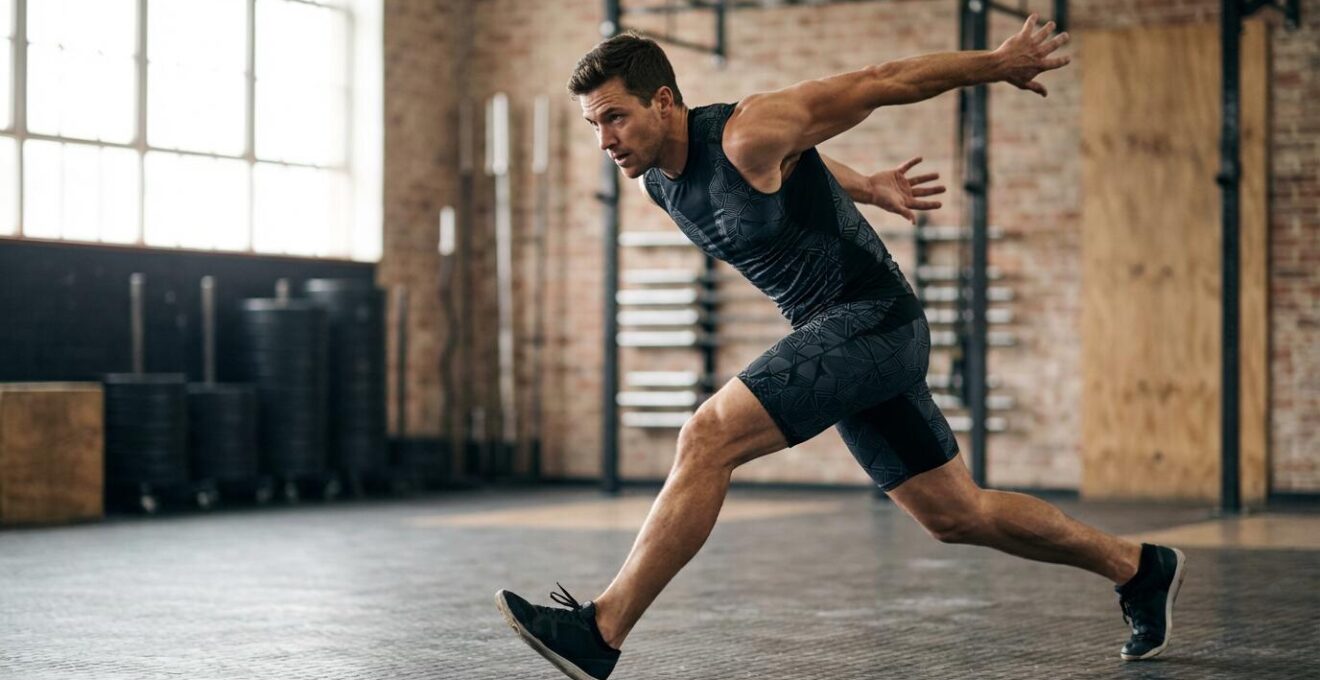
As the image demonstrates, this technique creates immense tension and potential energy. The long stride, lowered hips, and backward arm swing are all preparing the body for a violent, upward explosion. Mastering this takes practice. Start by walking through the motion: take a long second-to-last step, feel your hips drop, and then drive up. Gradually increase the speed until it becomes a fluid, powerful, and automatic part of your approach. This single mechanical fix can add inches to your jump overnight.
Ankle Braces or Tape: Which Provides Better Proprioception?
Ankle sprains are the bane of any jumping athlete’s existence. The immediate reaction is often to rely on an external support like a rigid brace or a heavy tape job. While these can be useful for short-term stability after an acute injury, they are a crutch, not a solution. Relying on them long-term can actually weaken your ankle and diminish your body’s most important defense mechanism: proprioception. This is your body’s innate sense of its position in space, a constant feedback loop between your joints and your brain.
Braces provide high mechanical stability but do so by restricting motion, which over time can reduce your brain’s reliance on the natural feedback from the ligaments and tendons in your ankle. Athletic tape offers better proprioceptive feedback because it pulls on the skin, providing a constant sensory cue. However, it loosens quickly and loses its mechanical support. The ultimate goal should be to build a “biological brace” by strengthening the muscles around the joint, making external aids unnecessary for prevention.
This table breaks down the trade-offs, but highlights why strengthening is the superior long-term strategy for any healthy or recovering athlete.
| Support Type | Mechanical Stability | Proprioceptive Feedback | Best Use Case |
|---|---|---|---|
| Ankle Brace | High (External) | Reduced over time | Acute injury recovery |
| Athletic Tape | Moderate (loosens) | Enhanced (skin pull) | Late-stage rehab |
| Strengthening Only | Natural (Internal) | Optimal long-term | Prevention & maintenance |
Building this internal stability is not only the best way to prevent future injuries, but it also enhances performance. A strong, stable ankle is a reactive ankle, capable of making micro-adjustments on landings and contributing to the ankle stiffness we discussed earlier. It allows you to trust your body, moving with confidence and power without fear of your ankle giving out.
Action Plan: Your Biological Brace Building Protocol
- Single-leg balance holds: Start with 3 sets of 30 seconds on each leg. Once you can do this easily, progress to performing them with your eyes closed to challenge your proprioception.
- Alphabet ankle traces: While seated, trace the letters of the alphabet from A to Z with each foot once a day. This improves range of motion and fine motor control.
- Resistance band eversions: Loop a band around your feet. Perform 3 sets of 15 repetitions, pushing your foot outwards against the resistance to strengthen the peroneal muscles that prevent inversion sprains.
- Lateral bounds: Perform 2-3 sets of 10 bounds per side. These dynamic movements teach your ankle to stabilize against lateral forces, mimicking game situations.
- Sticking your landings: Every time you do a jump, focus on landing softly and holding the landing for 2-3 seconds. This trains your body to absorb force correctly.
The Volume Mistake That Inflames Patellar Tendons in Teenagers
If you’re a young athlete, especially a male between 10 and 15, and the bony bump just below your kneecap is sore and swollen, you are not alone. This is likely Osgood-Schlatter disease, a common overuse injury. It’s a direct result of the number one training mistake young jumpers make: too much volume, too soon. Your obsession with dunking leads you to jump, jump, and jump some more, without adequate rest or a structured plan. This relentless stress on an immature skeletal system is a recipe for chronic pain.
This condition is particularly prevalent in young athletes for a specific reason. According to Johns Hopkins Medicine, it’s most common in athletic young people who play sports with frequent running and jumping, especially during growth spurts. During these periods, your bones can grow faster than the muscles and tendons attached to them. This creates a natural tension. The patellar tendon, which connects your kneecap to your shinbone, pulls repeatedly on its attachment point (the tibial tubercle). This constant traction leads to inflammation, pain, and in some cases, micro-fractures at the growth plate.
The prevailing theory describes it as repeated traction leading to microvascular tears and inflammation. You’re essentially pulling the tendon away from the bone with every single jump. The solution is not to “play through the pain.” The solution is to be smarter. You must manage your jumping volume meticulously. Never jump at 100% intensity more than two days in a row. Listen to your body; pain is a signal to rest and recover, not to push harder. Focus on quality over quantity, and integrate strengthening exercises for the hips and hamstrings to take some of the load off your quadriceps and patellar tendon.
In What Order Should You Progress from Box Jumps to Depth Jumps?
Plyometrics are the heart of vertical jump training, but they are potent medicine. Using the wrong exercise at the wrong time is a fast track to injury and stalled progress. Many athletes jump straight to advanced movements like depth jumps without building the necessary foundation, which is incredibly risky. A structured, five-stage progression is mandatory to build power safely and effectively.
This progression is based on two principles: mastering mechanics before adding intensity, and gradually conditioning your body to handle increasing ground reaction forces (GRFs). As you advance, the amount of force your body must absorb and redirect skyrockets. For instance, biomechanical research indicates that depth jumps can produce GRFs up to 5 times your body weight, whereas simple box jumps are closer to 3.5 times. Attempting to manage those high-impact forces without proper preparation is negligent.
Follow this exact sequence. Do not skip stages. You should be proficient and pain-free at one stage for at least two weeks before even attempting the next.
- Stage 1: Box Jumps. The primary goal here is to master landing mechanics. Jump onto a low box (e.g., 24 inches) and focus on landing softly and silently, with your hips back and knees out. This teaches force absorption.
- Stage 2: Seated Box Jumps. By starting from a seated position, you remove the stretch-shortening cycle. This forces you to generate power from a dead stop (concentric power), building raw explosive strength.
- Stage 3: Hurdle Hops. Now the focus shifts to reducing ground contact time. Set up a series of low hurdles and hop over them continuously, spending as little time on the ground as possible (aim for under 250ms). This builds the “biological spring.”
- Stage 4: Depth Drops. This is purely about force absorption. Step off a low box (12-18 inches) and focus ONLY on “sticking” the landing perfectly and instantly. You are learning to handle the impact that precedes a depth jump.
- Stage 5: Depth Jumps. The final stage. Step off the box, land, and immediately explode up into a maximal vertical jump. The goal is to link the force absorption (the drop) to a powerful explosion with a ground contact time under 200ms.
In What Order Should You Pair Heavy Lifts and Jumps?
Being strong in the gym is great, but it’s useless if you can’t display that strength quickly and explosively on the court. The bridge between raw strength and athletic power is a training method called Complex Training. This involves pairing a heavy resistance exercise with a biomechanically similar explosive exercise. The goal is to leverage a phenomenon known as Post-Activation Potentiation (PAP).
In simple terms, lifting a heavy weight “wakes up” your central nervous system (CNS). It recruits a maximum number of high-threshold motor units—the muscle fibers responsible for powerful, fast contractions. If you immediately follow that heavy lift with an explosive movement, your newly-awakened nervous system will drive a more forceful and powerful contraction, leading to a higher jump. Studies have shown this effect is real and potent; a potentiation protocol can increase vertical jump performance significantly.
The key is in the pairing and the rest period. The heavy lift and the explosive movement must be similar in pattern. The rest period must be long enough for muscular fatigue to dissipate but short enough for the CNS potentiation to remain. This is typically between 45 and 90 seconds. Waiting too long erases the effect; not waiting long enough means fatigue will hinder your performance.
Here is a practical guide to effective complex training pairs. You would perform the heavy lift, rest for the prescribed time, and then perform the explosive movement with maximal intent.
| Heavy Lift | Rest Period | Explosive Movement | Target Outcome |
|---|---|---|---|
| Back Squat @85% 1RM | 45-90 sec | Vertical Jumps x5 | Vertical power |
| Hip Thrusts @85% 1RM | 60-90 sec | Broad Jumps x3 | Horizontal power |
| Weighted Pull-ups | 45-60 sec | Med Ball Slams x5 | Upper body power |
This is an advanced training method. It should only be implemented by athletes who have a solid strength foundation and have mastered basic lifting and jumping techniques. When used correctly, however, it is one of the most effective tools for converting hard-earned gym strength into a dominant athletic presence.
Why Poor Landing Mechanics Cause 70% of Handball Knee Injuries?
We are obsessed with the “up” part of the jump, but the “down” part is what determines the longevity of your athletic career. A staggering number of non-contact knee injuries, particularly ACL tears, occur not during the jump, but during the landing. While the statistic in the title refers to handball, the principle is universal: poor force absorption is a ticking time bomb for your knees. When you land with stiff legs or let your knees collapse inward (known as knee valgus), you are directing immense stress straight into the ligaments of your knee.
A proper landing is an active skill, not a passive event. It requires your posterior chain—your glutes and hamstrings—to engage powerfully to absorb the impact, taking the strain off your joints. Your hips should hinge back as if sitting in a chair, your chest should stay up, and your knees should track in line with your feet, never caving inward. Studies on female athletes, who often have a wider hip-to-knee “Q-angle,” show an even greater need for focused strengthening of the hip abductors and gluteus medius to prevent this dangerous inward collapse.
You must train your landing with the same intensity you train your jump. Every single rep of every jump you do, from a simple box jump to a maximal depth jump, should end with a perfect, “stuck” landing. Your goal is to land as silently as possible; a loud landing is a sign of poor force absorption. Here are three essential drills to build an elite landing pattern and bulletproof your knees.
- Wall Sits with a ball between your knees: Hold for 3 sets of 30 seconds. Squeezing the ball forces your adductor muscles to activate, helping to maintain a neutral knee alignment and prevent collapse.
- 6-inch Depth Drops: Step off a very low box or step. The only goal is to land and “stick” the perfect landing position instantly. Hold for 3 seconds. This isolates the force absorption phase.
- Single-leg Romanian Deadlifts (RDLs): Perform 3 sets of 8 on each leg. This directly strengthens the hamstrings and glutes while teaching the crucial hip-hinge pattern needed for a safe landing.
Key Takeaways
- Explosive power comes from ankle stiffness and rapid force transfer, not slow-moving exercises like calf raises.
- The penultimate step is the key to converting horizontal speed into vertical lift; it must be trained explicitly.
- Building a “biological brace” through strengthening is superior to relying on external supports like braces or tape for long-term ankle health.
How to Convert Gym Strength into Athletic Power for Contact Sports?
You’ve put in the hours under the barbell. You’re strong. But when you get on the court, you feel slow and earthbound. This is the classic disconnect between the weight room and the field of play. Strength is the ability to produce force. Power is the ability to produce that force *quickly*. The final piece of the puzzle is bridging this gap, ensuring that every pound you can squat translates into explosive, game-winning athleticism.
There’s a direct correlation between maximal strength and jumping potential. As O’Hara Fitness Research points out in “The Science of Vertical Jump Training”:
Athletes who can squat 2x their body weight typically jump 6-8 inches higher than those who can only squat 1.5x their body weight
– O’Hara Fitness Research, The Science of Vertical Jump Training
This gives you a clear strength goal. But hitting that number isn’t enough. You must supplement your heavy lifting with “bridge” exercises. These are movements that train your body to move moderately heavy loads as explosively as possible. This develops your rate of force development (RFD)—the master quality of any explosive athlete. It’s not just about how much force you can produce, but how fast you can produce it.
Your training week should include both heavy strength work (like squats and deadlifts) and these power-focused bridge exercises. Always perform the power work with maximal intent; every single repetition should be performed as fast and violently as possible, regardless of the weight.
- Trap Bar Jumps: Use 30% of your bodyweight and perform 3 sets of 5 jumps. This develops “strength-speed.”
- Kettlebell Swings: Perform 4 sets of 8 explosive reps. This is a pure “speed-strength” movement, teaching hip extension power.
- Loaded Sled Pushes: Do 3 sets of 20 yards. This teaches you to produce high levels of force while in motion.
By combining a strong foundation, perfected mechanics, a well-progressed plyometric plan, and targeted power development, you are no longer just exercising. You are engineering a complete athlete. You are building a system that is not only capable of incredible feats of power but is also resilient and resistant to injury.
Now you have the blueprint. It’s a disciplined, science-backed approach that demands consistency and attention to detail. Stop guessing and start engineering. Commit to this 8-week plan, and you won’t just add inches to your vertical—you will transform yourself into a more powerful, more durable, and more confident athlete.