
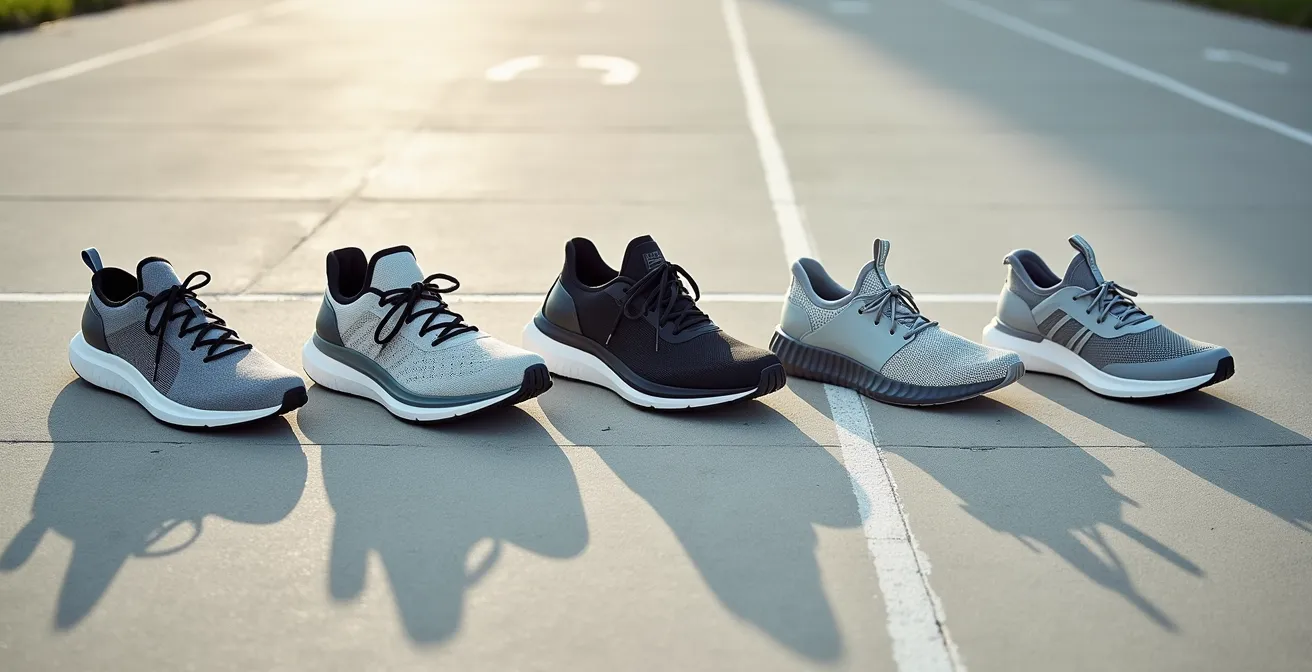
The biggest mistake in choosing running shoes is focusing on static arch type; the key to injury prevention is managing your dynamic gait mechanics.
- Footwear should counteract biomechanical flaws that appear during a run (like overpronation due to fatigue), not just match your foot’s shape at rest.
- Shoe features like heel drop and cushioning don’t just provide comfort; they actively redistribute impact forces across your kinetic chain, affecting your knees and Achilles tendon.
Recommendation: Select your next pair of shoes by analyzing their structural integrity and how they support your movement under load, rather than relying on generic « foot type » rules.
For many runners, the cycle is frustratingly familiar: a new pair of brightly colored running shoes feels great for a few weeks, only to be followed by the familiar twinge of shin splints or the sharp, stabbing pain of plantar fasciitis. The conventional wisdom, often repeated in stores and online, is to « know your arch type. » You might have even done the « wet test, » dutifully examining your footprint to diagnose yourself as having flat, neutral, or high arches. This approach is simple, intuitive, and has sold millions of pairs of shoes.
However, from a clinical pedorthic perspective, this static model is dangerously incomplete. It ignores the most critical factor in running: movement. Your foot’s shape at rest is only a fraction of the story. The real questions are: How does your foot behave under the impact of 3-5 times your body weight with every stride? How does your entire kinetic chain—from your ankle to your hips—respond to fatigue over the course of a run? Focusing solely on arch height is like choosing a car’s tires based on how they look in the showroom instead of how they perform on the road.
The truth is, selecting the right running shoe is a medical decision disguised as a retail purchase. It’s about managing dynamic forces, not accommodating a static shape. This guide will dismantle the outdated « arch-type » model and provide a new framework based on biomechanics. We will move beyond color and brand loyalty to analyze shoes as what they are: clinical tools designed to support your unique gait cycle and keep you running, pain-free.
This article provides a clinical framework for making an informed footwear decision. We will deconstruct the function of a running shoe from the ground up, examining how to identify biomechanical needs and assess when a shoe has failed structurally, ensuring your next pair serves as a true asset for your orthopedic health.
Summary: A Pedorthist’s Guide to Gait Mechanics Over Aesthetics
- Why Neutral Shoes Cause Pain for Flat-Footed Runners?
- How to Inspect Your Outsole to Know It’s Time to Replace?
- Max Cushion vs. Minimalist: Which Reduces Knee Impact?
- The ‘Black Toenail’ Mistake Caused by Buying Your Street Size
- How to Rotate Two Pairs to Extend Their Life by 20%?
- Stability or Speed: Which Shoe Feature Matters More for Wingers?
- The ‘Weekend Warrior’ Mistake That Ruptures Achilles Tendons
- Why a 5-Minute Dynamic Warm-Up Reduces Injury Risk by 50%?
Why Neutral Shoes Cause Pain for Flat-Footed Runners?
The common advice is that flat feet require stability shoes. But the more critical question is *why*. The issue isn’t the lack of an arch itself, but what happens to the foot under load. Many people have « flexible flat feet, » where the arch appears normal when non-weight-bearing but collapses inward upon impact—a movement called overpronation. A neutral shoe, which offers no medial support, simply allows this collapse to happen unchecked. This repeated, uncontrolled motion places immense strain on the plantar fascia, the posterior tibial tendon, and can misalign the entire kinetic chain, leading to pain in the shins, knees, and even hips. It’s a significant issue, as research shows that the vast majority of runners—up to 70%—overpronate to some degree.
However, not all flat feet are the same. A « rigid flat foot » is anatomically flat, with little to no arch even when seated. This type often requires motion-control shoes, which are more robust than standard stability models. Differentiating between flexible and rigid flat feet is crucial for proper shoe selection.
How to Differentiate Your Foot Type
- The Tiptoe Test: Stand barefoot and rise up onto your tiptoes. If a visible arch forms, you likely have flexible flat feet. Your muscles and tendons are capable of creating an arch, but they fail to support it under running loads.
- Jack’s Test: While seated, have someone passively lift your big toe upwards (dorsiflexion). If an arch becomes noticeable, this also indicates flexible flat feet.
- Assessment: If no arch forms during these tests, you may have rigid flat feet. This structural condition requires a different level of support. Flexible flat feet benefit from stability shoes that provide medial guidance, while rigid flat feet often need more structured motion-control shoes to limit excessive movement.
Choosing a neutral shoe for a flexible flat foot is an invitation for injury, as it provides no defense against the biomechanical stresses of a collapsing arch.
How to Inspect Your Outsole to Know It’s Time to Replace?
The « 400-600 mile rule » is a common guideline for shoe replacement, but it’s a blunt instrument. It fails to account for runner weight, surface type, and, most importantly, the specific rate of material degradation. A running shoe’s midsole, typically made of EVA foam, is its primary shock absorber. One podiatrist study found this critical component can lose its supportive properties after just 300 miles for active runners. Running on a « dead » shoe—one whose foam has permanently compressed—is like running with worn-out shock absorbers on a car: the frame (your body) takes the full force of every impact. Instead of relying on mileage alone, a physical inspection is a far more accurate method for assessing a shoe’s structural integrity.
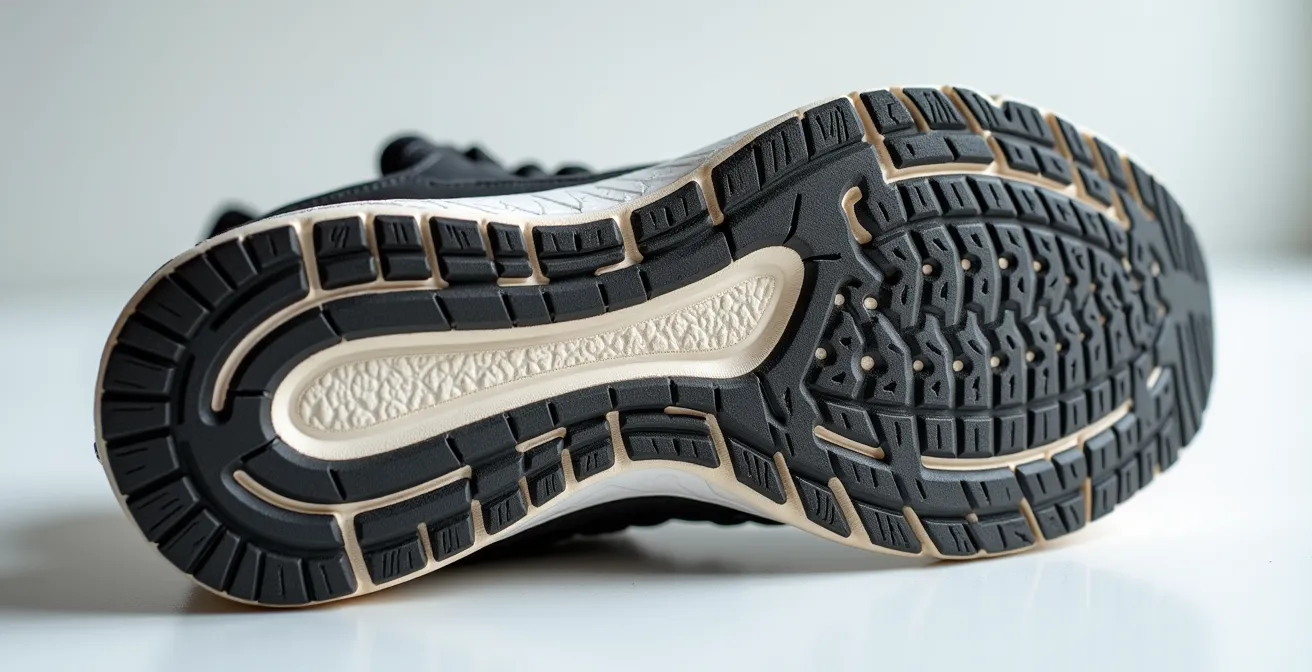
Visual wear on the outsole provides clues, but the real failure happens inside the midsole. You must learn to feel for signs of material fatigue. A compromised shoe not only fails to absorb shock but also loses its torsional rigidity, allowing your foot to twist in ways that can lead to sprains and stress injuries.
Your 5-Point Shoe Integrity Audit
- Press Test: Place the shoe on a flat surface and press your thumb into the midsole in the forefoot and heel areas. A new shoe offers firm resistance and rebounds quickly. A « dead » shoe will feel mushy and compress easily with little to no rebound.
- Twist Test: Hold the shoe by the heel and toe and twist it. A new shoe with good torsional support will resist this motion. A worn-out shoe will twist easily, like a wet towel, indicating its stabilizing structure has failed.
- Bend Test: Try to bend the shoe in half. It should have a distinct flex point under the ball of the foot. If you can fold it completely like a sandwich or if it bends in the middle of the arch, its shank is broken down.
- Wear Pattern Analysis: Place both shoes on a table and view them from behind. Are they tilting to one side? Asymmetrical wear between the left and right shoe can signal developing biomechanical imbalances that need to be addressed.
- Upper Inspection: Look for wear on the medial (inner) side of the shoe’s upper. If your little toe is pushing out the side or there’s wear near the big toe joint, it could indicate the shoe is too narrow or that you’re developing a bunion.
Max Cushion vs. Minimalist: Which Reduces Knee Impact?
The debate between maximalist and minimalist shoes is often framed around comfort, but the clinical focus should be on biomechanical load management. Neither style is inherently « better »; they are different tools that redistribute impact forces to different parts of the kinetic chain. According to research from ASICS, nearly 60% of runners may experience injuries related to ineffective shock absorption, making this choice critical. The key factor is not the amount of cushion, but the shoe’s « heel-to-toe drop »—the height difference between the heel and the forefoot.
A high-drop shoe encourages a heel-striking gait pattern. While the thick heel foam absorbs the initial impact, it increases the braking forces and peak load on the knee joint. Conversely, a low or zero-drop shoe promotes a midfoot or forefoot strike. This gait pattern reduces stress on the knees but significantly increases the load on the calves and Achilles tendon, which must work harder to control the landing. The choice is a trade-off: do you want to load your knees or your lower legs?
| Heel Drop Range | Primary Stress Point | Best For | Considerations |
|---|---|---|---|
| High Drop (>8mm) | Knees | Heel strikers, overpronators | Can slow cadence, loads knees more |
| Medium Drop (4-8mm) | Balanced | Midfoot strikers | Versatile for various running styles |
| Low/Zero Drop (<4mm) | Achilles and calves | Forefoot strikers | Loads Achilles more, requires adaptation |
Therefore, a runner with a history of knee pain (e.g., patellofemoral syndrome) might paradoxically feel worse in a highly cushioned, high-drop shoe. They might benefit from transitioning to a lower-drop model to shift the load away from the knee. Conversely, a runner with chronic Achilles tendonitis should be cautious with minimalist, zero-drop shoes.
The ‘Black Toenail’ Mistake Caused by Buying Your Street Size
Subungual hematoma, or « runner’s toenail, » is a common complaint that runners often dismiss as an unavoidable part of the sport. It’s not. It is a clear clinical sign of improper shoe fit, specifically inadequate length. When running, especially downhill, your foot slides forward inside the shoe with every stride. If there isn’t enough space between your longest toe and the end of the shoe, your toenail will repeatedly impact the front of the toe box. This micro-trauma causes bleeding under the nail, resulting in the characteristic black or purple discoloration and, often, the eventual loss of the nail.
The primary mistake is buying running shoes in your street shoe size. Your feet naturally swell during a run due to increased blood flow, a process called transient edema. Furthermore, they splay out upon impact. A proper running shoe should be at least a half to a full size larger than your casual shoes to accommodate this. A good rule of thumb is to ensure there is a thumb’s width of space between your longest toe and the end of the shoe.
However, recent professional fittings have revealed that length is not the only factor. Foot volume—the overall three-dimensional space your foot occupies—is equally important. Runners with high-volume feet (a high instep or thicker foot) may find that even in a correctly sized shoe, pressure on the top of the foot from the laces causes discomfort or restricts circulation. These individuals may need shoes with a deeper, higher-volume upper or a wider toe box to prevent the foot from being compressed, which can also contribute to forward sliding and black toenails.
Proper Shoe Fitting Guidelines
- Shop for shoes in the afternoon or evening when your feet are at their most swollen to get the most accurate sizing.
- Always wear the same type of socks (and any orthotics or braces) you use for running when trying on new shoes.
- Once the shoe is on, stand up to allow your foot to spread under your body weight. Check for the thumb’s-width space at the front.
- Perform a quick jog in the store or on a treadmill. Your heel should not slip, and there should be no pinching or excessive pressure anywhere.
How to Rotate Two Pairs to Extend Their Life by 20%?
Shoe rotation is often seen as a luxury or a tactic for serious marathoners, but from a material science perspective, it is a crucial maintenance strategy for all runners. The practice of alternating between two or more pairs of shoes does more than just give your shoes a « rest day. » It allows the foam midsole to physically recover its structural integrity. The EVA (ethylene vinyl acetate) or similar polymer foams used in running shoes are viscoelastic materials. This means they deform under load (your body weight) and slowly return to their original shape over time.
Research on foam properties shows this recovery process is not instantaneous. It can take 24 to 48 hours for a shoe’s midsole to fully decompress and regain its optimal cushioning and support capabilities. Running in a shoe that is still in a compressed state from the previous day’s run accelerates its permanent breakdown. This not only shortens the shoe’s effective lifespan but, more critically, reduces its protective qualities. Running on compressed foam can diminish its shock absorption by up to 30%, passing that extra impact directly to your joints and tissues.
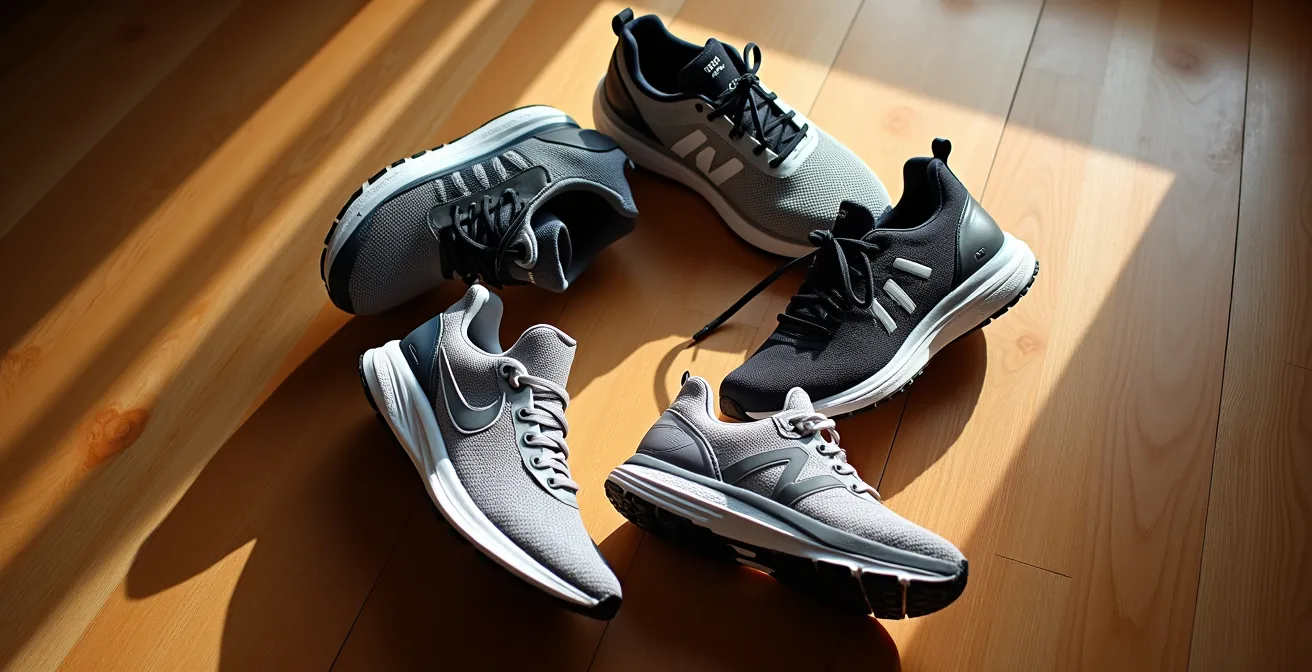
A strategic rotation can extend the functional life of your shoes and, more importantly, reduce injury risk by varying the mechanical stress on your body. By switching between shoes with different characteristics (e.g., different drop heights or cushioning levels), you prevent any single muscle group or connective tissue from being overstressed day after day.
A Strategic Rotation Plan
- Pair A (Workhorse): A durable, well-cushioned daily trainer. Use this for the bulk of your mileage, such as easy days and long runs (approximately 80% of your weekly volume).
- Pair B (Specialist): A lighter, more responsive shoe. Deploy this for speedwork, tempo runs, or races. This shoe could also have a different drop height to provide a different stimulus to your lower legs.
- Track Mileage: Use an app or a simple log to track the mileage on each pair. Begin assessing them for replacement using the physical inspection methods after 300 miles.
- Enforce Recovery Time: The most important rule is to allow a minimum of 24 hours—ideally 48—before wearing the same pair of shoes for another run.
Stability or Speed: Which Shoe Feature Matters More for Wingers?
While the term « winger » is specific to field sports, the underlying dilemma is one every runner faces: when should you prioritize stability over speed? For shorter, faster efforts like a 5K race or interval training, a lightweight, responsive « speed shoe » with features like a carbon plate can improve running economy. For longer distances like a half or full marathon, a more structured « stability shoe » might be the key to finishing injury-free. The decision hinges on a crucial factor: fatigue.
As a runner’s body fatigues, their form deteriorates. Muscles that normally stabilize the foot and leg become less effective, and biomechanical flaws like overpronation can become more pronounced. This insight is captured perfectly by an ASICS Gait Analysis Specialist:
Fatigue Changes Everything: Your gait mechanics in the first mile are not the same as in the last. A runner who is ‘neutral’ when fresh may begin to overpronate when tired.
– ASICS Gait Analysis Specialist, ASICS Gait Analysis Guide
This means that a runner who is perfectly fine in a neutral shoe for a 5K might need the guidance of a stability shoe to prevent their arch from collapsing during the final miles of a marathon. The choice isn’t about being a « stability runner » or a « neutral runner »; it’s about selecting the right tool for the job. For fast, short runs where form is likely to hold, a speed shoe is appropriate. For long, grueling runs where fatigue is inevitable, a stability shoe offers an essential safety net.
| Feature | Speed Shoes | Stability Shoes | Hybrid ‘Stable Speed’ |
|---|---|---|---|
| Weight | Lightweight (<8oz) | Heavier (9-11oz) | Moderate (8-9oz) |
| Midsole | Responsive, firm | Dual-density support | Guided responsive foam |
| Best Distance | 5K-10K | Half/Full Marathon | All distances |
| Example Models | Carbon-plated racers | Brooks Adrenaline | Saucony Tempus, Hoka Arahi |
Key Takeaways
- Your running shoe choice should be based on your dynamic gait mechanics under load, not your static arch type at rest.
- A shoe is a mechanical tool that wears out; learn to physically inspect its midsole and torsional rigidity rather than relying solely on a mileage count.
- Shoe features like heel drop and cushioning are tools to manage biomechanical load by shifting stress between your knees, calves, and Achilles tendon.
The ‘Weekend Warrior’ Mistake That Ruptures Achilles Tendons
The « weekend warrior » syndrome—going from a sedentary week to intense weekend activity—is a well-known recipe for injury. In running, one of the most dangerous manifestations of this is making abrupt and radical changes in footwear, particularly a sudden switch from traditional high-drop shoes to minimalist, zero-drop models. This seemingly simple change dramatically alters the biomechanical load on the lower leg. Research from the Mayo Clinic Health System shows that running generates impact forces of 3 to 5 times a person’s body weight. Mismanaging these massive forces can have catastrophic consequences.
A traditional running shoe with a 10-12mm heel drop shortens the Achilles tendon and calf muscles at rest. When a runner suddenly switches to a zero-drop shoe, these tissues are forced to lengthen and absorb significantly more eccentric load with every stride. For a body that is not conditioned for this new stress, the result can be acute Achilles tendonitis or, in the worst cases, a full rupture.
This is not a theoretical risk. An analysis of runner injuries demonstrated that those who made an abrupt transition from high-drop to zero-drop shoes without a gradual adaptation period experienced a 40% higher rate of Achilles-related injuries. The tissues simply cannot handle the sudden increase in demand. A safe transition from a high-drop to a low-drop shoe requires a dedicated adaptation period of 4 to 8 weeks, where the drop height is decreased in small increments (e.g., 2-3mm at a time) and mileage in the new shoes is increased slowly. The weekend warrior’s desire for a quick change bypasses this crucial conditioning phase, putting the Achilles tendon in a vulnerable position.
Why a 5-Minute Dynamic Warm-Up Reduces Injury Risk by 50%?
A dynamic warm-up is often viewed as a perfunctory precursor to the « real » workout, but its role in injury prevention is profound and directly linked to the function of your running shoes. Its primary purpose is not just to « get warm, » but to activate the specific neuromuscular pathways your body will use during the run. It prepares your kinetic chain to work efficiently, ensuring that the large, powerful muscles do their job, so smaller, stabilizing muscles don’t have to compensate.
As biomechanics experts from ASICS explain, this compensation is a primary source of injury:
Imbalances around the joints mean that large muscle groups such as the hamstrings, glutes and quads often do less of the work than they’re supposed to. In their place, smaller stabilising muscles have to step in and compensate.
– ASICS Biomechanics Team, ASICS Gait Analysis Study
When you run, your shoes either guide your foot (stability models) or allow it to move freely (neutral models). A warm-up should prepare your body for that specific environment. It’s about waking up the proprioceptive system and activating the muscles that will support your foot and leg within the shoe. For example, if you wear stability shoes to control overpronation, your warm-up should include glute activation exercises (like clamshells or bridges) to provide active, muscular support from the hip, reducing the shoe’s workload. This synergy between active muscular control and passive shoe support creates a robust defense against injury, potentially reducing risk by up to 50%.
Tailoring Your Warm-Up to Your Shoes
- For Stability Shoes: Focus on glute and core activation. Include exercises like glute bridges, bird-dog, and single-leg balance drills to actively support your pelvis and leg alignment.
- For Cushioned Shoes: Prioritize mobility. Perform leg swings (forward and side-to-side) and hip circles to prepare your joints for the full range of motion.
- For Minimalist Shoes: Prepare the tendons. Add gentle plyometrics like A-skips and B-skips, plus calf raises, to prime the Achilles and calf muscles for the increased load they will bear.
This targeted approach ensures your body is not just warm, but neurologically and muscularly prepared for the specific demands of your run and your footwear.
The next time you shop for running shoes, approach the process not as a consumer, but as a clinician evaluating a piece of medical equipment. Your long-term running health depends on it. Begin today by applying these analytical principles to assess your current shoes and plan for your next purchase.