

The key to a true 35-minute workout isn’t intensity, but the ruthless elimination of systemic time waste.
- Hidden “time-thieves” like phone scrolling, gym commutes, and equipment transitions secretly add 30-60 minutes to a typical session.
- Optimizing workout density through strategic exercise pairing and active rest protocols can more than double your time efficiency.
Recommendation: Stop focusing on the clock during sets and start optimizing the entire workout system, from your front door and back again.
The 90-minute gym trip for a “one-hour workout” is a paradox every busy executive and parent knows intimately. You carve out a precious 60-minute slot, only to see it evaporate between the commute, the locker room, and waiting for a squat rack to open up. The common advice—”use compound lifts,” “try supersets,” “rest less”—is correct but incomplete. It addresses the workout itself but ignores the systemic friction that sabotages your schedule before you even lift a weight.
The truth is, a genuinely effective 35-minute workout is not about exercising faster; it’s about being a ruthless efficiency expert. It’s about identifying and eliminating the hidden time-thieves that plague your fitness routine. What if the key wasn’t just pairing a push with a pull, but understanding the “travel cost” between those two exercises in a crowded gym? What if your five-minute warm-up could do more than just prevent injury, but actually potentiate your entire workout for better performance?
This guide isn’t another list of exercises. It’s a system audit for your training. We will dismantle the entire process, from the decision to work out to the final rep, to expose the inefficiencies that are costing you time and results. By applying principles of system optimization, you’ll learn to build a workout that is not only brutally effective but also fits into the real-world constraints of an unforgiving schedule.
For those who appreciate a different kind of dedication and commitment, the following video offers a classic take on never giving up. It serves as a visual metaphor for the consistency this system requires.
This article provides a complete framework for reclaiming your time. We will deconstruct common workout mistakes and rebuild your approach with efficiency at its core, covering everything from mental focus between sets to the strategic selection of gym equipment.
Summary: A System for the 35-Minute Full-Body Workout
- Why Scrolling Your Phone Between Sets Wastes 15 Minutes?
- How to Pair Push and Pull Exercises to Double Density?
- Home Gym vs. Commercial Gym: Calculating the Commute Cost
- The ‘Cold Start’ Error That Snaps Tendons on Heavy Days
- When to Use Machines vs Free Weights for Speed?
- Rower vs. Air Bike: Which Machine Induces Nausea Faster?
- How to Stick to a 20-Minute Hotel Room Routine Without Equipment?
- How to Build a Functional Home Gym in Less Than 50 Square Feet?
Why Scrolling Your Phone Between Sets Wastes 15 Minutes?
The single greatest time-thief inside the gym isn’t a person, but the device in your pocket. The casual scroll between sets feels like a harmless 60-second break, but it’s a profound saboteur of workout efficiency. The mental context-switching from a physically demanding lift to a socially engaging feed fragments your focus, extends rest periods unconsciously, and kills your momentum. It’s not just the time spent scrolling; it’s the time required to mentally re-engage with the intensity of your next set. This distraction is more than just a bad habit; it’s a performance killer.
The impact is quantifiable and significant. When your mind is disengaged, your body follows. Heart rate drops too low, the neuromuscular system cools down, and the metabolic stress needed for growth dissipates. Research confirms this negative effect, showing a 29% decrease in workout performance when athletes use social media between sets. To reclaim this lost time and focus, you need to replace the passive distraction with a structured, active protocol. Instead of reaching for your phone, execute a deliberate “Active Rest” sequence.
This isn’t about doing more work; it’s about making your rest period productive. Implement this 60-second system:
- Seconds 0-15: Log your set details (weight/reps) in a physical notebook. This tactile act keeps you anchored in the physical reality of the workout.
- Seconds 15-45: Perform mobility work for your *next* exercise. If you just did bench press and are moving to rows, do arm circles or band pull-aparts. This prepares the target muscles.
- Seconds 45-60: Conduct a mental rehearsal. Visualize the perfect form, breathing pattern, and successful completion of the next lift. This primes your nervous system for execution.
How to Pair Push and Pull Exercises to Double Density?
Workout density—the amount of work performed per unit of time—is the primary metric for an efficiency expert. The most common tool for increasing density is the superset, but not all supersets are created equal. The fatal flaw in most superset plans is ignoring the “transition cost”: the time and energy lost moving between two different pieces of equipment, especially in a crowded commercial gym. A superset that pairs barbell squats with pull-ups sounds great on paper but is a logistical nightmare in practice, requiring you to navigate across the gym floor, potentially losing your equipment at both ends.
The solution is to prioritize low-travel pairings, also known as antagonist supersets, performed at a single station. By pairing a pushing movement (like a dumbbell bench press) with a pulling movement (like a dumbbell row), you can train opposing muscle groups back-to-back with virtually zero transition time. This allows one muscle group to rest while the other works, keeping your heart rate elevated and slashing total workout time without compromising volume. It is the purest form of workout efficiency.
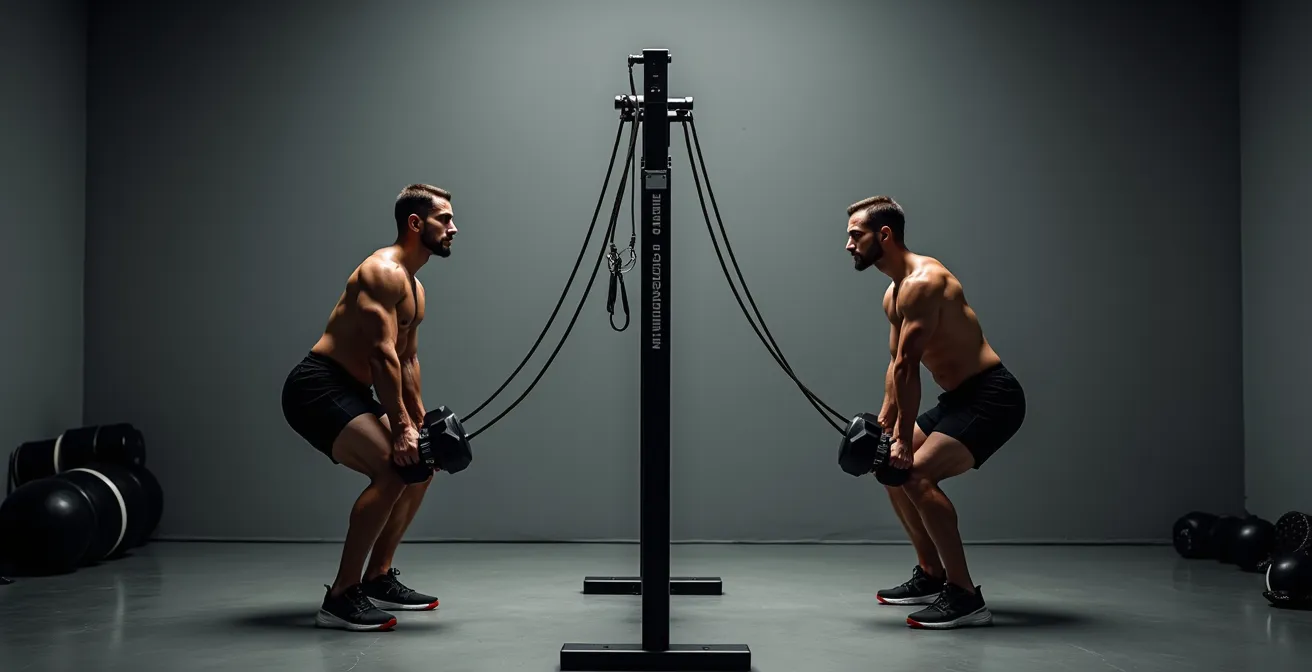
The table below illustrates the critical difference between high-efficiency, low-travel pairings and their time-wasting, high-travel counterparts. An efficient workout design minimizes movement around the gym floor and maximizes time spent under tension.
| Low-Travel Pairings (Same Station) | Equipment Needed | High-Travel Pairings (Avoid in Crowded Gyms) |
|---|---|---|
| Dumbbell Bench Press + Dumbbell Row | Bench + Dumbbells | Barbell Squat + Pull-ups |
| Cable Press + Cable Row | Cable Machine | Leg Press + Overhead Press |
| Goblet Squat + Kettlebell Swing | Single Kettlebell | Deadlift + Dips |
Home Gym vs. Commercial Gym: Calculating the Commute Cost
The largest, most overlooked time-thief in fitness is the gym commute. We meticulously plan our 35-minute workout but fail to account for the total “door-to-door” time commitment. When you factor in a 15-minute drive each way, five minutes for parking and entry, and ten minutes in the locker room, your “hour-long” workout has ballooned into a 90-to-120-minute black hole in your schedule. This is the ultimate friction point, the barrier that makes consistency feel impossible on a busy day.
Case Study: True Time Cost Analysis
An efficiency audit of the typical gym visit reveals a stark reality. Analysis of data shows the average commercial gym visit requires 90-120 minutes in total. This includes the commute, parking, changing, and the inevitable wait times for popular equipment. The exact same workout protocol performed in a home gym setting, by contrast, takes only 35-40 minutes from start to finish. The home gym eliminates nearly an hour of non-productive, transitional time, making it the single most powerful tool for workout consistency.
While the initial investment in a home gym seems high, a simple cost-benefit analysis proves otherwise. When you add up monthly gym fees, gas, and the monetary value of your time, the financial case becomes clear. The typical breakeven point for a modest home gym investment, when compared to the recurring costs of a commercial gym membership, is often between 18-24 months. After that point, your home gym is not only saving you time but also money. It transforms the workout from a scheduled “trip” into an accessible, on-demand part of your daily routine, dramatically increasing the likelihood of long-term adherence.
The ‘Cold Start’ Error That Snaps Tendons on Heavy Days
In engineering, a “cold start” refers to starting machinery without a proper warm-up, leading to excessive wear and catastrophic failure. The same principle applies to the human body, especially on days you plan to lift heavy. Walking into the gym and jumping directly into your first working set is the physiological equivalent of redlining a cold engine. It’s a massive, unnecessary risk that leads to pulled muscles, strained ligaments, and snapped tendons. This single error can cost you not just one workout, but weeks or months of recovery time—the ultimate inefficiency.
The old-school advice of holding static stretches is equally flawed. As the American College of Sports Medicine points out, this practice can actually reduce power output and performance. True readiness requires a dynamic, systematic approach.
Pre-workout static stretching can decrease power output and performance. Dynamic, movement-specific preparation that mimics upcoming exercises is superior for injury prevention.
– American College of Sports Medicine, ACSM Guidelines for Exercise Testing
An efficiency expert doesn’t leave this to chance. You need a standardized, non-negotiable warm-up protocol. The RAMP system (Raise, Activate, Mobilize, Potentiate) is the gold standard, and it can be executed in five minutes flat.
Your 5-Minute Pre-Flight Checklist: RAMP Protocol
- Minute 1: Raise. Your goal is to increase heart rate and blood flow. Perform 60 seconds of jumping jacks, light jogging in place, or skipping rope.
- Minutes 2-3: Activate/Mobilize. Wake up the specific muscles and joints you’ll be using. For a lower body day, this means bird-dogs and glute bridges. For upper body, think band pull-aparts and cat-cow stretches.
- Minutes 4-5: Potentiate. This is the key step. Prime the nervous system with explosive, unweighted versions of your first exercise. If you’re about to do barbell squats, perform 5-10 explosive jump squats. If you’re doing bench press, do 5-10 explosive push-ups.
When to Use Machines vs Free Weights for Speed?
The debate between free weights and machines is often framed as a matter of dogma, but for an efficiency expert, it’s a simple question of using the right tool for the right job. Neither is universally superior; each has a distinct advantage when your primary currency is time. Your goal is to maximize “time-to-tension,” or how quickly you can get into a productive, muscle-building set. Free weights are king for activating stabilizer muscles and building functional strength, but they come with a high setup cost—finding dumbbells, loading a barbell, and positioning a bench.
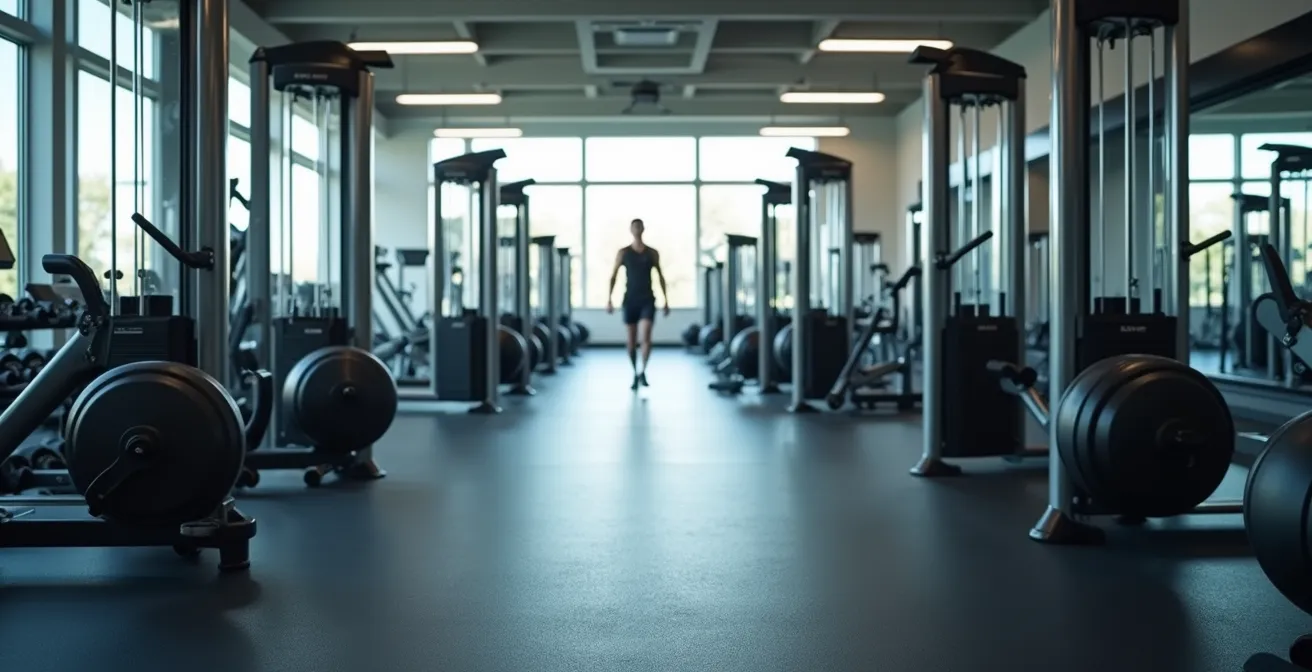
Machines, on the other hand, offer near-instantaneous setup. Changing the weight is as simple as moving a pin. This makes them the undisputed champion for specific intensity techniques designed to save time, such as drop sets. Attempting a drop set with a barbell requires stripping plates, a slow and cumbersome process. On a machine, it’s a two-second adjustment that allows you to continue the set with minimal rest, dramatically increasing metabolic stress and workout density. The strategic use of machines is not a compromise; it’s an intelligent optimization.
This analysis breaks down the choice based on the specific efficiency factor you need to prioritize at any given moment in your workout.
| Factor | Free Weights | Machines | Best Use Case |
|---|---|---|---|
| Setup Time | High (2-5 min) | Low (10 sec) | Machines win for supersets |
| Muscle Activation | Superior (stabilizers engaged) | Good (isolated) | Free weights for compound moves |
| Drop Set Speed | Slow (plate changes) | Instant (pin adjustment) | Machines for intensity techniques |
| Safety When Fatigued | Requires spotter | Built-in safety | Machines for workout finishers |
Rower vs. Air Bike: Which Machine Induces Nausea Faster?
The provocative question isn’t just for shock value; it gets to the heart of what makes these machines so brutally effective for time-crunched workouts. The reason the rower and air bike can make you feel nauseous so quickly is the same reason they are unparalleled metabolic tools: they demand massive, full-body energy expenditure with no “cheat” reps. On an air bike, the harder you push with your legs, the harder you must work with your arms. On a rower, every stroke engages over 85% of your body’s muscles. There is no coasting. This total-body demand spikes your heart rate and oxygen consumption almost instantly, which is the entire point.
This intense metabolic disturbance is the trigger for a powerful physiological effect known as Excess Post-exercise Oxygen Consumption (EPOC), or the “afterburn effect.” Your body has to work harder for hours after the workout to restore itself to a state of equilibrium, burning additional calories in the process. According to Cleveland Clinic research, this effect can produce a 6-15% increase in calorie burn for hours after you’ve stopped exercising. This is the definition of efficiency—getting a metabolic return on your investment long after the workout is over.
Therefore, the goal is not to avoid the nausea but to strategically weaponize it. These machines are best used not for long, steady-state cardio, but for short, high-intensity intervals that maximize the EPOC response. A strategic application for a 35-minute workout would be to use them as a “finisher” after your strength work. A 4-minute Tabata protocol (20 seconds all-out, 10 seconds rest, for 8 rounds) on the air bike or a series of 250m sprints on the rower will create a greater metabolic impact than 20 minutes of jogging.
How to Stick to a 20-Minute Hotel Room Routine Without Equipment?
For the busy professional, travel is often the biggest disruptor of workout consistency. The lack of equipment in a hotel room can feel like an insurmountable friction point. However, an efficiency expert sees constraints not as barriers, but as opportunities for creative problem-solving. The goal is not to replicate your gym workout, but to achieve the same physiological principle—muscular tension—using only your bodyweight and your environment.
The common complaint that bodyweight workouts aren’t intense enough is a failure of programming, not a limitation of the method. You can dramatically increase the intensity without adding a single pound of external weight. Professional trainers report that by simply implementing tempo manipulation (e.g., taking four seconds to lower into a squat) and isometric holds (pausing at the hardest part of a push-up), you can achieve significant results. In fact, a study on training intensity showed that these techniques can increase muscle tension by up to 40% compared to performing standard, fast-paced reps. This makes a well-programmed hotel workout just as effective at stimulating muscle.
The second key is to leverage your environment. A hotel room is not an empty space; it’s a jungle gym waiting to be used. By seeing furniture as potential equipment, you can perform a surprisingly comprehensive full-body routine.
- Upper Body Pulling: Use a sturdy desk or table for inverted rows. Slide underneath, grip the edge, and pull your chest towards it.
- Single-Leg Strength: Elevate your rear foot on the edge of the bed or a chair for Bulgarian split squats, increasing the range of motion and stability challenge.
- Triceps & Chest: A stable chair is perfect for tricep dips. Keep your hands close to your body to maximize tricep engagement.
- Loaded Carries: Your luggage is a variable-weight dumbbell. Fill it with clothes or books and perform suitcase carries up and down the room to build core stability and grip strength.
Key Takeaways
- Your workout’s true duration includes the commute, setup, and phone scrolling—these are the real targets for optimization.
- Double your workout density by pairing push/pull exercises at the same station to eliminate “travel time” between sets.
- A 5-minute dynamic RAMP warm-up is non-negotiable; it prevents injury and potentiates performance, saving you weeks of lost time later.
How to Build a Functional Home Gym in Less Than 50 Square Feet?
The final pillar of a truly efficient fitness system is creating a zero-friction environment. If the analysis has proven that a home gym is the ultimate time-saver, the final barrier becomes space. The belief that you need a sprawling basement or a dedicated garage to build a functional gym is a myth. With strategic equipment selection, a space as small as a large closet or the corner of a living room can be transformed into a high-performance training zone.
The key is to prioritize multi-functional, compact, and scalable equipment. A pair of adjustable dumbbells, for example, can replace an entire rack of 15-20 individual dumbbells, saving immense space. A doorway-mounted pull-up bar provides a vertical training option without consuming any floor space. The rise of foldable equipment, such as squat racks and functional trainers that mount to the wall and fold away to a depth of mere inches, has revolutionized what’s possible in a small footprint. A case study of the Torque F9 Fold-Away Functional Trainer showed that such equipment can offer over 50 exercise variations while occupying less than 8 square feet when stored.
Building your gym can be scaled according to your budget and commitment level. The focus should always be on acquiring pieces that offer the maximum number of exercise possibilities for their physical and financial cost.
| Budget Level | Essential Equipment | Space Required | Exercise Coverage |
|---|---|---|---|
| Good ($500) | Adjustable dumbbells, Pull-up bar, Resistance bands | 20 sq ft | 70% of exercises |
| Better ($1500) | Above + Foldable bench, Kettlebells, Jump rope | 35 sq ft | 85% of exercises |
| Best ($3000+) | Above + Foldable rack, Olympic barbell, Gymnastics rings | 50 sq ft | 95% of exercises |
The system has been laid out. The time-thieves have been identified, and the protocols to defeat them are clear. Your 35 minutes are waiting. The only remaining variable is execution.