
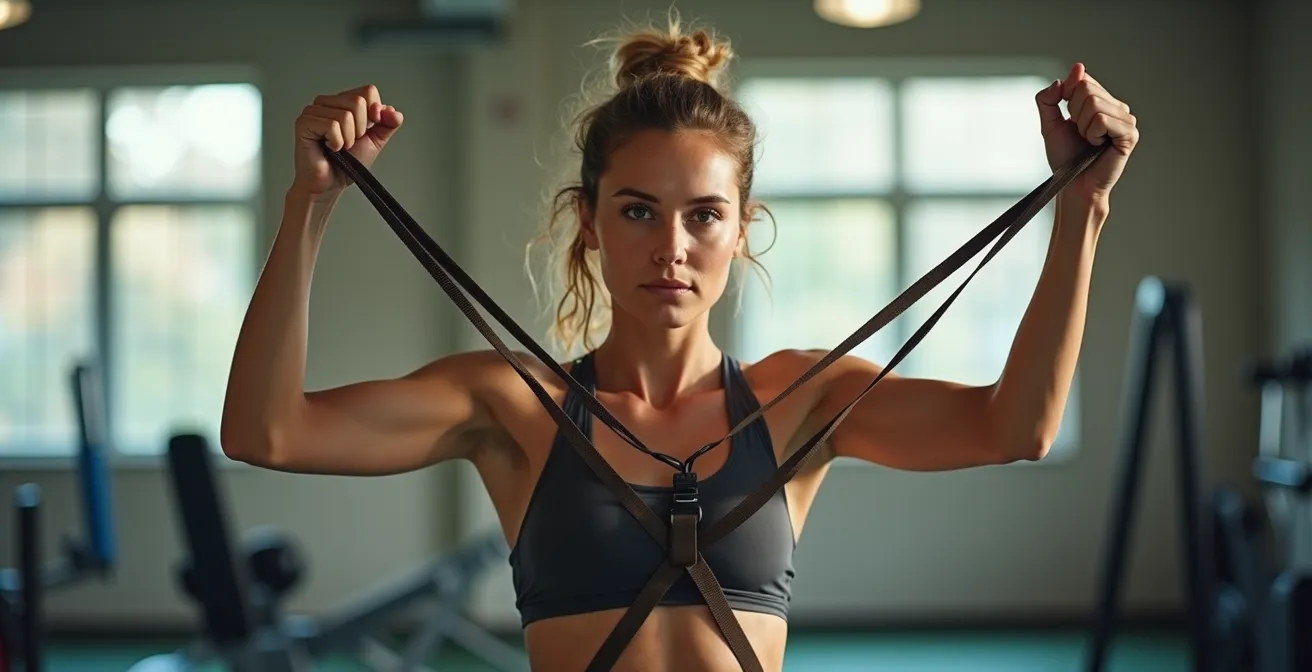
Fixing tennis-related asymmetry is a systemic issue of the entire kinetic chain, not just a matter of strengthening your non-dominant arm.
- Unilateral lower back pain often stems from weak hip stabilizers forcing the back to overcompensate for rotational forces.
- Equipment choices, like racket weight and grip size, directly influence muscle strain and can create or worsen chronic compensatory patterns.
Recommendation: Shift your focus from isolated muscle work to integrated exercises that restore proper hip-to-shoulder sequencing and core stability.
For any long-term racket sport player, the physical signs are undeniable: one forearm is noticeably larger, the shoulder on the dominant side feels perpetually tight, and a nagging, one-sided ache in the lower back has become a regular post-match companion. It is, in fact, perfectly normal for a tennis player’s body to reflect the unilateral demands of the sport. This asymmetry, however, is not a badge of honor; it’s a blueprint of dysfunction. It’s the physical manifestation of years of ingrained, lopsided movement that, left unaddressed, leads to chronic pain, performance plateaus, and frustrating injuries.
The conventional wisdom often suggests simplistic fixes: “just do some curls on your weak arm” or “stretch your back more.” This approach fails because it treats the symptoms, not the root cause. The pain in your elbow or back is rarely the origin of the problem; it’s the final link in a chain of biomechanical compensations. The body, in its quest for efficiency, has created workarounds for underlying weaknesses or mobility restrictions. Your dominant side is overworking not just because it’s stronger, but because other parts of the kinetic chain—specifically your hips and core—are not doing their job correctly.
The true path to correcting these imbalances lies in a fundamental shift in perspective. Instead of isolating the “weak” side, we must focus on re-calibrating the entire system. This means understanding how rotational forces travel through the body, why your non-dominant side has become neurologically “lazy,” and how subtle factors like grip size or string tension are silently contributing to the problem. It’s a process of neuromuscular re-education, teaching the body to move as an integrated, balanced unit once again.
This guide will deconstruct the common muscular imbalances faced by tennis and squash players from a corrective exercise standpoint. We will explore the anatomical reasons behind unilateral pain and provide a structured approach to dismantle the compensatory patterns that cause it, moving from foundational core stability to the specifics of equipment and swing mechanics.
Summary: A Systemic Approach to Correcting Racket Sport Asymmetry
- Why Your Lower Back Hurts Only on One Side After Squash?
- How to Design a Gym Routine for Your ‘Weak’ Arm?
- Heavy vs. Light Racket: Which Causes More Elbow Vibration?
- The Grip Size Error That Lead to Chronic Forearm Pump
- When to Restring Your Racket: The ‘Hours Played’ Rule
- Side Plank vs. Front Plank: Which Fixes Asymmetry Better?
- The Training Error That Leads to Chronic Elbow Tendinitis
- How to Generate More Swing Speed Using Only Your Hips?
Why Your Lower Back Hurts Only on One Side After Squash?
That distinct, one-sided ache in your lower back after a tough match is a classic sign of rotational stress overwhelming your body’s support structures. During a forehand or backhand swing, your body generates immense rotational force. In a well-functioning kinetic chain, this force is primarily managed by your hips and obliques. However, when key stabilizers are weak, your lower back is forced to pick up the slack. The primary culprit is often a weak gluteus medius on the non-dominant side, which is responsible for pelvic stability during single-leg loading and rotation.
When this hip stabilizer fails to engage properly, your body creates a compensatory pattern. The quadratus lumborum (QL), a deep muscle in your lower back on the dominant side, becomes chronically overactive, trying to prevent excessive pelvic drop and rotation. It’s essentially “hitching” your hip up to create a stable base that your glutes should be providing. Over thousands of repetitions, this leads to hypertrophy, tightness, and trigger points in the QL on one side, while the corresponding muscle on the other side remains relatively dormant. You’re not just dealing with a tight back; you’re dealing with a fundamental hip-to-core sequencing problem.
The solution isn’t to stretch the painful side into submission. While that might provide temporary relief, the long-term fix involves strengthening the weak link: the gluteus medius and core stabilizers on the opposite side. By restoring their function, you allow the lower back to return to its intended role of support, rather than acting as a primary rotator and stabilizer—a job for which it is poorly designed.
How to Design a Gym Routine for Your ‘Weak’ Arm?
Addressing the size and strength difference in your arms requires a more intelligent approach than simply performing more bicep curls with your non-dominant arm. The goal is not just aesthetic symmetry but functional balance. Your “weak” arm isn’t just weaker; it’s neurologically inhibited and lacks the stability and proprioceptive awareness of its dominant counterpart. Therefore, your training must focus on neuromuscular re-education through unilateral, stability-focused exercises.
Forget bilateral movements like the standard bench press or barbell rows for now. Your dominant side will always take over. Instead, build your routine around these three pillars of unilateral training:
- Carries: Single-arm farmer’s walks and suitcase carries are phenomenal. They force your entire non-dominant side—from your grip and shoulder to your obliques and hips—to fire in unison to resist lateral flexion. This teaches the body to work as an integrated stabilizing unit.
- Presses: Single-arm dumbbell presses (both overhead and on a bench) challenge shoulder stability in a way bilateral pressing cannot. To take it a step further, the bottom-up kettlebell press is the gold standard for rotator cuff activation and grip stability.
- Pulls: Single-arm dumbbell rows are a staple. Focus on initiating the pull with your back, not your arm, and resisting torso rotation. This directly fights the rotational imbalances developed on the court.
The key is to use a weight that is challenging but allows for perfect form. You are retraining movement patterns, not just chasing hypertrophy. The focus is on quality of contraction and stability, forcing the brain to build a stronger connection with the muscles of your non-dominant side.
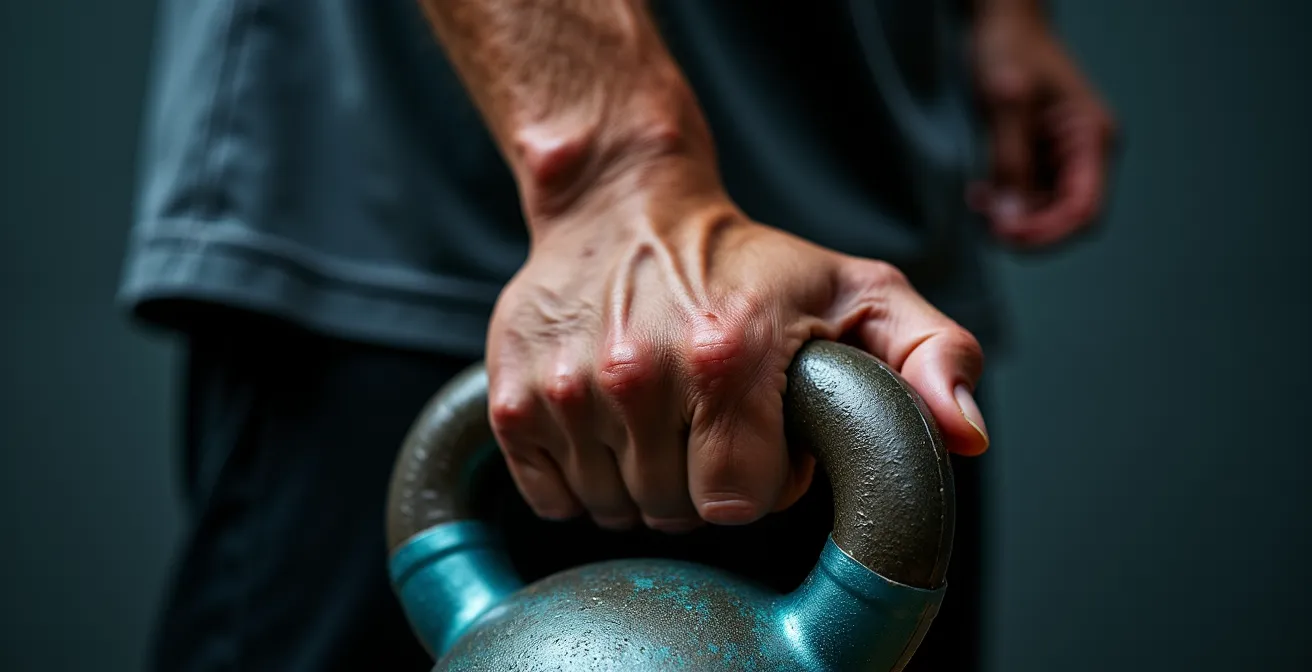
As the illustration demonstrates, exercises like the bottom-up press force the smaller stabilizing muscles of the shoulder and forearm to engage intensely. This type of training builds a foundation of stability that directly translates to better control and injury resilience on the court.
Heavy vs. Light Racket: Which Causes More Elbow Vibration?
It seems counter-intuitive, but a lighter racket often transmits more harmful vibration to the arm than a heavier one. Players, especially those with developing technique, are drawn to lighter frames because they feel easier to swing fast. However, this lightness comes at a biomechanical cost. A lighter racket has less mass to resist the ball’s impact, meaning more of that shock and vibration travels up the frame and into your arm. Furthermore, a lighter frame requires more muscular effort from the shoulder and forearm to remain stable at impact.
A heavier racket, by contrast, possesses more inertia. It is inherently more stable and plows through the ball more effectively, absorbing and dampening a greater percentage of the impact force before it reaches your elbow and shoulder. This is why many professional players use heavier frames customized to their specific needs; it’s a tool for both power and protection. The trade-off is that a heavier racket requires better technique and more strength to wield effectively, potentially causing fatigue-related injuries if a player is not conditioned for it.
The following table, based on common biomechanical principles and equipment analysis, breaks down the trade-offs. As it highlights, heavier frames are generally recommended for players looking to reduce shock and vibration.
| Racket Weight | Muscle Activation Level | Vibration Dampening | Injury Risk Factor |
|---|---|---|---|
| Light (260-280g) | High compensation needed | Poor | Increased elbow/shoulder strain |
| Medium (290-310g) | Moderate | Good | Balanced risk profile |
| Heavy (320g+) | Lower per stroke | Excellent | Fatigue-related injuries |
Ultimately, choosing a racket is about finding the heaviest frame you can comfortably manage for the duration of a match without your technique breaking down. For a player with existing muscle imbalances, switching to a slightly heavier, more head-light frame can be a significant step in reducing the chronic strain that fuels tendinitis.
The Grip Size Error That Lead to Chronic Forearm Pump
Chronic forearm pain or “pump” is often blamed on overuse, but a persistent and frequently overlooked cause is an incorrectly sized racket grip. The handle is your only connection to the racket, and if it’s not the right size, your forearm muscles are forced into a state of constant, inefficient contraction. This is a subtle but powerful driver of muscle imbalance and tendinopathy.
If your grip is too small, you must squeeze excessively hard to prevent the racket from twisting in your hand on off-center hits. This constant, death-grip tension overloads the flexor tendons in your forearm, often leading to pain near the inner elbow (Golfer’s Elbow) or wrist. Conversely, if your grip is too large, you cannot get a secure hold, which reduces your wrist’s ability to stabilize the racket head. This also requires excessive grip pressure and can limit your ability to generate racket-head speed, forcing your shoulder to compensate and do more work.
Finding the optimal size is crucial for allowing your forearm to remain relaxed yet stable. A simple self-assessment protocol can help you diagnose your current setup:
- Play for 30 minutes with your current grip size, paying close attention to your forearm.
- Immediately after playing, map the location of the fatigue.
- If the primary pain/fatigue is near your wrist, your grip is likely too small. Try adding one overgrip.
- If the pain/fatigue is concentrated near your elbow, your grip may be too large. You may need to have the base grip changed to a smaller size.
- Test the new configuration in another 30-minute session and look for a more even distribution of fatigue across the forearm muscles.
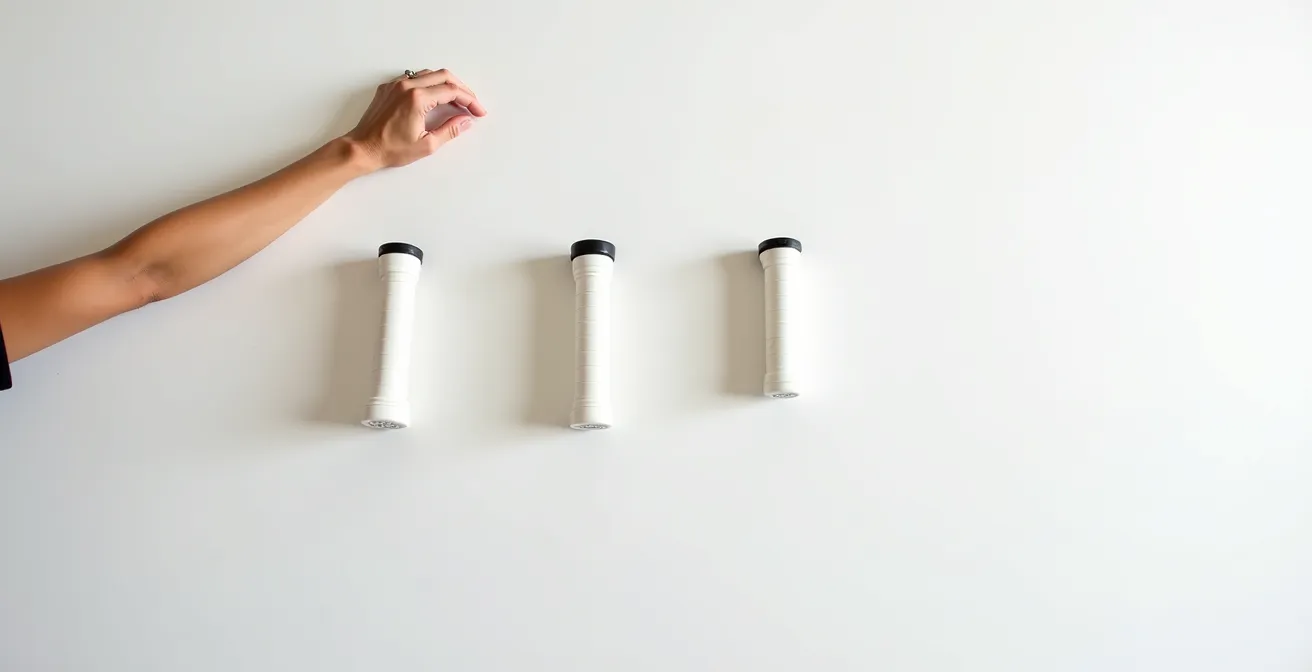
As visualized above, different grip sizes alter the mechanical demands on the forearm. A correctly sized grip distributes pressure evenly, allowing for a firm but relaxed hold that minimizes the compensatory tension responsible for chronic pain.
When to Restring Your Racket: The ‘Hours Played’ Rule
Players often wait until a string breaks to get their racket restrung, but by that point, they’ve likely been playing with dysfunctional equipment for weeks. Strings are the “engine” of the racket, and they lose tension from the very first hit. While this initial drop is normal, the continued degradation of string tension forces subconscious, detrimental changes in your swing mechanics.
As strings lose their elasticity and “go dead,” they provide significantly less power and feel. To achieve the same ball depth and speed, you instinctively start to swing harder and use more arm and shoulder muscle to generate force. This subtle shift is what experts call a “compensation cascade.” You are no longer using the efficient, hip-driven kinetic chain but are instead muscling the ball with your upper body. This directly feeds into and exacerbates existing muscle imbalances, placing excessive strain on the shoulder, elbow, and wrist.
According to a Tennis Technical Analysis Team in a 2024 study, this process is insidious: “String tension loss forces subconscious micro-adjustments in a player’s swing, requiring more arm and shoulder engagement to generate power.” This is why maintaining proper string tension is not just about performance; it’s a critical injury prevention strategy. Professional players are acutely aware of this, often restringing rackets after just a few hours of play to maintain consistent response and protect their arms.
A good rule of thumb for recreational players is to restring your racket as many times per year as you play per week. If you play four times a week, you should be restringing at least four times a year. For more serious players, tracking hours is more accurate: polyester strings should typically be replaced after 10-15 hours of play. Ignoring this guideline means you are actively training your body to use inefficient, injury-producing movement patterns.
Side Plank vs. Front Plank: Which Fixes Asymmetry Better?
While the front plank is a decent general core exercise, it is vastly inferior to the side plank for correcting the specific asymmetries found in racket sport athletes. The primary forces in tennis and squash are rotational and lateral. The front plank works the core in the sagittal plane (forward and backward), primarily targeting the rectus abdominis and transverse abdominis for anti-extension. It does little to challenge the rotational and lateral stabilizers that are critical for controlling the kinetic chain during a swing.
The side plank, in contrast, directly targets the muscles that fight these forces: the internal and external obliques, the quadratus lumborum (QL), and the gluteus medius. It is an anti-lateral-flexion exercise, forcing the very muscles that stabilize the pelvis and trunk during the loading and unloading phase of a swing to engage isometrically. The side plank is not just an exercise; it’s a diagnostic tool. According to physical therapy research, the inability to maintain a level hip position during a side plank is a strong indicator of gluteus medius weakness, a key driver of lower back and hip pain in tennis players.
For a tennis player, a core program built around front planks is a missed opportunity. Your training must reflect the demands of your sport. By prioritizing side planks and their variations, you are directly strengthening the muscular “slings” that transfer energy from your lower body to your upper body, reducing the compensatory strain on your spine and shoulders.
Action Plan: Progressive Rotational Plank Protocol for Tennis
- Weeks 1-2: Master static side planks on each side. Aim for 30-45 seconds with perfect form, noting any significant difference in endurance between your dominant and non-dominant sides.
- Weeks 3-4: Introduce movement by adding T-rotations. From a front plank position, rotate into a side plank, reaching for the ceiling. Perform 10 slow, controlled rotations per side.
- Weeks 5-6: Increase instability with the “Stir the Pot” exercise. Hold a plank on a stability ball and make small, controlled circles with your elbows, 15 reps clockwise and 15 counter-clockwise.
- Weeks 7-8: Integrate breathwork. During static side plank holds, perform 5 deep diaphragmatic breaths, focusing on expanding your rib cage without losing core tension.
- Assessment: Perform a “Hip Drop Test” weekly. Hold a side plank and perform 5-10 small hip dips. Notice if one side is significantly less controlled than the other.
The Training Error That Leads to Chronic Elbow Tendinitis
Chronic elbow tendinitis, or “tennis elbow,” is the quintessential overuse injury, but its root cause is often far removed from the arm itself. The most significant training error that leads to this condition is a failure to develop and maintain proper hip mobility, specifically internal hip rotation. In a powerful, efficient swing, power is generated from the ground up, starting with the legs and hips. The hips rotate, which in turn rotates the torso, the shoulder, and finally the arm, which acts like the tip of a whip. This is the kinetic chain in action.
When an athlete has limited internal hip rotation, this seamless transfer of energy is broken. The body cannot generate sufficient rotational velocity from the lower body. To compensate and still produce power, the athlete begins to overuse the smaller muscles of the arm and shoulder. The elbow joint, caught in the middle, is subjected to immense eccentric forces it was never designed to handle, leading to micro-tears and inflammation in the extensor tendons. As a formal case study on the topic notes, professional players who developed chronic elbow tendinitis showed insufficient hip internal rotation forcing compensatory arm overuse.
This physical dysfunction is often compounded by a physiological error: inadequate recovery, or a lack of “down-regulation.” As leading expert Dr. Todd Ellenbecker explains, “Without sufficient down-regulation through proper sleep and breathwork, the body stays in a fight-or-flight state, which impairs tissue healing and makes tendons more susceptible to inflammation.” Intense training without deliberate recovery keeps the nervous system in a high-stress state, elevating cortisol and inhibiting the body’s natural repair processes. This creates a perfect storm where a biomechanically stressed tendon is also unable to heal properly, turning acute soreness into a chronic condition.
The real training error, therefore, is twofold: focusing on arm strength while ignoring hip mobility, and prioritizing high-intensity training without building in structured periods of nervous system recovery.
Key takeaways
- Muscle imbalance is a systemic kinetic chain problem, not a local weakness. The source of pain is rarely the cause of the problem.
- Effective core training for racket sports must be asymmetrical and rotational (e.g., side planks) to match the demands of the game.
- Equipment (racket weight, grip size, string tension) and recovery (down-regulation) are non-negotiable variables that directly impact biomechanics and injury risk.
How to Generate More Swing Speed Using Only Your Hips?
The ultimate solution to correcting muscle imbalances is also the secret to unlocking greater performance: learning to use your hips to drive the swing. By shifting the source of power generation from your arm to your large, powerful hip muscles, you not only reduce the strain on your shoulder and elbow but also dramatically increase your racket-head speed. This is achieved by mastering hip-shoulder separation—the ability to keep your shoulders coiled back for a split second longer as your hips begin to rotate forward.
This separation creates a “stretch-shortening” effect in the muscles of your core, much like stretching a rubber band before letting it fly. This stored elastic energy is then released explosively through the kinetic chain, accelerating the torso, shoulder, and arm with minimal muscular effort. It’s the difference between pushing a ball and whipping it. The results are significant; biomechanical analysis reveals that optimized kinetic chain sequencing can increase swing speed by up to 20% while simultaneously reducing arm strain.
Training this quality involves specific drills designed to teach your body the feeling of loading and exploding from the hips. Medicine ball rotational throws are a perfect starting point, as they force you to generate power from your core and hips. On the court, drills like practicing serves while kneeling isolate the torso and hip rotation, preventing you from over-relying on your legs. The goal of these exercises is to build a new, more efficient neuromuscular pattern where the swing is initiated by your hips, not your arm.
By focusing your training on improving this fundamental movement, you transform your approach. You stop fighting against your body’s compensatory patterns and start building a more powerful, resilient, and balanced athletic foundation. The pain reduction becomes a welcome side effect of a more efficient swing.
To truly resolve these deep-seated imbalances, adopt a holistic training philosophy. Begin today by integrating hip mobility drills and unilateral core exercises into your warm-ups and workouts, and commit to a systemic assessment of your technique and equipment.