
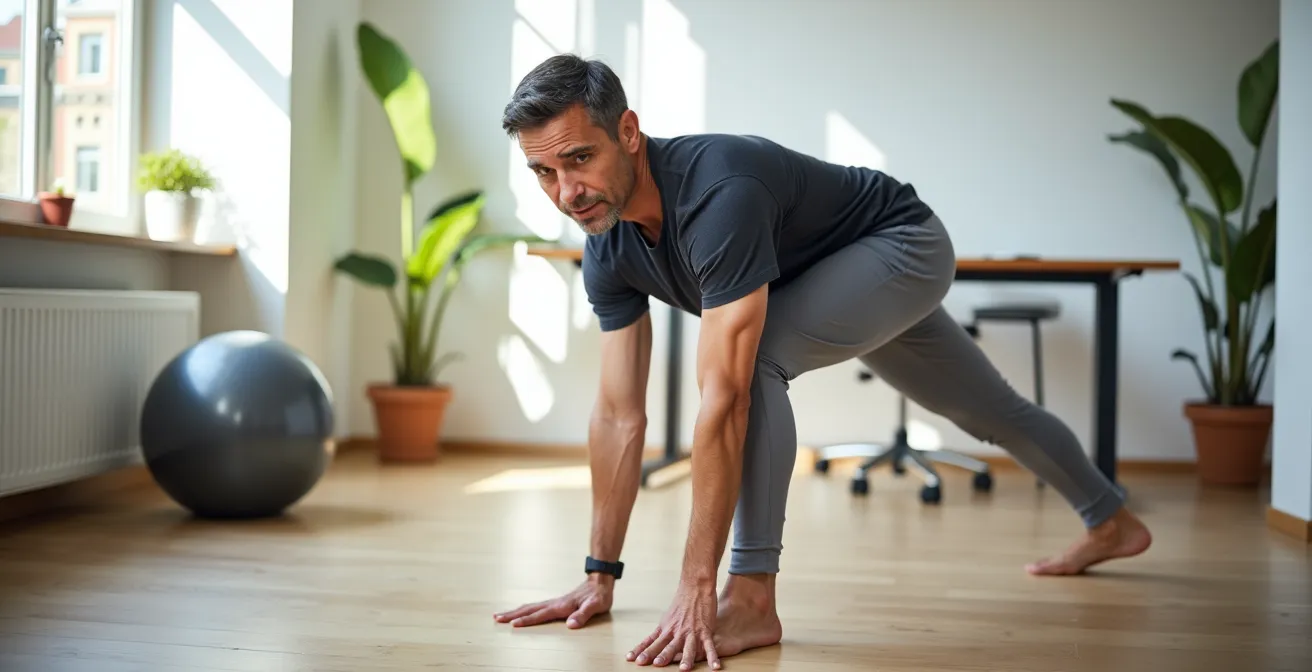
Forcing your muscles into a stretch is the slowest and most ineffective way to touch your toes.
- True flexibility comes from teaching your nervous system to feel safe in new ranges of motion, not just lengthening muscle tissue.
- Releasing the “straitjacket” of deep connective tissue (fascia) through slow, sustained holds yields more permanent gains than quick, bouncy stretching.
Recommendation: Prioritize contract-relax (PNF) techniques and mastering the hip-hinge movement pattern over simple passive hamstring stretches.
If the simple act of bending over to touch your toes feels like a distant memory, you’re not alone. After years chained to a desk, the body adapts. That familiar “locked” feeling in your lower back and the unyielding tightness in the back of your legs is a common complaint among corporate workers. The default advice is usually a simple prescription: just stretch your hamstrings more. You’re told to hold a stretch for 30 seconds, be consistent, and maybe even bounce a little to get deeper.
While well-intentioned, this advice often misses the root cause of the problem. Chronic tightness isn’t just a matter of “short” muscles. It’s a complex interplay between your nervous system, which has learned to put the brakes on movement to protect you, and your fascia, the web of connective tissue that has slowly molded itself around your sedentary posture. Simply pulling on a tight muscle without addressing these underlying systems is like trying to stretch a tangled rope – you just make the knots tighter.
But what if the key wasn’t to force your body into submission, but to coax it into releasing its protective grip? This guide will reframe your approach to flexibility. We will move beyond simply pulling on muscles and instead explore how to re-educate your nervous system, release deep fascial tension, and build the foundational stability required for genuine, lasting mobility. We will explore why some common stretching habits are counterproductive and introduce smarter techniques that work *with* your body, not against it. By the end, you’ll have a clear roadmap to not only touch your toes, but to move with more freedom and less pain in your daily life.
This article breaks down the essential principles and techniques to safely and effectively reclaim your flexibility. Explore the sections below to understand the science and build your personal action plan.
Summary: A Coach’s Guide to Unlocking Your Hamstrings
- Why Bouncing During Stretches Actually Tightens Your Muscles?
- How to Use Contract-Relax Methods to Double Flexibility Gains?
- Yin Yoga vs. Vinyasa: Which Best Releases Deep Fascia Tension?
- The Hypermobility Mistake That Destabilizes Your Joints
- When to Static Stretch: Post-Workout or Before Bed?
- Static vs. Dynamic Stretching: Which Ruins Power Output Before Lifting?
- How to Dissociate Torso and Hips for Maximum Torque?
- How to Choose a Yoga Retreat That Isn’t Just a Fancy Vacation?
Why Bouncing During Stretches Actually Tightens Your Muscles?
It’s a common sight in old-school gym classes: someone reaching for their toes, performing little bounces to try and inch closer to the floor. This method, known as ballistic stretching, feels intuitive, but it’s one of the most counterproductive things you can do for flexibility. Your muscles are equipped with a protective mechanism called the stretch reflex (or myotatic reflex). When a muscle is stretched too quickly or forcefully—as it is during a bounce—specialized sensory receptors send an alarm signal to your spinal cord. The immediate response is a command for the muscle to contract, to protect itself from a potential tear.
So, every time you bounce, you are actively triggering the very same tightening you’re trying to release. Instead of encouraging the muscle to let go, you’re training it to resist, creating a neurological tug-of-war. This not only halts your progress but also significantly increases your risk of injury, as you are applying force to a muscle that is actively contracting. The goal of effective stretching is to calm the nervous system and convince it that the new range of motion is safe, not to startle it into a defensive lockdown.
A far superior approach involves slow, controlled movements. As a case study from Dani Winks’ 30-day flexibility program showed, participants who avoided bouncing and instead used controlled static holds and proper technique saw measurable improvements. The program highlighted the importance of a flat back to isolate the hamstrings, preventing the common “cheat” of rounding the spine, which does little to actually lengthen the target muscles. The takeaway is clear: fighting your body’s protective reflexes is a losing battle. True progress comes from gentle persuasion, not force.
How to Use Contract-Relax Methods to Double Flexibility Gains?
If bouncing is out, what’s the most effective way in? The answer lies in a powerful technique that works *with* your nervous system: Proprioceptive Neuromuscular Facilitation (PNF). While the name sounds complex, the most common application—the contract-relax method—is simple and incredibly effective. It’s a way to “trick” your nervous system into allowing a deeper stretch than static stretching alone.
Here’s how it works: You move into a stretch until you feel a moderate tension. Then, you isometrically contract the stretched muscle against an immovable object (like the floor, a wall, or a strap) for 5-10 seconds. This contraction activates a sensory organ in the muscle tendon called the Golgi Tendon Organ (GTO), which senses changes in muscle tension. When the GTO detects this high level of tension, it sends a signal that overrides the stretch reflex, telling the muscle to relax. This creates a brief window of opportunity, a “neurological loophole,” where the muscle’s resistance is significantly reduced. As you relax the contraction, you can then gently move deeper into the stretch, claiming new range of motion. A meta-analysis confirms that PNF stretching shows greater range of motion improvements compared to other common methods.
This technique is a game-changer for desk workers because it directly targets the neurological guarding that keeps muscles chronically tight. It teaches your brain that it’s safe to release its death grip. By actively engaging and then relaxing, you are having a conversation with your nervous system, rather than just yelling at it.

As you can see in the demonstration, the key is the active contraction phase. This conscious engagement followed by a deliberate release is what differentiates PNF from passive stretching and is responsible for its remarkable effectiveness.
Yin Yoga vs. Vinyasa: Which Best Releases Deep Fascia Tension?
Not all yoga is created equal when it comes to untangling the knots from years of sitting. The key difference lies in what tissue you are targeting. Dynamic, flowing styles like Vinyasa are excellent for warming up the body and improving muscular elasticity—the muscle’s ability to stretch and return to its original length. However, for the deep, stubborn tightness felt by many office workers, we need to look beyond the muscles and target the fascia.
Fascia is the dense web of connective tissue that encases and interpenetrates everything in your body, from muscles to organs. Due to prolonged postures, like sitting, this tissue can become stiff and dehydrated, forming adhesions that restrict movement. This fascial “straitjacket” won’t respond to the quick stretches of a Vinyasa flow. Instead, it requires a different approach, which is where Yin Yoga excels. Yin involves holding passive floor-based poses for extended periods, typically 3-5 minutes. This long, gentle stress allows the fascial tissue to undergo a process called “creep”.
Creep is the gradual, plastic deformation of connective tissue under a sustained, low-level load. Unlike the temporary elastic change in a muscle, this plastic change is semi-permanent, helping to remodel the fascial matrix for greater long-term mobility. A systematic review on fascial release confirmed that this type of slow, sustained hold is particularly effective for reversing postural adaptations from desk work. To access this deep tissue, it’s best to practice when the muscles are “cool,” as warm, pliable muscles will absorb the stretch, preventing it from reaching the deeper fascial layers. So, while Vinyasa makes you feel good temporarily, Yin Yoga is what creates profound, lasting structural change.
Here is a simple sequence to try after work to begin targeting these deep fascial lines:
- Caterpillar Pose: 3-5 minutes in a seated forward fold to target the entire posterior chain.
- Dangling Pose: 2-3 minutes in a standing forward fold, letting gravity do the work.
- Twisted Roots: 3 minutes per side, a supine twist to address the IT band and lateral fascia.
- Nerve Glides: Finish with 2 minutes of gentle, slow nerve flossing to integrate the releases.
The Hypermobility Mistake That Destabilizes Your Joints
In the quest for flexibility, it’s easy to think that more is always better. However, there’s a critical difference between mobility (the ability to actively control your range of motion) and hypermobility (excessive, uncontrolled joint laxity). For some people, especially those who are naturally “bendy,” the inability to touch their toes might not stem from tightness at all, but from a lack of core stability. Their brain might be restricting hamstring length as a protective measure to prevent them from moving into a range where their spine and pelvis are unstable and at risk.
Aggressively stretching an already lax joint system without first establishing a foundation of stability is a recipe for destabilization and potential injury. You might achieve the “goal” of touching your toes, but you do so by compromising your joint integrity, often by excessively rounding your lower back instead of hinging at the hips. The real goal isn’t just to reach the floor; it’s to do so with a controlled, stable spine.
Before embarking on an aggressive stretching program, it’s wise to perform a quick stability self-assessment. Can you perform the fundamental movements that support deep ranges of motion? If your body lacks the core strength to stabilize your pelvis and spine during a hip hinge, your nervous system will rightly put on the emergency brake long before your hamstrings reach their true end range.
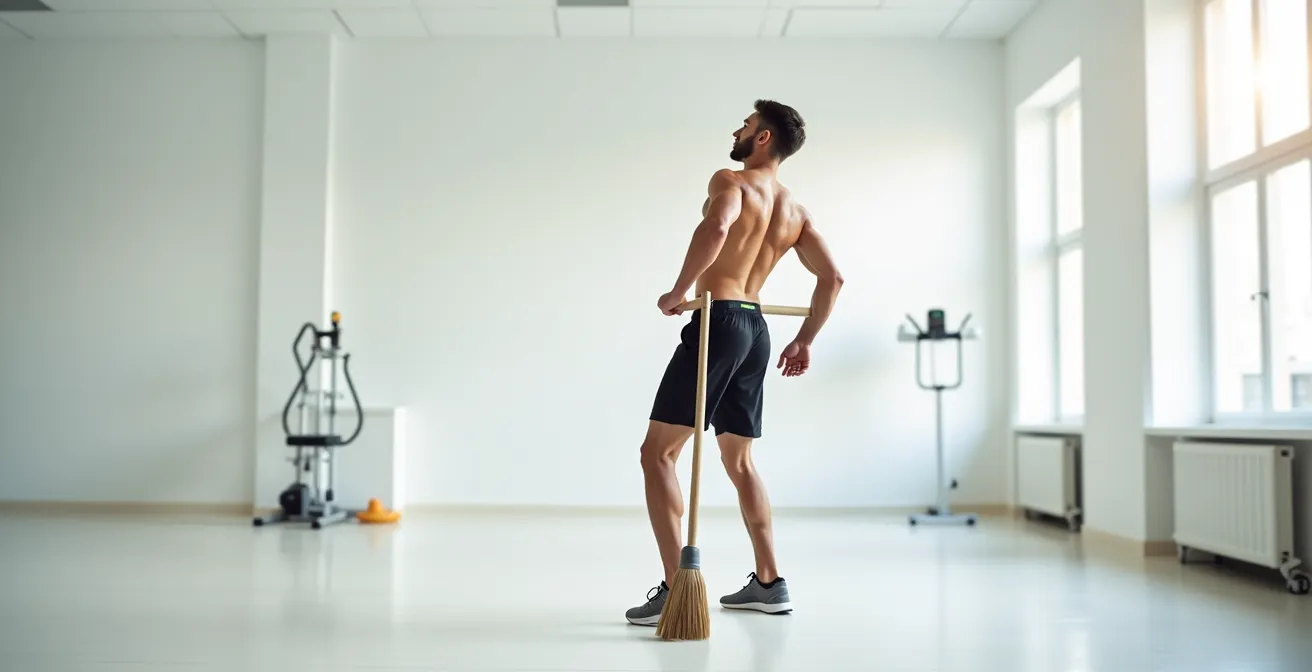
Performing a hip hinge with a broomstick, as shown, is a perfect test. If the stick loses contact with your head, mid-back, or tailbone, it indicates you’re flexing your spine instead of purely moving from the hips. If you fail this or other stability tests, your priority should be strengthening your core and stabilizing muscles, not more stretching.
- Test 1: Hip hinge with neutral spine. Can you touch your knees while maintaining a straight back?
- Test 2: Side plank hold. Can you maintain for 30 seconds on each side without your hips sagging?
- Test 3: Single-leg balance. Can you hold for 60 seconds with your eyes closed?
If any of these prove challenging, dedicate a few weeks to stability work before chasing extreme flexibility.
When to Static Stretch: Post-Workout or Before Bed?
The timing of your stretching can significantly influence its effectiveness. The two most popular and beneficial times for deep, static stretching are immediately after a workout and shortly before bed, but they serve slightly different purposes. Deciding when to stretch depends on your primary goal: are you capitalizing on warm muscles for maximum length gains, or are you trying to down-regulate your nervous system for recovery and repair?
Stretching post-workout is highly effective for increasing range of motion. Your muscles are warm and pliable, your circulation is elevated, and your nervous system is primed for adaptation. This is the ideal window to push your flexibility. In fact, a comprehensive review found that static stretching performed within 5 minutes post-exercise showed significantly greater flexibility improvements compared to stretching “cold.” By stretching when your tissues are most receptive, you can make more efficient and safer progress in your range of motion goals.
The Nerd Fitness Sleep and Flexibility Protocol
While post-workout stretching is great for gains, an evening stretching routine offers a powerful, twofold benefit. A Nerd Fitness project documented that participants who performed gentle static stretches combined with slow, diaphragmatic breathing about 30 minutes before bed saw significant results. Not only did they measurably improve their hamstring flexibility over 4 weeks, but they also reported a marked improvement in sleep quality. This is because gentle stretching and deep breathing activate the parasympathetic nervous system—our “rest and digest” mode. This down-regulation calms the mind, reduces stress, and creates the perfect physiological environment for tissue repair and adaptation to occur during sleep.
So, what’s the verdict? For maximum flexibility gains, stretch after your workout when your muscles are warm. For enhanced recovery, reduced stress, and improved sleep quality (which also aids flexibility), a gentle stretching routine before bed is unbeatable. For the dedicated desk worker, a combination of both is the ultimate strategy.
Static vs. Dynamic Stretching: Which Ruins Power Output Before Lifting?
The debate between static and dynamic stretching has a clear winner when it comes to preparing for athletic performance. For decades, the old-school approach was to hold long static stretches before a game or a lifting session. However, modern sports science has shown this to be detrimental. The primary goal of a warm-up is to prepare the body for explosive, powerful movement, and long static holds do the exact opposite.
Holding a static stretch for 30-60 seconds dampens the nervous system. It sends a signal to the muscle to relax and lengthen, which temporarily reduces its ability to contract forcefully and quickly. Think of it like a rubber band that has been overstretched; it loses some of its snappy power. Recent research demonstrates that static stretching reduced power output by 3.7%. This might not sound like much, but it can be the difference in a personal record lift or a sprint.
Dynamic stretching, on the other hand, involves actively moving your joints through their full range of motion. Think leg swings, torso twists, and walking lunges. This type of warm-up primes the neuromuscular pathways, increases blood flow, and raises core body temperature without dampening the stretch reflex. It essentially tells your nervous system, “Get ready to move!” The same research found that dynamic stretching actually increased power output by 1.3%. For any activity requiring strength or speed—from weightlifting to running—a dynamic warm-up is non-negotiable.
The following table, based on a comprehensive review of stretching modalities, clearly breaks down the differing effects on your nervous system and performance.
| Stretching Type | Neural Drive Effect | Power Output Change | Best Use Case |
|---|---|---|---|
| Static (30-60s) | Dampens signal | -4.6% decrease | Post-workout or separate session |
| Dynamic | Primes pathways | +1.3% increase | Pre-workout warm-up |
| Static (<30s) | Minimal dampening | -1.1% decrease | Can use pre-workout if brief |
The takeaway is simple: save the long, relaxing static stretches for after your workout or before bed. Before you lift or play, get moving.
How to Dissociate Torso and Hips for Maximum Torque?
The single most important movement pattern for touching your toes has surprisingly little to do with your hamstrings’ initial length. It’s about your ability to dissociate your hips from your spine. Most people who can’t touch their toes don’t fail because their hamstrings are too short; they fail because they don’t know how to perform a proper hip hinge. Instead of bending at the hips, they initiate the movement by rounding their spine. Their brain has fused the “bend over” command into a single, inefficient movement of spinal flexion.
This is a protective mechanism. When the deep core muscles responsible for stabilizing the spine are weak, the brain is reluctant to allow the pelvis to tilt forward independently. Bending from the spine feels safer, even though it places enormous strain on the lumbar discs and completely fails to stretch the hamstrings. To unlock your forward fold, you must first teach your brain how to move the pelvis around a stable, neutral spine. This motor control is the true key.
Core Stability: The Prerequisite to Hip Mobility
Research on desk workers powerfully illustrates this connection. One study showed that individuals who couldn’t perform a proper hip hinge pattern typically had weak transverse abdominis muscles—the deep “corset” muscle of the core. After just 4 weeks of targeted core stability work (like dead bugs and pallof presses), a remarkable 87% of participants could successfully dissociate their hip and spine movement. This newfound motor control directly translated to an average 4-inch improvement in their forward fold reach, without a single traditional hamstring stretch being performed.
A simple but highly effective drill to learn this dissociation is the wall hip hinge. This provides tactile feedback to teach you the feeling of sending your hips back while keeping your spine long.
- Stand with your back to a wall, feet hip-width apart and about 2-3 inches away.
- Keeping your back straight (imagine a broomstick along your spine), push your hips straight back until your glutes touch the wall. Allow a soft bend in your knees.
- Focus on the feeling of folding at the crease of your hips. Your torso should lower as a direct result of your hips moving backward.
- Return to standing by squeezing your glutes. Practice 10 reps, then step an inch further from the wall and repeat.
Key Takeaways
- Effective flexibility training is about communicating with your nervous system using techniques like PNF, not forcing muscles.
- Lasting change in mobility comes from slowly remodeling deep connective tissue (fascia) with long, passive holds.
- You must establish core stability and master the hip hinge movement pattern before chasing extreme ranges of motion.
How to Choose a Yoga Retreat That Isn’t Just a Fancy Vacation?
As you delve deeper into your flexibility journey, you might consider a yoga retreat to accelerate your progress. However, the market is saturated with options that are more “vacation with a side of yoga” than transformative movement experiences. To ensure you invest your time and money wisely, you need to look beyond beautiful scenery and gourmet food. A truly effective retreat should be grounded in the principles of biomechanics, anatomy, and functional movement—the very concepts we’ve discussed.
A transformative retreat focuses on education, not just practice. It should empower you with the knowledge of *why* you are doing certain movements and how to adapt them to your unique body. The goal should be to send you home with a personalized toolkit for continued progress, not just a memory of doing impressive poses on a beach. Look for instructors whose credentials go beyond a basic yoga teacher training. Certifications in kinesiology, functional range conditioning (FRC), or therapeutic specializations are strong indicators of a deeper understanding of the human body.
Touching your toes is a position everyone should just have. You should be able to fold your body in half the same way you should be able to sit in a deep squat position.
– Roger Frampton, Founder of The Frampton Method
This quote captures the essence of a functional approach: flexibility isn’t a party trick; it’s a fundamental human capacity. A good retreat will help you reclaim that capacity by teaching you how your body is *designed* to move, providing assessments to identify your specific limitations, and giving you a clear, actionable plan to address them.
Your Checklist for a Transformative Retreat
- Verify Instructor Credentials: Look for advanced qualifications like FRC certification, kinesiology degrees, or therapeutic specializations.
- Confirm Educational Components: Ensure the schedule includes daily anatomy or physiology workshops, not just back-to-back practice sessions.
- Seek Personalized Assessments: A quality retreat should offer personalized movement assessments upon arrival to tailor the experience.
- Check for Functional Focus: The language should be about functional movement and joint health, not just achieving aesthetic yoga poses.
- Ensure a Take-Home Program: The retreat should conclude with providing you a personalized corrective exercise program to continue your progress at home.
Start applying these principles today, not just to touch your toes, but to reclaim a body that moves with freedom, confidence, and resilience for years to come.