

Swinging harder with your arms is a biomechanical trap; true speed is unlocked by retraining your nervous system to fire your hips first, turning your torso into a powerful, coiled spring.
- Your brain has a “neuromuscular governor” that limits speed to prevent injury. Arm-driven swings trigger this governor, creating performance-killing tension.
- Power is generated through hip and torso “dissociation,” creating torque. This requires specific drills, not just trying to “turn your hips.”
Recommendation: Shift your focus from strength to sequencing. Begin with overspeed and anti-rotation drills to reprogram your kinetic chain from the ground up.
For most golfers and batters, the quest for more speed leads to a frustrating paradox: the harder you try to swing with your arms, the slower and less effective the result. You feel yourself straining, muscling the club or bat, yet the ball goes nowhere. This approach is rooted in a fundamental misunderstanding of how the human body generates rotational power. The common advice to “use your hips” or “separate your shoulders” is correct in principle but often fails in practice because it ignores the true engine of the swing: the neuromuscular system.
The power you seek isn’t found in bigger biceps or a stronger grip. It’s latent within a perfectly timed kinematic sequence that starts from the ground and explodes through your core. Your arms and hands are the last part of this chain—they are the whip, not the handle. Attempting to generate power with them first is like trying to crack a whip by holding the tip. It disrupts the entire sequence, creates tension, and forces your brain to put the brakes on to prevent injury. This is a battle you can’t win with brute force.
The real key is to shift your mindset from a muscle-first approach to a sequence-first one. It’s about reprogramming your body’s “software” to unlock the explosive potential of your hips. This involves understanding the biomechanics of torque, the specific force vectors that translate strength into speed, and the training methods that reset your brain’s internal speed limits. It’s less about getting stronger and more about getting smarter in your movement.
This guide will deconstruct the biomechanics of a hip-driven swing. We will explore why relying on your arms is a self-defeating strategy, how to properly train hip and torso dissociation, and which training modalities deliver the fastest, most sustainable gains. We will also cover the critical injury-prevention principles and mental techniques needed to access this power under pressure.
By understanding these principles, you can move beyond frustrating plateaus and begin building a swing that is not only faster but also more efficient, repeatable, and safer for your body. The following sections provide a clear roadmap to unlocking this potential.
Summary: Unlocking Rotational Power from the Ground Up
- Why Your Strong Arms Are Actually Slowing Down Your Swing?
- How to Dissociate Torso and Hips for Maximum Torque?
- Weighted Bat vs. Overspeed Training: Which Increases MPH Faster?
- The ‘Over-Rotation’ Mistake That Herniates Discs
- How to Sync Your Breathing with Impact for Peak Power?
- Landmine Press vs. Bench Press: Which Transfers Better to Sports?
- Why Your Lower Back Hurts Only on One Side After Squash?
- How to Control the Adrenaline Dump Before Your First Sparring Session?
Why Your Strong Arms Are Actually Slowing Down Your Swing?
The instinct to use your arms to generate power is a neurological trap. Your brain’s primary objective is self-preservation, and it employs a “neuromuscular governor” to limit movement speed and force to levels it deems safe. When you try to muscle a swing with your arms, you create excessive tension. This tension signals a lack of control to the central nervous system (CNS), which responds by hitting the brakes, tightening muscles, and disrupting the fluid, spring-like quality of the kinetic chain. Instead of accelerating the club or bat, your arms end up fighting your own protective instincts.
The proof of this governor lies in overspeed training. By swinging a lighter-than-normal implement, you trick the brain. The reduced effort required to move the light object allows you to achieve speeds beyond your normal limits. This process demonstrates to your CNS that moving faster is safe, effectively recalibrating the governor to a higher setting. In fact, research from TPI shows that overspeed training can unlock a 5 mph or more immediate swing speed gain in less than 10 minutes. This gain isn’t from new strength; it’s from removing the neurological brakes that were already holding you back.
The goal, therefore, is not to overpower this governor but to reprogram it. A properly sequenced, hip-driven swing is smooth and efficient, reducing the tension that triggers the CNS alarm bells. Power flows from the large, strong muscles of the legs and core to the small, fast muscles of the arms and hands. This allows the arms to function as they are intended: as fast-moving levers that transfer, rather than create, energy.
Your Action Plan: Reprogramming the Neurological Speed Governor
- Start with 3 swings using a light club (20% lighter than your driver) at maximum effort to reset your brain’s speed limitations.
- Perform 3 swings with a slightly heavier club (10% lighter), focusing on maintaining the same feeling of speed.
- Finish with 3 swings using your regular driver, trying to maintain the speed sensation from the lighter clubs.
- Rest for 2 minutes between sets to allow for full neurological recovery and prevent fatigue from altering mechanics.
- Track your speed improvements with a radar device to identify which swing sequence generates the fastest and most consistent results.
How to Dissociate Torso and Hips for Maximum Torque?
The term “dissociation” is central to rotational power, yet it’s widely misunderstood. It doesn’t simply mean turning your hips before your shoulders. True dissociation is the act of creating, storing, and releasing energy by generating maximum separation between your lower and upper body. Think of it like wringing out a towel: the more you twist one end against the other, the more potential energy you build up. In a swing, your hips are one end, and your torso is the other. This separation creates a powerful stretch-shortening cycle in the oblique and core muscles.
During the backswing, the goal is to rotate the upper body (torso) against a relatively stable lower body. Then, to initiate the downswing, the hips begin to rotate toward the target while the upper body momentarily stays back. This creates the “X-Factor”—the angle of separation between the hip line and the shoulder line. The greater this angle (within a safe range), the more elastic energy is stored in your core. The subsequent rapid “snap back” of the torso to catch up with the hips is what unleashes this stored energy, accelerating the arms and the implement with incredible velocity.
A simple yet highly effective way to feel this separation is the door frame drill. By holding your upper body static, you force your hips to learn how to move independently. This isolates the key movement and helps build the specific motor pattern required for powerful dissociation.
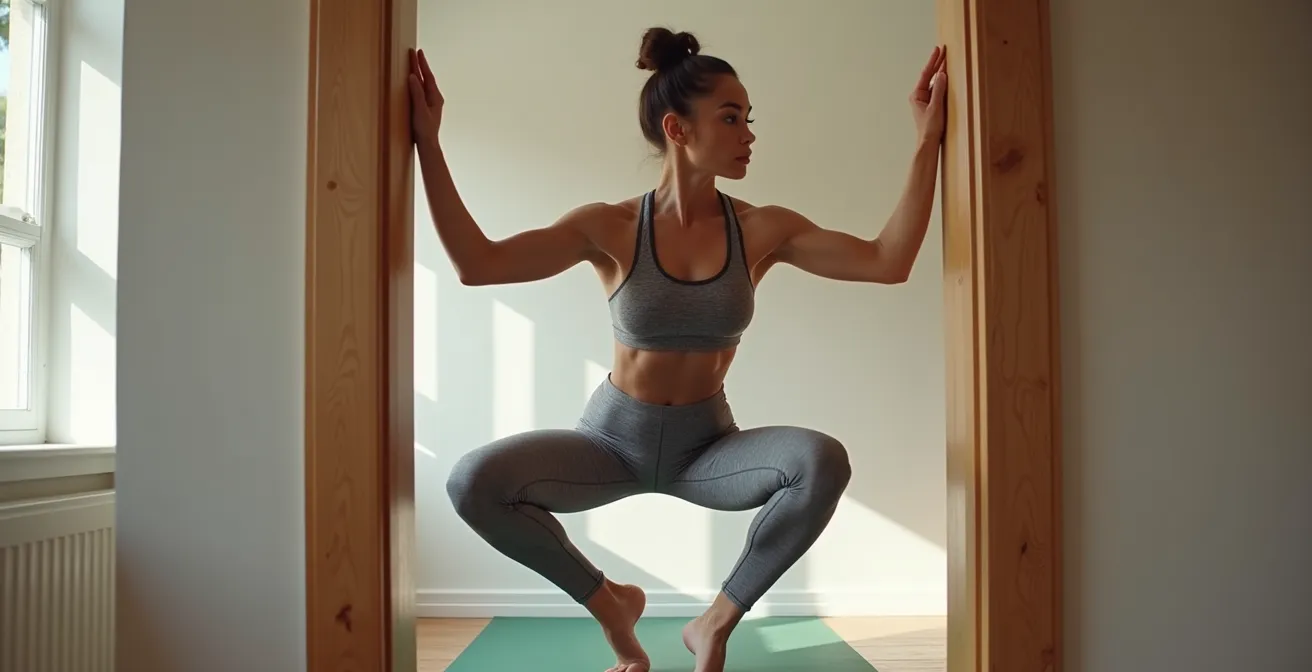
As you can see in this drill, the hands and shoulders remain fixed, forcing the pelvis to rotate. Practice this slowly at first, focusing on the feeling of stretch through your midsection. This sensation is the foundation of torque. Over time, this isolated movement can be integrated into a full swing, replacing the arm-dominant push with a powerful, core-driven rotation.
Weighted Bat vs. Overspeed Training: Which Increases MPH Faster?
When it comes to swing training, two methods dominate the conversation: weighted training (swinging a heavier implement) and overspeed training (swinging a lighter one). While both can be beneficial, they target different aspects of performance, and their effectiveness varies significantly. Weighted training primarily builds specific strength in the swing musculature, while overspeed training targets the neuromuscular system to increase its maximum firing rate. For most athletes looking for the fastest gains in speed, the answer lies in combining them.
A training protocol that uses only a weighted bat tends to build strength but can inadvertently train the body to move slowly. Conversely, overspeed training alone can increase speed but may not be as effective if the athlete lacks the underlying strength to control the faster motion. The most effective approach, known as contrast training, involves using a spectrum of weights—light, normal, and heavy—within the same session. This combination develops strength, reprograms the neurological governor for speed, and teaches the body how to apply that strength at high velocity.
The following table breaks down the typical results and best applications for each method, highlighting the superior gains from a combined approach.
| Training Method | Speed Gain (12 weeks) | Best For | Volume Required |
|---|---|---|---|
| Weighted Bat Only | ~1 mph average | Strong but slow athletes | High (90+ swings) |
| Overspeed Only | ~3 mph average | Fast but weak athletes | Low (30 swings) |
| Contrast Training | ~3x improvement | All athlete types | Moderate (60 swings) |
Case Study: MyGolfSpy Community SuperSpeed Training Results
A real-world test demonstrates the power of this approach. Seven MyGolfSpy Forum members tested SuperSpeed Golf’s contrast training protocol over 6 months. The results were significant, showing an average swing speed increase from 89 to 96 MPH—a 7 mph gain. One participant even saw their drives increase from 230 to 261 yards. The study highlighted a characteristic two-stage jump: an immediate gain in the first six weeks (the normalization period) as the nervous system adapted, followed by a secondary jump between weeks 15 and 26 as neurological adaptations and improved ground force sequencing solidified.
The ‘Over-Rotation’ Mistake That Herniates Discs
In the pursuit of power through hip rotation, many athletes make a critical and dangerous error: over-rotation. This occurs when the kinetic chain is broken, typically due to poor glute activation or limited hip mobility. Unable to generate force from the hips, the body tries to compensate by forcing rotation from the lumbar spine (the lower back). The lumbar spine is designed primarily for flexion and extension (bending forward and backward), with very limited rotational capacity. Forcing it to become the primary engine for rotation places tremendous, unsafe stress on the intervertebral discs.
This hazardous compensation is often a symptom of trying to create more hip-torso separation than your body can safely handle. As experts Lindsay & Horton noted in the Journal of Orthopaedic & Sports Physical Therapy, this pattern is a direct path to injury:
Golfers with LBP tend to rotate their upper body beyond their physical limits of trunk rotation during the backswing, resulting in an uncompensated rotational moment to the lumbar spine.
– Lindsay & Horton, Journal of Orthopaedic & Sports Physical Therapy
This “uncompensated rotational moment” means the lower back is twisting without the support and proper sequencing from the hips and thoracic spine. It becomes the weak link absorbing forces it was never meant to handle. Biomechanical research reinforces this, revealing that golfers with Low Back Pain (LBP) demonstrate significantly less trunk extension strength and have a more limited trunk rotation angle. Their bodies instinctively try to generate the missing rotation from the wrong place—the vulnerable lumbar region.
A healthy swing feels powerful but “connected.” The sensation of over-rotation, often accompanied by a feeling of losing balance or the lower back arching excessively, is a major red flag. The solution is not to rotate less but to rotate *better*, by improving hip mobility and glute strength so the lumbar spine can remain stable while the hips and thoracic spine do the rotating.
How to Sync Your Breathing with Impact for Peak Power?
One of the most overlooked elements in power generation is breathing. Most athletes either hold their breath—creating full-body tension—or breathe passively, failing to harness its stabilizing potential. The correct technique, often called “power breathing”, involves a sharp, forceful exhalation that is precisely timed with the moment of impact. This is not just about getting air out; it’s a biomechanical tool for enhancing core stiffness and maximizing energy transfer.
When you exhale forcefully (like a “Tss!” or “Shh!” sound), your deep abdominal muscles, including the transverse abdominis and obliques, contract involuntarily. This action dramatically increases intra-abdominal pressure, creating a rigid “natural weightlifting belt” around your midsection. This momentary core stiffness is critical. A stable core provides a solid platform against which your rotating hips can push, ensuring that the energy generated from the ground up is efficiently channeled through the torso to the arms and, finally, to the implement.
Without this synchronized exhalation, the core can remain “soft” at impact. A soft core is like a loose joint in the kinetic chain; it leaks energy. Power generated by the hips dissipates in the midsection instead of accelerating the swing. Timing is everything: the exhale should begin just before impact and peak at the moment of contact, ensuring maximum core stability when it’s needed most.

This technique can be practiced with exercises like the medicine ball rotational throw, as depicted here. Focus on initiating the throw with your hips and timing a sharp exhalation as the ball leaves your hands. The feeling of the core “bracing” at the moment of release is the exact sensation you want to replicate in your swing. It transforms your breathing from a passive biological function into an active component of your power sequence.
Landmine Press vs. Bench Press: Which Transfers Better to Sports?
In the gym, athletes often default to the bench press as the primary upper-body strength builder. However, for a rotational athlete, its benefits are surprisingly limited. The key to effective strength training for sports is the principle of specificity and force vector transfer. A force vector is simply the direction in which force is applied. To improve a rotational swing, exercises should mimic the force vectors and movement planes of that swing. This is where the landmine press proves vastly superior to the traditional bench press.
The bench press involves a purely horizontal force vector, pushing a weight away from the chest in a single plane of motion (the sagittal plane). While it builds raw pressing strength, this movement has almost no direct transfer to a golf swing or baseball swing, which are multi-planar, rotational, and require force to be transferred diagonally from the ground up. Furthermore, the stable, supported position on a bench minimizes the need for core activation—the exact opposite of what’s needed in a dynamic swing.
The landmine press, by contrast, is a perfect match. Performed in a standing or half-kneeling position, it involves pressing a barbell anchored to the floor at an angle. This creates a diagonal force vector that mirrors the path of energy in a swing. It forces the body to stabilize through the entire core and transmit power from the feet through the hips and torso to the hands, engaging all three planes of motion (sagittal, frontal, and transverse). It is a true full-body, integrated movement.
This table clearly illustrates the biomechanical differences and why the landmine press is a more sport-specific choice for rotational athletes.
| Exercise | Force Vector | Planes of Motion | Rotational Transfer | Core Activation |
|---|---|---|---|---|
| Bench Press | Pure horizontal | Sagittal only | Low | Minimal |
| Landmine Press | Diagonal (ground to hands) | Sagittal, Frontal, Transverse | High | Full trunk stabilization |
Why Your Lower Back Hurts Only on One Side After Squash?
Experiencing lower back pain concentrated on one side is a common and unnerving issue for athletes in asymmetrical sports like squash, tennis, and golf. This unilateral pain is rarely a sign of a random injury; it’s a predictable outcome of asymmetrical loading. Every swing or stroke loads one side of your body more than the other. Over thousands of repetitions without proper counter-balancing, this creates significant muscular imbalances, movement dysfunctions, and ultimately, pain.
The body’s kinetic chain is a masterpiece of balance. The powerful rotation to your dominant side (e.g., a right-handed forehand) must be decelerated by the muscles on your non-dominant side. When the “decelerators” (like the left glute and core for a right-handed player) are weak, other structures must pick up the slack. Often, it’s the quadratus lumborum (QL) muscle on the opposite side of the back that becomes chronically overworked and tight as it tries to prevent the spine from over-rotating. This leads to that familiar one-sided ache.
This imbalance is more than just a feeling; it has measurable physiological consequences. Research on asymmetrical sports shows that individuals with chronic low back pain exhibit greater lumbar muscle stiffness and often have a reduced gluteus maximus cross-sectional area on their non-dominant side. In simple terms, the stabilizing glute muscle has weakened, forcing the back muscles to stiffen up in a desperate attempt to create stability, leading directly to pain and reduced mobility.
The solution is not to stop playing, but to actively fight this imbalance with a dedicated anti-rotation strength protocol. These exercises specifically target and strengthen the core and hip muscles responsible for resisting rotational forces, re-establishing the balance your body needs to move powerfully and pain-free.
Your Checklist: The Anti-Rotation Protocol for Asymmetrical Athletes
- Pallof Press: Perform 3 sets of 12 reps on each side, focusing intently on resisting the rotational pull from your non-dominant side.
- Single-leg Romanian Deadlifts: Emphasize the non-dominant leg to build unilateral hip and glute stability; perform 3 sets of 10 reps.
- Side Plank with Rotation: Hold a side plank for 30 seconds on your weaker side, adding a slow, controlled rotation to challenge the obliques.
- Bird Dog Progressions: Focus on contralateral (opposite arm/leg) stability and control; perform 3 sets of 8 very slow, deliberate reps per side.
- Half-Kneeling Cable Chops: Perform 3 sets of 10, emphasizing the deceleration phase as you control the pull from your non-dominant side.
Key Takeaways
- Swing speed is primarily a neurological skill, not a measure of brute strength. Power is unlocked by reprogramming your brain’s safety governors.
- True power comes from the torque created by hip-torso dissociation. This is a learned skill that must be trained with specific drills.
- Sport-specific strength training is about transferring force vectors. Exercises like the Landmine Press are far more effective for rotational athletes than the Bench Press.
How to Control the Adrenaline Dump Before Your First Sparring Session?
While the title mentions sparring, the principle is universal for any high-pressure athletic performance, from a crucial tee shot to stepping into the batter’s box. The “adrenaline dump”—that sudden rush of nerves, shaky hands, and racing heart—is a performance killer. This physiological response, driven by the sympathetic nervous system, triggers a cascade of events that directly sabotage the delicate biomechanics of a high-speed swing. The key to performing under pressure is learning to consciously down-regulate this response.
Adrenaline and performance anxiety cause the central nervous system to go into a protective mode, creating widespread muscle tension. This tension is catastrophic for a fluid, powerful swing. Neuromuscular research indicates that this tension robs the muscles of their “spring-like” quality, stiffening the entire kinetic chain and preventing the efficient transfer of energy from the hips. Your body becomes rigid and slow precisely when you need it to be fluid and fast. You lose access to your finely tuned technical skills, which are overridden by a primal fight-or-flight response.
Fortunately, you can learn to manually pump the brakes on your nervous system. Simple, voluntary actions can send powerful signals to the brain to shift from a state of high alert to one of calm focus. This allows you to stay in control and execute the movement you’ve trained, rather than a tense, compromised version of it.
Case Study: Padraig Harrington’s Physiological Sigh Technique
Professional golfer Padraig Harrington provides a perfect example of mastering this skill. Seeking to “remove the governor” in competition, he implemented specific breathing techniques to manage pre-shot adrenaline. The result was a tangible increase in ball speeds to the mid-180s mph, even under tournament pressure. The most effective tool he used was the “physiological sigh,” identified by neuroscientists as the fastest voluntary way to down-regulate the autonomic nervous system. The technique is simple: a double-inhale through the nose (one big breath, then a smaller one to fully inflate the lungs), followed by a long, slow exhale through the mouth. This simple action offloads carbon dioxide and signals immediate safety to the brain, allowing technical skills to remain accessible.
Understanding these biomechanical principles is the first and most critical step. The next is to move from knowledge to action. Start by honestly assessing your own swing—are you an arm-swinger? Do you feel that one-sided back pain? Then, systematically implement one of these protocols and begin the process of building a faster, safer, and more powerful swing from the ground up.