

The tendency for competitive athletes to freeze or make poor choices in critical moments isn’t a failure of skill, but a breakdown in cognitive processing. Instead of repeating generic advice to “stay calm,” this guide deconstructs the mental machinery behind elite performance. By understanding and training the specific cognitive levers—from managing visual perception under fatigue to mastering focus—you can systematically rebuild your response to pressure and turn split-second panic into decisive action.
You’ve been there. The final seconds are ticking down, the game is on the line, and the ball is in your hands. A teammate is wide open for an easy score, but in that split-second, you hesitate, make the wrong pass, or simply freeze. The opportunity vanishes. Afterward, the frustration is immense, not because of a physical limitation, but because your mind let you down. For years, athletes have been told to “practice more,” “trust their gut,” or “just relax,” but this advice fails to address the root cause of high-pressure failure: a breakdown in your cognitive architecture.
This isn’t about a lack of talent or willpower. It’s about how your brain processes information under duress. Factors like physical fatigue, a narrow field of vision, and a misplaced focus can sabotage even the most skilled performers. But what if the key wasn’t simply to resist pressure, but to understand its mechanics and re-engineer your mental response to it? This guide moves beyond the platitudes to explore the cognitive science of elite decision-making. We will dissect the mental errors that lead to costly mistakes and provide concrete, trainable frameworks to build true mental dominance.
We will examine why fatigue clouds your judgment, how to expand your awareness of the entire field of play, and when to trust instinct over a pre-planned system. By treating decision-making as a skill, you can transform it from a source of anxiety into your greatest competitive advantage.
To navigate this deep dive into cognitive performance, here is a breakdown of the key mental arenas we will explore, providing a complete roadmap to mastering high-pressure situations.
Summary: Mastering Split-Second Decisions Under Pressure
- Why You Miss Open Teammates When You Are Physically Exhausted?
- How to Expand Your Field of Vision Without Moving Your Head?
- Instinct vs. System: Which Playstyle Wins Close Matches?
- The Mental Error That Leads to Turnovers in the Final Quarter
- How to Review Game Tape to Spot Tactical Patterns in 30 Minutes?
- The Focus Error That Causes Missed Free Throws Under Pressure
- Why Your Offside Trap Fails 80% of the Time in Sunday Leagues?
- How to Maintain Mental Dominance When Losing by 10 Points?
Why You Miss Open Teammates When You Are Physically Exhausted?
The most common misconception is that late-game mistakes are purely physical. In reality, your brain is the first casualty of fatigue. As your body tires, your cognitive resources deplete, leading to a cascade of mental errors. The most significant of these is a narrowing of perceptual awareness. You stop seeing the whole field and develop “tunnel vision,” focusing only on the ball or the defender directly in front of you. That open teammate on the wing might as well be invisible because your brain no longer has the processing capacity to register them.
This is not a subjective feeling; it is a measurable phenomenon. Research confirms that mental fatigue leads to a dramatic impairment in visual perception and technical performance. Your ability to scan, recognize patterns, and execute the correct pass degrades significantly long before your legs give out. Essentially, your brain is trying to conserve energy by shutting down non-essential data streams, and unfortunately, that includes information from your peripheral vision.
To combat this, you must train your decision-making *under conditions of fatigue*. The goal is to make cognitive processing more efficient, so it requires less energy. Integrate high-intensity sprints at the end of practice, then immediately transition into complex tactical drills like a 3-on-2 or 4-on-3 scenario without rest. This forces your brain to adapt and learn to make smart plays while in a depleted state. By consistently exposing your mind to this specific stressor, you build cognitive resilience, ensuring your mental performance remains sharp when the physical pressure is at its peak.
How to Expand Your Field of Vision Without Moving Your Head?
While fatigue narrows your vision, elite athletes actively train to expand it. The secret lies not in physically looking around more, but in a technique known as the “Quiet Eye”. This is a trainable gaze-control skill that separates the merely good from the truly great. As cognitive psychologist Matthew Robison from the University of Notre Dame explains, it’s a specific method of perception.
The quiet eye technique involves training an athlete’s gaze to maintain focus on a specific location while simultaneously using peripheral vision to monitor the broader scene.
– Matthew Robison, Notre Dame Research
Imagine a point guard staring at the rim to freeze the defense, while simultaneously tracking the movement of cutters in their peripheral field. This isn’t a genetic gift; it’s a learned cognitive skill. By holding your central gaze steady on a tactically relevant point for a slightly longer duration before initiating movement, you give your brain a stable anchor from which to process peripheral information more effectively. This technique calms the chaotic visual scanning that often leads to panic and allows you to “see” more of the game without frantic head movements.
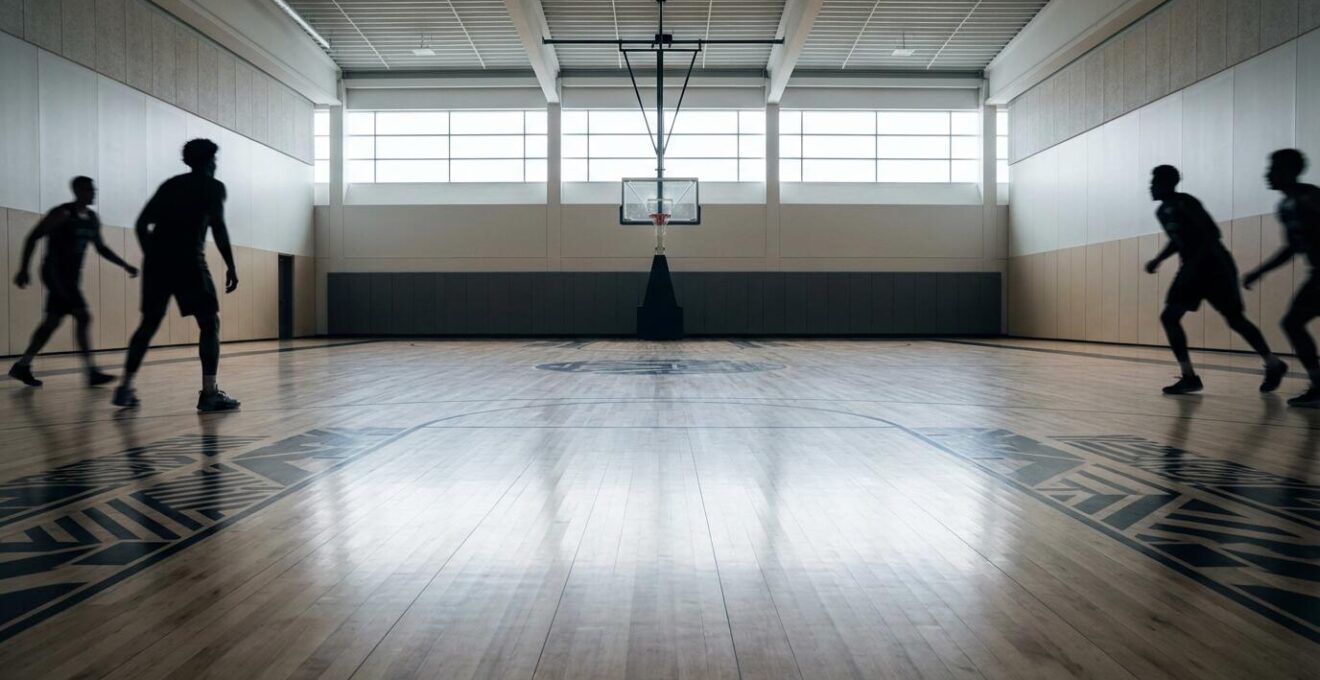
As the image above illustrates, the court is a vast space of information. Quiet Eye training helps you process that entire space. This skill has been shown to improve performance across various sports. A study focused on elite golfers demonstrated how this training can directly impact results under pressure.
Case Study: Quiet Eye Training in Elite Golf Performance
In a study involving 22 athletes from a national junior golf team, participants underwent Quiet Eye training. The results were significant: after the training, the athletes experienced an increase in their hit rate when putting under pressure. Furthermore, their self-rated pressure levels and state anxiety decreased, while their quiet eye duration and total fixation time on the ball increased, proving a direct link between trained gaze control and clutch performance.
Instinct vs. System: Which Playstyle Wins Close Matches?
Every athlete faces the classic dilemma: follow the coach’s system or trust your gut instinct? The answer isn’t to choose one over the other, but to understand when to deploy each. This decision is governed by two distinct cognitive operating modes, known as System 1 (intuitive) and System 2 (deliberative) thinking. System 1 is fast, automatic, and based on thousands of hours of pattern recognition—this is your “instinct.” System 2 is slow, analytical, and conscious—this is you “thinking through” the play.
In high-pressure, time-critical moments, experts rely almost exclusively on System 1. Their brains recognize a familiar pattern and execute a pre-programmed response in milliseconds. However, when a situation is novel or highly uncertain, a reliance on pure instinct can be disastrous. In fact, when uncertainty exceeds a critical threshold, the brain deliberately shifts from the intuitive System 1 to the analytical System 2 to find a novel solution. Forcing an “instinctive” play in a completely unfamiliar scenario is a recipe for a turnover.
The key to winning close matches is developing a hybrid approach. The table below breaks down when each system is most effective, based on recent analysis of decision-making models in sports.
| Decision Type | Best Used When | Processing Speed | Accuracy Rate |
|---|---|---|---|
| Instinct (System 1) | Familiar patterns, time pressure < 200ms | Automatic/Fast | Higher in experts |
| System (System 2) | Complex/atypical situations | Controlled/Slow | Higher with time available |
| Hybrid Approach | Pre-game preparation + in-game execution | Variable | Optimal performance |
Winning playstyles use System 2 during preparation (film study, tactical planning) to build a deep library of patterns. This robust preparation then allows System 1 to execute flawlessly and automatically during the game. You don’t “choose” instinct; you earn it through deliberate, systematic practice.
The Mental Error That Leads to Turnovers in the Final Quarter
The single biggest mental error that causes turnovers in clutch moments is a shift in focus from process to outcome. When the pressure mounts, athletes stop thinking about *how* to execute the play and start worrying about the consequences of failure. Your internal monologue shifts from “find the open man” (process) to “don’t turn the ball over” (outcome). This negative, outcome-based thinking paralyzes the fluid, automatic skills you’ve honed in practice. It pulls you out of your intuitive System 1 and forces you into a slow, hesitant System 2 at the worst possible moment.
The brain cannot effectively process a negative command. Telling yourself “don’t miss” actually forces your brain to visualize missing. This creates cognitive interference and muscular tension, leading directly to the mistake you’re trying to avoid. The solution is to develop a robust, pre-planned mental routine that you can deploy to instantly shift your focus back to the process, regardless of the external pressure. This routine acts as a cognitive reset button.
By creating and practicing this routine, you build a mental anchor that is stronger than the chaos of the game. It allows you to take control of your focus, block out outcome-based anxiety, and let your trained skills take over. The following checklist provides a framework for building your own bulletproof mental routine.
Your Action Plan: The Process-Cue Mental Routine
- Establish a Process Cue: Create a single, powerful word or short phrase that anchors you to the task at hand. Examples: “next play,” “see the court,” or “stay ready.” This is your primary trigger.
- Practice a Reset Breath: Master box breathing. Inhale for a 4-count, hold for 4, and exhale for 4. Repeat 3-5 times after a mistake or during a stoppage to regulate your nervous system.
- Use a Physical Anchor: Link your mental cue to a simple, repeatable physical action, like tapping your chest, adjusting your grip, or clapping your hands. This physical anchor makes the mental reset more automatic.
- Reframe to Positive Action: Consciously shift your internal language from a negative outcome focus (“don’t turn it over”) to a positive, actionable instruction (“find the open man” or “strong pass”).
- Implement a Pre-Performance Routine: Before a free throw, a corner kick, or any set play, execute a quick, consistent sequence (e.g., two dribbles, deep breath, say cue word) to activate your process-focused mindset.
How to Review Game Tape to Spot Tactical Patterns in 30 Minutes?
Most athletes watch game tape passively, like a fan. They re-watch highlights or groan at mistakes. Elite performers, however, review tape with a specific cognitive goal: active pattern recognition. The objective isn’t just to see what happened, but to understand the recurring tactical sequences of both their team and their opponents. This transforms film review from a chore into a high-leverage mental training session that directly fuels your intuitive System 1.
To do this effectively in a short amount of time, you must be systematic. Don’t watch the whole game. Instead, focus on specific situations. For example, spend 10 minutes watching only your team’s offensive possessions in the half-court. Then spend 10 minutes on your opponent’s defensive rotations. Look for repeated actions: Where does the point guard look first? How does the defense react to a ball screen? Which player is consistently late on a rotation? This focused approach builds a mental library of “if-then” scenarios.

This method of active analysis has proven highly effective. By dissecting game situations, you’re not just memorizing plays; you’re training your brain to anticipate what’s coming next, allowing you to react faster and more decisively in real-time.
Case Study: Spanish Tennis Players’ Video Analysis
Spanish sports scientists conducted a study on how video analysis impacts young tennis players’ decision-making. Instead of passive viewing, players watched replays of specific points, were prompted with questions to analyze their mistakes, and had to suggest improvements. The study found that this active technique significantly improved their split-second strategic choices, specifically in “selecting the most suitable shot for the game situation.” This proves that an interactive, analytical approach to film study directly enhances in-game intelligence.
The Focus Error That Causes Missed Free Throws Under Pressure
The free throw is a perfect microcosm of pressure. It’s a closed skill, performed countless times, yet even professionals falter in clutch moments. The critical error is not mechanical but attentional: a shift from an external to an internal focus of attention. When pressure mounts, athletes often start thinking about their body mechanics: “Is my elbow tucked? Am I bending my knees enough?” This internal focus disrupts the smooth, automated motor program your body has perfected through thousands of repetitions.
As sports psychology experts from the Cook Vision Therapy Center advise, the key is to lock into a specific external target.
Instead of thinking about your elbow position (internal focus), focus intently on a small, specific target, like the back of the rim or a single link on the net.
– Sports Psychology Experts, Cook Vision Therapy Center
This advice is backed by the same “Quiet Eye” principle we discussed earlier. By fixing your gaze on a precise external target for a sustained period before initiating the shot, you quiet the “noise” of internal thoughts and allow your body to execute its well-trained program. Research demonstrates that players with longer quiet eye durations during free throws consistently show higher accuracy rates. This is because a stable gaze facilitates a stable motor output.
To implement this, find a hyper-specific target. Don’t just look at “the rim.” Look at the single hook that holds the net on the front of the rim. Or find a small discoloration on the backboard. Your entire mental energy should be devoted to focusing on that one spot. This external anchor prevents your mind from drifting to the score, the crowd, or your own elbow, ensuring a fluid and automatic release.
Why Your Offside Trap Fails 80% of the Time in Sunday Leagues?
The offside trap is a beautiful illustration of collective decision-making. When it works, it’s a symphony of synchronized movement. When it fails, it’s a catastrophic breakdown in communication and timing. In amateur leagues, the failure rate is notoriously high, and it’s rarely due to a single player’s lack of speed. The problem is a lack of a single, unambiguous cognitive trigger for the entire defensive line.
For a trap to succeed, all four or five defenders must move as one entity. This requires them to react to the exact same cue at the exact same moment. In professional settings, this is trained to the point of being a collective System 1 (intuitive) response. In amateur leagues, however, the process is chaotic. One defender moves on the passer’s backswing, another when the ball is struck, and a third hesitates, waiting for confirmation. This staggered reaction creates the fatal gap for an attacker to run through.
Fixing the offside trap is a cognitive training exercise, not a fitness one. The defensive line must establish and drill a single, shared trigger. This could be the moment the passer’s planting foot hits the ground or the peak of their backswing. This trigger must be trained relentlessly, often using tools like elastic bands connecting the defenders to teach them the “feel” of unified movement. The goal is to move beyond verbal commands and develop a shared, non-verbal intuition through hundreds of repetitions. The process starts with pressure on the ball carrier, as this forces a more predictable action, making the trigger easier for the defensive line to read in unison.
Key Takeaways
- Mental fatigue directly impairs visual perception, causing you to miss opportunities you would normally see.
- The “Quiet Eye” technique—a steady gaze on a key target—is a trainable skill that expands peripheral awareness and calms the mind.
- True instinct (System 1) is not random; it’s built upon thousands of hours of systematic practice and pattern recognition (System 2).
How to Maintain Mental Dominance When Losing by 10 Points?
Being down on the scoreboard is one of the most significant sources of mental fatigue and cognitive disruption. The pressure of the deficit can lead to hurried shots, selfish play, and a complete collapse of team strategy. Maintaining mental dominance in this scenario is not about a “rah-rah” speech; it’s about executing a specific cognitive routine to regain control of your emotional state and attentional focus.
The first step is to consciously shift your locus of control from external factors (the score, the referees, bad luck) to internal ones (your effort, your execution, your communication). Acknowledge the frustration without judgment—”I’m frustrated by this deficit”—and then immediately pivot to one single element you can control on the very next play. This could be your defensive intensity, setting a hard screen, or making the extra pass.
Furthermore, break the overwhelming goal of “overcoming a 10-point deficit” into manageable micro-games. Your new objective is to “win the next five minutes” or “get three defensive stops in a row.” This reframes the task from impossible to achievable, reducing cognitive load and restoring a sense of agency. This approach is supported by research showing that mindfulness and nature exposure interventions significantly counteract mental fatigue, and these micro-focus techniques act as a form of in-game mindfulness. By projecting calm confidence, you can create positive emotional contagion, stabilizing the energy of your entire team.
By deconstructing your mental game and applying these cognitive frameworks, you are no longer a victim of pressure but the architect of your response to it. The next step is to move from understanding these concepts to actively implementing them in your training and competition. Begin by identifying the single biggest cognitive error that holds you back and apply the relevant framework today.