
Your defenders’ lack of pace isn’t the problem; your lack of a cohesive, low-effort system is what’s getting you beat.
- A 5-3-2 formation provides natural cover against wingers and is more forgiving of individual errors than a traditional 4-4-2.
- Simple, drilled “if-then” rules and small-sided overload games build smart decision-making faster than endless 11v11 practice.
Recommendation: Implement a 5-3-2 system focused on zonal marking and make proactive defensive substitutions around the 60-minute mark to neutralize speed and maintain defensive integrity.
You know the feeling. The ball gets played out wide, your centre-half turns like a barge, and some 19-year-old winger with more pace than sense is suddenly bearing down on goal. It’s the recurring nightmare of every amateur coach, the moment that makes you want to pack it all in. You scream “get tighter!” or “talk to each other!” from the touchline, but you know it’s useless. The damage is already done. Most coaches think the answer lies in complex tactics they’ve seen on TV, like a high-risk offside trap, or they simply lament not having faster players.
But what if the solution isn’t about having faster defenders, but smarter ones? What if you could build a system that makes the winger’s speed almost irrelevant? The truth is, at the amateur level, a simple, well-drilled system will always beat a team of talented but disorganized individuals. It’s about system over speed. It’s about creating predictable zones and using low-effort triggers that force the opposition into making the mistakes for you. This isn’t about reinventing football; it’s about applying professional discipline to amateur limitations.
This guide will give you the tactical blueprint. We’ll dissect why your current defensive setup is failing, help you choose a formation that protects your flanks without needing world-class athletes, and provide concrete drills to improve your team’s split-second decision-making under pressure. It’s time to stop chasing shadows and start building a wall.
To help you navigate these tactical adjustments, we’ve broken down the key areas you need to master. This structure will guide you from identifying the core problems in your defensive line to implementing practical solutions on the training ground and on match day.
Summary: A Coach’s Guide to Neutralizing Pace
- Why Your Offside Trap Fails 80% of the Time in Sunday Leagues?
- How to Teach Verbal Cues to Introverted Defenders in 2 Sessions?
- 4-4-2 or 5-3-2:How to Maintain a Balanced Lifestyle When You Travel 15 Days a Month?
- The Warm-Up Mistake That Causes Hamstring Tears in the First 10 Minutes
- When to Make Substitutions: The 60-Minute Mark Strategy for Amateur Legs
- Landmine Press vs. Bench Press: Which Transfers Better to Sports?
- Instinct vs. System: Which Playstyle Wins Close Matches?
- How to Improve Split-Second Decision Making Under High Pressure?
Why Your Offside Trap Fails 80% of the Time in Sunday Leagues?
The offside trap is the amateur coach’s holy grail—a beautiful, intelligent way to defend. In theory. In practice, it’s a liability that costs you more goals than it saves. The reason is simple: it demands a level of synchronicity that is almost impossible to achieve with limited training time. The most common cause for failure is when one single defender doesn’t move upfield at the exact same moment as their teammates. One player’s hesitation, a moment of distraction, or a misheard shout is all it takes for the entire system to collapse and give the opposition a clear run on goal.
Relying on a high-risk offside trap is the opposite of building a robust system. A good defense is built on principles that reduce the chance of catastrophic failure, not increase it. For Sunday league, that means a deeper line, an emphasis on keeping play in front of you, and removing the need for split-second, perfectly coordinated movements across the entire back four. You need a system that is forgiving, where one player’s mistake can be covered by another. Before you even consider implementing a high-risk trap, your defensive unit must master the absolute basics of communication and movement, which are far more valuable assets.
Your Action Plan: The Bare Minimum for an Offside Trap
- Designate one center-back as the ‘trap captain’ who calls the movement with a clear, loud verbal command. No ambiguity.
- Practice the ‘step-up drill’ constantly: all defenders move forward in unison on command, even without opposition, to build muscle memory.
- Use visual cues like a raised arm from the trap captain to supplement the verbal command for players who might not hear it in a noisy match.
- Film your defensive line during practice games. Watching the footage is the only way to identify which player consistently breaks the chain and why.
Instead of gambling on this high-wire act, focus your energy on building a defense that doesn’t need to take such risks. A solid, deep-lying defense is less glamorous, but it wins more games in the long run.
How to Teach Verbal Cues to Introverted Defenders in 2 Sessions?
“Talk more!” is the most useless piece of advice you can give a quiet defender. Some players just aren’t natural-born leaders or loud communicators, and you can’t change their personality. But you can give them a system. The key isn’t to make them shout; it’s to equip them with a simple, non-negotiable set of low-effort triggers and cues that become second nature. Communication on the pitch isn’t about making speeches; it’s about transmitting critical information efficiently. For an introverted player, a simple, clear hand signal or a single-word command is far more effective than being expected to constantly organize the line with their voice.
This is where coaching comes in. You need to create a non-verbal language for your defense. Simple hand signals for stepping up, dropping off, or indicating a player to mark can be drilled until they are automatic. The legendary Arsenal defense under George Graham is a prime example. They perfected their famous offside trap not through a team of screaming captains, but through clockwork precision built on simple, repetitive cues. It proves that defensive communication can be systematized rather than relying on natural vocal leadership.
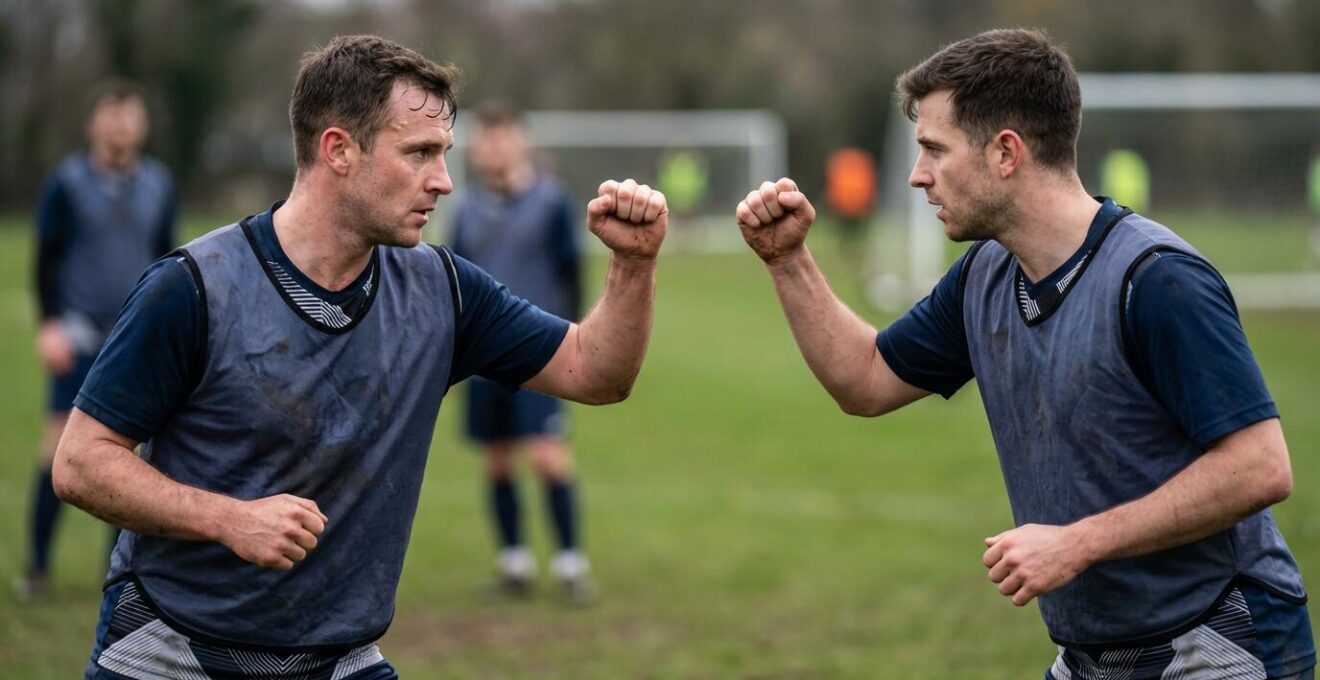
In your training, pair up defenders and have them practice these signals. One player points to a runner, the other acknowledges. One raises a fist to signal “step up,” and the whole line responds. By making it a mechanical drill, you remove the social anxiety and pressure, turning communication into just another part of the tactical execution. This method empowers your quiet players by giving them an effective tool they are comfortable using.
Ultimately, a defender who makes the right signal is far more valuable than one who shouts the wrong instruction. Focus on the system, not the volume.
4-4-2 or 5-3-2:How to Maintain a Balanced Lifestyle When You Travel 15 Days a Month?
Your choice of formation is the bedrock of your defensive system. For an amateur team dealing with fast wingers and players of varying ability, the classic 4-4-2 is often a trap. It leaves your full-backs isolated and demands a huge amount of coordinated pressing and covering from your midfielders. One missed tackle or a moment of hesitation, and the winger has acres of space to run into. You need a formation that is inherently more stable and provides natural cover in wide areas. That formation is the 5-3-2 (or 3-5-2).
A 5-3-2 gives you a dedicated wing-back and a wide centre-back on each side of the pitch. This immediately creates a 2-v-1 situation against the opposing winger, forcing them to either pass backwards or attempt a high-risk dribble into a crowded area. It’s a system that is naturally more conservative and forgiving of individual errors because there is always a covering player. As tactical analysis shows, a 5-3-2 is also often simpler to implement with limited training time.
A 5-3-2, while seemingly complex, can be simpler to drill defensively (‘stay in your zone’) than a 4-4-2’s coordinated pressing, making it ideal for teams that train infrequently.
– Tactical analysis from European coaching methodology, 11-a-Side Soccer Tactics Guide
The mental load on the players is lower. Instead of a complex, coordinated press, the core instruction is “protect your zone.” This simplicity is a massive advantage when you only see your players once a week. The following table breaks down why a 5-3-2 is a more practical choice for amateur teams looking to build a solid defensive foundation.
| Aspect | 4-4-2 Formation | 5-3-2 Formation |
|---|---|---|
| Training Time Required | 15-20 hours to implement basics | 10-12 hours for zone defense |
| Forgiveness to Errors | Low – gaps expose defense quickly | High – extra defender provides cover |
| Player Absence Impact | High – specific roles hard to replace | Low – easier plug-and-play substitutions |
| Winger Defense | Vulnerable without fullback support | Natural double-coverage with wingback |
| Mental Load | High – requires coordinated pressing | Lower – simpler ‘stay in zone’ principle |
Stop trying to fit your players into a system that exposes their weaknesses. Choose a formation that protects them and plays to the strengths of a collective, organized unit.
The Warm-Up Mistake That Causes Hamstring Tears in the First 10 Minutes
There’s nothing more frustrating than seeing one of your key players pull up with a hamstring injury just minutes into a match. You’ve lost a player for weeks, and your game plan is in tatters before it even began. In most amateur teams, this is not bad luck; it’s a direct result of an outdated and dangerous warm-up routine. The single biggest mistake is performing long-hold static stretching (e.g., touching your toes for 30 seconds) right before a game. You think you’re preparing the muscle for action, but you’re actually doing the opposite.
Static stretching tells the muscle to relax and lengthen. It can temporarily decrease force production and power, making the muscle less prepared for the explosive, high-intensity movements of a football match. When a player then sprints or makes a sudden change of direction, the “switched-off” muscle is far more susceptible to tears. Research has consistently shown the risks associated with this practice.
The solution is to replace static stretching with dynamic stretching. These are active movements that mimic the actions of the game, taking your muscles and joints through their full range of motion. Think leg swings, high knees, butt kicks, and walking lunges. This type of warm-up increases blood flow, activates the central nervous system, and improves mobility without compromising muscle power. According to research published in BMC Musculoskeletal Disorders, dynamic stretching is a superior method for preparing the body for athletic performance while reducing injury risk. It’s a simple change that can keep your players on the pitch and out of the treatment room.
Stop treating the warm-up as a casual kick-about. Implement a professional, dynamic routine, and you’ll significantly cut down on those infuriating early-game injuries.
When to Make Substitutions: The 60-Minute Mark Strategy for Amateur Legs
In amateur football, fatigue is not just a physical state; it’s a tactical weapon that the opposition will use against you. Most coaches wait until a player is visibly struggling—hands on knees, jogging back—before making a substitution. This is a reactive and costly mistake. By the time you see the signs of exhaustion, the damage has already been done. Their decision-making has slowed, their positioning has become sloppy, and they are a liability. The best coaches are proactive, not reactive, with their changes.
The critical period in any 90-minute game is between the 60th and 75th minute. This is when amateur legs, which lack professional conditioning, truly begin to tire. A smart strategy is to plan your defensive substitutions around the 60-minute mark, regardless of whether your players look tired or not. Bringing on a fresh set of legs, particularly in the fullback or wide midfield positions that do the most running, can completely reinvigorate your defensive structure and deny the opposition the chance to exploit tired bodies in the final third of the game.
The Professional Blueprint: Pre-emptive Substitutions
This isn’t just a gut feeling; it’s backed by data. A comprehensive analysis of substitution patterns in Europe’s top five leagues showed a clear correlation between early defensive changes and success. Teams that made pre-emptive defensive substitutions between the 55th and 65th minutes conceded significantly fewer late goals compared to those that made reactive substitutions after the 70-minute mark. This proves that maintaining defensive integrity relies on anticipating fatigue, not just responding to it.

Treat your substitutes not as a panic button, but as a strategic tool. Use them to impose your will on the final 30 minutes of the match and secure the result.
Landmine Press vs. Bench Press: Which Transfers Better to Sports?
A defender’s strength isn’t about how much they can bench press. That’s gym strength. What you need is functional, on-the-pitch strength. It’s the ability to absorb a shoulder charge from a powerful forward, hold your ground, and redirect that force through your core to win the ball. The traditional bench press, performed while lying down, does very little to develop this kind of integrated, whole-body power. It isolates the chest and shoulders, largely ignoring the core and lower body, which are the true source of an athlete’s stability.
A far more effective exercise for any football player, especially a defender, is the Landmine Press. Performed while standing and pushing the bar upwards and away from the body, this movement forces you to transfer power from the ground up, through your legs and core, and out through your upper body. This exact kinetic chain is what you use countless times during a match. It builds rotational power, enhances core stability, and teaches the body to work as a single, powerful unit—not a collection of isolated muscles.
The difference in how these exercises translate to athletic performance is not subtle. The Landmine Press challenges your stability and forces your core to engage at a much higher level, making it a superior tool for building sport-specific strength. The following table highlights the key differences:
| Aspect | Landmine Press | Bench Press |
|---|---|---|
| Force Transfer Pattern | Ground-to-opponent through core | Isolated upper body push |
| Stability Challenge | High – unilateral, standing | Low – supported by bench |
| Core Activation | 85% engagement throughout | 20% passive stabilization |
| Rotational Power Development | Excellent with variations | None |
| Sport-Specific Application | Mimics shoulder charge absorption | Limited transfer to field movements |
Encourage your players to train smarter, not just heavier. Focusing on functional movements like the Landmine Press will build resilient, effective defenders far better than chasing a new personal best on the bench press.
Instinct vs. System: Which Playstyle Wins Close Matches?
Every coach wants players with great “footballing instincts”—that innate ability to read the game and be in the right place at the right time. But in the chaos of an amateur match, relying purely on instinct is a recipe for disaster. Instinct is unpredictable. A system, on the other hand, provides a reliable foundation. It gives every player a clear understanding of their role and responsibility, especially when under pressure. It’s the system that gets you through the first 85 minutes of a match, providing the structure and discipline needed to stay competitive.
However, football is not a game of chess. There will always be moments of chaos—a lucky bounce, a deflected shot, a moment of individual brilliance from an opponent—where the system breaks down. This is where instinct must be allowed to take over. The best defensive units are not rigid robots; they are disciplined players who know exactly when they are permitted to abandon the system and rely on their intuition. As modern tactical analysis suggests, finding this balance is the key to a truly elite defense.
A rigid ‘System’ should govern 80% of defensive actions to provide a solid base, but players must be empowered to use ‘Instinct’ for the 20% of chaotic moments.
– Modern tactical analysis, Soccer Defending Principles
Your job as a coach is to define the rules of engagement. You must provide a clear framework that tells a player when to stick to the system and when to trust their gut. This isn’t about stifling creativity; it’s about providing the discipline that enables creativity to be effective. A player who knows they have cover behind them is more confident to step out and make an interception. The system gives them that confidence.
- Abandon system when: You are the last defender with no cover.
- Abandon system when: The ball enters your own 6-yard box.
- Abandon system when: You are down a goal in the last 5 minutes and need to take a risk.
- Maintain system when: Multiple defenders are in position and organized.
- Maintain system when: The ball is in midfield or wide areas, where shape is paramount.
Build the system first. Drill it relentlessly. Then, and only then, teach your players when it’s okay to break it. That is how you create a defense that is both solid and adaptable.
Key Takeaways
- A disciplined system is more valuable than individual speed. Focus on organization, not just athleticism, to neutralize fast opponents.
- The 5-3-2 formation offers natural defensive advantages for amateur teams, providing better cover in wide areas and being more forgiving of errors.
- Proactive substitutions around the 60-minute mark are a strategic weapon to maintain defensive intensity and prevent late-game collapses due to fatigue.
How to Improve Split-Second Decision Making Under High Pressure?
The difference between a good defender and a great one isn’t speed or strength; it’s the speed of their brain. It’s the ability to assess a situation, process the information, and make the optimal decision in the fraction of a second before an attacker does. You can’t teach this in a classroom or with players standing still. Decision-making is a skill that must be honed under pressure, in situations that replicate the intensity of a real match. Traditional 11v11 drills are often too slow and don’t provide enough repetitions for a defender to truly sharpen their mind.
The most effective way to accelerate this learning curve is through small-sided, high-intensity overload drills. These are games like 2v2, 3v2, or 4v3 played in a confined space. By constantly putting defenders in outnumbered situations, you force them to make a high volume of critical decisions in a short period. They have to decide instantly: do I press the ball? Do I drop off and cover the space? Do I try to force the attacker one way or another? This method rapidly builds a mental library of patterns and solutions.
Case Study: Accelerated Learning Through Overload Drills
The effectiveness of this method is well-documented in professional coaching. For example, coach Jack Collison’s 2v2 defensive drill methodology demonstrates this principle perfectly. His analysis shows that using overload situations in training increases decision-making speed by forcing defenders to make 40-60 critical decisions per 10-minute session. This is a massive increase compared to the mere 10-15 decisions they might make in a traditional 11v11 practice game over the same period. This accelerated learning curve translates directly to calmer, smarter, and faster reactions in match situations.
Another powerful tool is to program your defenders with an “If-Then” system. This involves giving them a simple, pre-determined response to common attacking scenarios. It removes the guesswork and allows them to react almost automatically.
- IF a winger receives the ball facing you, THEN get tight immediately and force them wide, away from the goal.
- IF a winger receives the ball with their back to you, THEN maintain a 2-step distance to prevent them from turning easily.
- IF a through-ball is played into the channel, THEN your first action is to drop and protect the space behind, not challenge the ball.
- IF you are outnumbered in a 2v1, THEN your primary job is to delay the attack and funnel them wide, giving your teammates time to recover.
Stop making your players just run; start making them think. Use these high-repetition drills and clear “If-Then” rules to build a defense that outsmarts the opposition, long before a footrace even begins.