
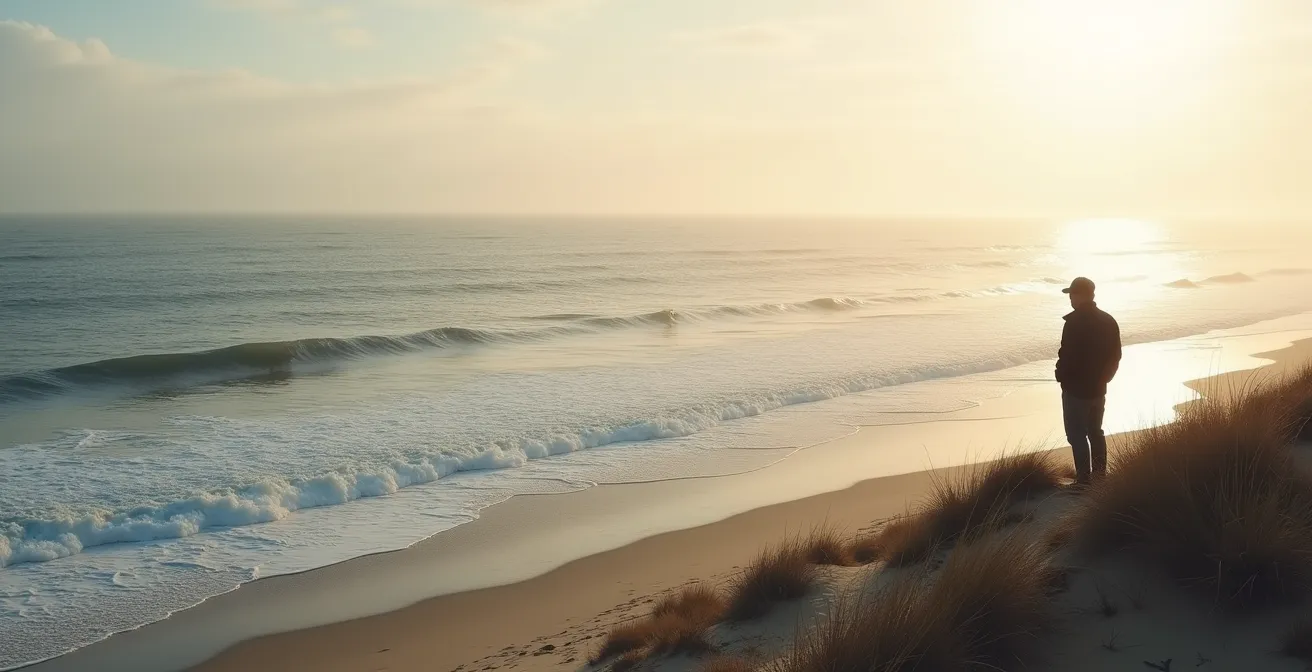
The secret to spotting dangerous rip currents isn’t just about looking for visual signs; it’s about reading the ocean’s entire energy system before you even touch the water.
- Long-period swells, even on small days, pack immense power and create the most deceptive rips.
- Your pre-surf observation isn’t a casual glance—it’s a disciplined 15-minute protocol to map out the break’s hidden dangers and social hierarchy.
Recommendation: Shift your focus from spotting rip ‘symptoms’ (like channels) to understanding their ’cause’ (the water’s energy and movement patterns) for true water safety.
You pull up to a new break. The waves look manageable, the sun is out, and the stoke is high. For an intermediate surfer, this is the dream: a new challenge, a new canvas. But beneath that inviting surface, the ocean is running a complex and powerful system. Most surfers are taught the basics: look for the channel of calm water, the foamy plume heading out to sea. This is sound advice, but it’s also reactive. It’s like only looking for smoke without ever learning what causes a fire.
Relying on these obvious signs alone means you’re seeing the rip current when it’s already fully formed and active. As a lifeguard, I’ve seen firsthand that the most dangerous situations arise from the rips you don’t see coming. The true art of ocean safety, especially at an unfamiliar spot, lies in a deeper literacy. It’s about understanding the invisible forces at play—the energy packed into a long-period swell, the subtle textures on the water’s surface, and the way your own gear can be either a lifesaver or a liability.
But what if the key wasn’t just spotting the rip, but anticipating it? What if you could read the ocean’s intent by understanding its energy system? This guide is built on that very principle. We’re moving beyond the beginner’s checklist to the veteran’s mindset. It’s not about fear; it’s about respect and a higher level of awareness. This is how you develop the instinct to know where a rip will be, long before it becomes a problem.
This article will break down the essential components of that advanced awareness. We will explore how wave dynamics create hidden dangers, why observation is a critical discipline, and how your equipment and physical conditioning form the foundation of your safety net. By the end, you will have a framework for approaching any new break with the confidence that comes from genuine understanding, not just guesswork.
Summary: A Surfer’s Guide to Anticipating and Understanding Rip Currents
- Why a 3-Foot Wave at 16 Seconds Is Dangerous for Beginners?
- How to Respect Localism Without Missing Every Wave?
- 3/2mm vs. 4/3mm: Which Wetsuit for 15°C Water and Wind?
- The Leash Mistake That Can Cost You a Finger or Eye
- How to Position Your Body to Catch Waves with 3 Strokes?
- Down vs. Synthetic Insulation: Which Saves You in Wet Conditions?
- When to Transfer Weight: The Key to Smooth Carving
- How to Train for High Altitude Trekking at Sea Level?
Why a 3-Foot Wave at 16 Seconds Is Dangerous for Beginners?
On the surface, a three-foot wave sounds perfect for an intermediate surfer. It’s manageable, fun, and seems low-risk. But the number that truly matters is the second one: the wave period. A 16-second period means the wave has traveled a vast distance across the ocean, accumulating a huge amount of deep-water energy. When this energy hits the shore, all that water has to go somewhere. This is the engine that drives powerful, often invisible, rip currents. Unlike the choppy, short-period wind swell that stays localized, long-period swells create systematic, large-scale water movements.
This immense volume of water pushes onto the beach with each wave in a set, and then funnels back out to sea through the path of least resistance, forming a rip. These rips can be deceptively strong and wide, moving much faster than you can swim. In fact, rip currents can move at speeds exceeding 8 feet per second, which is faster than an Olympic swimmer can sprint. This is why a day that looks calm can be far more hazardous than a stormy, chaotic day. The danger isn’t in the wave’s face; it’s in the massive, silent river of water it creates afterward.
To truly read the water, you must learn to identify the subtle clues that this powerful energy system leaves behind. It’s a skill that requires shifting your focus from just the breaking waves to the patterns of the water in between.
Action Plan: Spotting Long-Period Swell Rip Currents
- Check the wave forecast: Pay close attention to the period. Any swell with a period over 10-12 seconds, even if only 2-3 feet high, signals strong rip current potential.
- Look for calm channels: Before entering, scan the surf zone for gaps between the breaking waves. These calm-looking areas are often the rip’s outgoing path.
- Monitor wave set timing: Long lulls between sets are a classic sign of a powerful groundswell. Use this time to observe water movement, not to paddle out blindly.
- Get an elevated position: If possible, watch from dunes or a cliff for a few minutes. The higher vantage point makes it much easier to identify the flow patterns and channels.
- Watch for seaward movement: Look for discolored, sandy water or lines of foam moving away from the shore, perpendicular to the waves. These are clear indicators of an outgoing current.
How to Respect Localism Without Missing Every Wave?
Paddling out at a new break isn’t just an environmental challenge; it’s a social one. “Localism” is a reality, and while it can sometimes manifest aggressively, it’s often rooted in a desire to maintain safety and order in the lineup. The key to navigating this is to demonstrate respect through observation. This isn’t about being timid; it’s about being smart. The same observational discipline that helps you read rip currents will also help you understand the unwritten rules of the break.
Before you even think about waxing your board, you should initiate a mandatory observation period. This is your most critical tool for integration and safety. The goal is to understand the flow of the lineup, identify the key players, and map the hazards—all of which are interconnected. Locals often surf near permanent rips next to jetties or piers because the channel provides an easy ride back out. Not knowing this can put you in a dangerous spot and mark you as a liability.
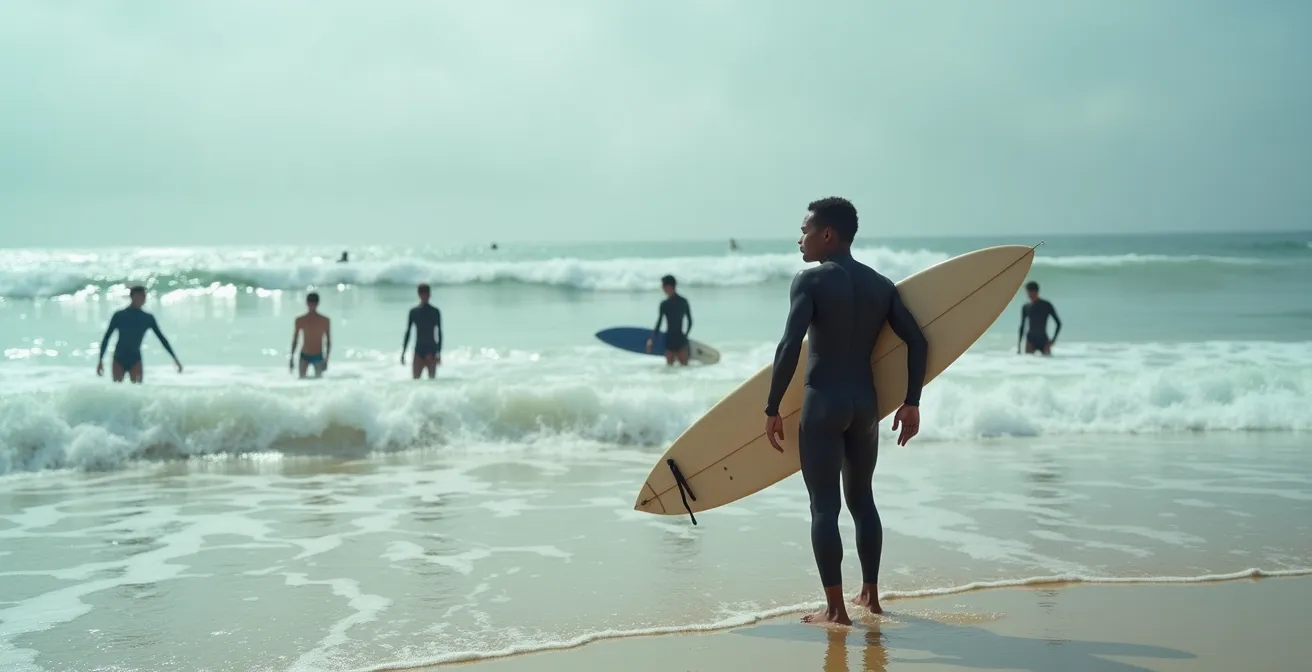
As the image above illustrates, this process should be patient and focused. You are gathering intelligence that will keep you safe and help you find your place in the pecking order. This simple act of watching shows you have respect for the ocean and the other surfers.
Case Study: The Beach Entry Protocol
Experienced surfers consistently recommend an essential protocol for any new break: observe the lineup from the shore for at least 15 minutes before entering. This dedicated observation period allows a newcomer to achieve several critical objectives. First, you can identify the main takeoff zones and see where the best waves are breaking. Second, you begin to understand the pecking order—who is leading the pack and what the general rhythm of wave-catching is. Finally, and most importantly, you can recognize potential hazards like permanent rip currents near structures, which are often the very spots where skilled locals are surfing. By taking this time, you’re not just waiting; you’re learning, and this knowledge is your ticket to a safer, more successful session.
3/2mm vs. 4/3mm: Which Wetsuit for 15°C Water and Wind?
Your wetsuit is more than just a tool for comfort; it’s a critical piece of survival equipment. In the context of rip currents, your gear choice can directly impact your ability to stay calm, rational, and physically capable of getting yourself out of a bad situation. For water hovering around 15°C (60°F), the choice between a 3/2mm and a 4/3mm wetsuit becomes a strategic decision about mobility versus insulation, which has direct implications for rip current safety.
A 3/2mm suit offers fantastic flexibility, allowing for less restricted paddling. This can be a major advantage if you need to swim parallel to the shore to escape a rip, as you’ll fatigue less quickly. However, it offers minimal protection against wind chill. If you’re exposed to wind while wet, your body temperature will drop rapidly, which can lead to poor decision-making or even the early onset of hypothermia. A 4/3mm suit provides significantly more insulation, keeping your core temperature stable for longer sessions and protecting you from wind. The trade-off is reduced mobility and increased paddling fatigue. As a lifeguard, I’ve always preached that a warm surfer is a smart surfer. Cold leads to panic, and panic is the real enemy in a rip current.
This is why understanding your own body and the day’s conditions is paramount. The following table breaks down the performance factors to help you make an informed decision.
As you assess the trade-offs in the table below, remember that your ability to survive an unexpected drag out to sea depends on maintaining both physical energy and mental clarity. An analysis of wetsuit performance shows the clear differences:
| Factor | 3/2mm Wetsuit | 4/3mm Wetsuit |
|---|---|---|
| Session Duration | Optimal for 1 hour or less | Comfortable for 2.5+ hours |
| Wind Protection | Minimal – rapid cooling when exposed | Better insulation against wind chill |
| Paddling Flexibility | Maximum mobility, less fatigue | Restricted movement, more tiring |
| Rip Current Safety | Better for quick escapes | May hinder swimming parallel to shore |
| Body Type Suitability | High metabolism/active surfers | Lower metabolism/waiting surfers |
The best way to avoid rip current problems: Know how to swim. Never swim alone. Always swim in an area protected by lifeguards.
– Chris Brewster, United States Lifesaving Association
The Leash Mistake That Can Cost You a Finger or Eye
Your surfboard leash feels like a simple convenience, keeping you connected to your board. But in powerful surf or a strong rip current, it transforms into a high-tension cable storing immense potential energy. A common and dangerous mistake is to wrap the leash cord around your fingers or hand while waiting for waves or managing your board in the whitewash. When a powerful wave hits, that cord can tighten in a fraction of a second, leading to severe injuries including deep cuts, broken fingers, or even amputation. Similarly, the board itself, when pulled by a wave at the full extent of the leash, can rocket back towards you, causing serious impact injuries to your face or eyes.
This is why treating your leash as a piece of high-performance safety equipment is non-negotiable. The forces involved are significant, especially in the turbulent, multi-directional flow of a rip current. The fact that rip currents account for over 80% of surf beach lifeguard rescues highlights how frequently surfers find themselves in these powerful, unpredictable situations. Your leash is your lifeline, but only if you use it correctly and ensure it’s in perfect working order. Before every session, especially at a new break, a thorough equipment check is not optional; it’s a professional standard of preparation.
Proper leash management means always keeping your hands and fingers clear of the cord. Control your board by its rails or deck. Furthermore, a pre-session inspection is vital to prevent equipment failure when you need it most. Here are the critical checks you must perform:
- Swivel Inspection: Check that the swivel mechanisms on both ends of the leash rotate freely. Sand, salt, and corrosion can cause them to seize, leading to tangles and knots under tension.
- Length Verification: Your leash should be approximately the same length as your board, or up to a foot longer. A leash that is too short won’t properly absorb the shock of a wave, causing the board to snap back violently.
- Velcro and Rail Saver Integrity: Examine the velcro on the cuff and the rail saver for any signs of fraying, thinning, or wear. A failed velcro cuff means you’ve lost your board, which is your primary flotation device.
- Emergency Release Practice: You should be able to release the leash cuff from your ankle instantly without looking. Practice this on the beach so the motion is pure muscle memory if you get tangled or pinned by your board underwater.
How to Position Your Body to Catch Waves with 3 Strokes?
Catching a wave efficiently isn’t about brute strength; it’s about perfect timing and positioning. It’s about conserving energy, a skill that becomes life-or-death critical if you find yourself fighting a current. The pro who glides into a wave with three seemingly effortless strokes isn’t just a stronger paddler. They are a master at reading the ocean’s “underwater signature”—the subtle signs of a wave’s impending arrival.
As a wave approaches from deep water, it begins to draw water up from the trough in front of it. This upwelling creates a very specific texture on the surface. The water can look like it’s subtly boiling or shimmering. This is the moment to act. By positioning your body correctly on the board—chest up, eyes forward, weight slightly forward—and taking your first powerful strokes as you feel that lift from behind, you are using the wave’s own energy to propel you. You are becoming part of the energy system, not fighting it. This is a skill honed over thousands of hours, turning conscious observation into pure instinct.
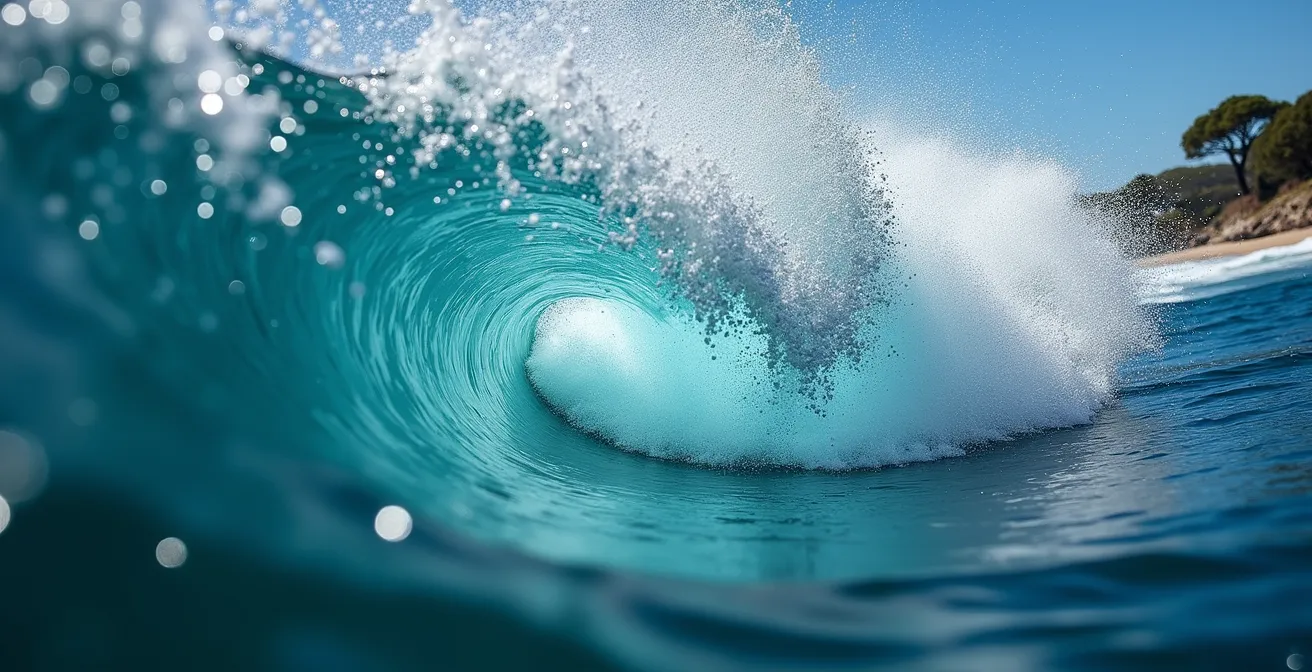
This deep connection to the water’s movement allows advanced surfers to not only catch waves with ease but also to use the ocean’s currents to their advantage, turning a potential hazard into a strategic tool.
Case Study: Using Rip Currents as Paddling Channels
At many beach breaks, experienced surfers have learned to identify and strategically use the currents that feed into a main rip. These lateral or “feeder” currents often run parallel to the beach and act as a slow-moving “conveyor belt” back towards the lineup. Instead of paddling directly against the incoming waves, these surfers will ride a wave in and then intentionally drift with the feeder current, which carries them effortlessly back outside. The key is to have the awareness to paddle out of this channel before it merges into the main, faster-moving rip that heads straight out to sea. By mastering this technique, surfers can conserve a massive amount of energy, saving it for catching waves rather than wasting it on the paddle back out.
Down vs. Synthetic Insulation: Which Saves You in Wet Conditions?
While we often focus on in-water safety, your survival toolkit extends to the moment you get out. Post-surf hypothermia is a real and insidious threat, especially after a long, draining session where you might have been fighting currents. The insulation in your jacket can be the difference between a quick recovery and a serious medical situation. In a marine environment, where everything is damp, salty, and exposed, the choice between down and synthetic insulation is not about comfort—it’s about function and survival.
Down insulation is incredibly warm for its weight in dry conditions. However, when it gets wet, it clumps together and loses almost all of its insulating properties. It also takes an extremely long time to dry without an external heat source. Synthetic insulation, on the other hand, is the clear winner for any water-based activity. It is designed to retain a high percentage of its insulating value even when soaking wet. It also dries much faster, often just from your own body heat. In an emergency scenario—say, your car won’t start after a winter surf—a wet down jacket is a dangerous liability, while a synthetic one could save your life.
Panic and exhaustion from a rip current encounter can leave you depleted and vulnerable. Having the right gear on shore is the final link in your safety chain. The table below, sourced from scientific analysis, makes the performance differences starkly clear.
| Characteristic | Down Insulation | Synthetic Insulation |
|---|---|---|
| Wet Performance | Loses 90% insulation when wet | Retains 80% insulation when wet |
| Drying Time | 24-48 hours without heat source | 2-4 hours with body heat alone |
| Compression Recovery | Permanent damage when wet-compressed | Full loft recovery after compression |
| Ocean Spray Resistance | Fails with salt water exposure | Maintains function with salt exposure |
| Emergency Survival Value | Liability in wet conditions | Life-saving in prolonged exposure |
Panic and Exhaustion: The sudden pull of a rip current may trigger panic, causing swimmers to expend energy fighting the current, which can lead to exhaustion.
– Florida Department of Health, Marine Hazards Safety Guidelines
When to Transfer Weight: The Key to Smooth Carving
On the surface, the mechanics of a smooth, powerful carve seem disconnected from the raw survival skill of reading a rip current. But they are two sides of the same coin: energy management. Reading a rip is about understanding and navigating the ocean’s energy to stay safe. Carving is about harnessing and manipulating that same energy to perform. A surfer who can execute a perfect carve has an intuitive, almost subconscious, understanding of how their board, body, and the wave’s power interact. This deep-seated feel for the water translates directly into better instincts in all situations.
A smooth carve is not a sudden, violent turn. It is a fluid transfer of weight that begins from the bottom of the wave, flows up the face, and projects you into the next section. The timing is everything. Trying to turn too early or too late results in a loss of speed and control. The key is to wait for the moment of maximum G-force compression at the bottom of the wave. This is when the wave’s power is most available to you. By initiating your turn at this precise moment, you are using the wave to power your maneuver, rather than fighting against it. The entire sequence is a kinetic chain that starts with your eyes and head, flows through your shoulders, and finishes with your hips and feet.
This sequence demonstrates a high level of ocean literacy. It’s about feeling the forces at play and responding with precise, timed movements. Here is the breakdown of that sequence:
- Feel the Compression: As you come off the bottom of the wave, feel the moment of maximum pressure and speed. This is your signal to begin the turn.
- Lead with Your Eyes: Turn your head and fix your eyes on the point on the wave face where you want to go. Your body will always follow your eyes.
- Rotate Your Shoulders: Following your eye line, rotate your upper body and shoulders. It’s crucial to maintain a low center of gravity by keeping your knees bent.
- Commit Your Weight: As your upper body rotates, complete the maneuver by shifting your weight onto your new rail. Your hips and feet will follow naturally, driving the board through the arc of the turn.
Key Takeaways
- Ocean safety is proactive, not reactive. True skill lies in anticipating hazards by understanding the ocean as an energy system.
- The wave period, not just its height, is the single most important predictor of powerful and dangerous rip currents.
- Your equipment, from wetsuit to leash, is a survival system. Its condition and proper use are as critical as your swimming ability.
How to Train for High Altitude Trekking at Sea Level?
It might seem like a world away from a discussion about rip currents, but preparing your body for the extreme environment of high altitude shares a core principle with ocean safety: proactive conditioning. The “waterman” ethos is about being a capable and resilient athlete in any environment. Whether you’re facing a two-wave hold-down or the thin air at 14,000 feet, your survival depends on your body’s ability to perform under severe physiological stress. Training for this stress before you’re in the situation is the mark of a true professional.
The primary challenge at altitude is hypoxia, or lack of oxygen. Your body adapts by increasing red blood cell production, but this takes time. Interestingly, athletes have found a way to “cross-adapt” by simulating this stress at sea level. This involves leveraging a different kind of stressor to trigger similar physiological changes. It’s a testament to the body’s remarkable ability to adapt when pushed systematically.
Case Study: The Cross-Adaptation Training Protocol
To prepare for high-altitude events while living at sea level, elite athletes have successfully used heat acclimation protocols to simulate altitude stress. By training in hot, humid conditions for a period of 10 to 14 days, they can trigger a significant increase in their blood plasma volume—by as much as 12%. This adaptation improves cardiovascular efficiency and the body’s ability to transport oxygen, providing benefits that are remarkably similar to those gained from altitude exposure. This method has been validated for improving performance at elevations up to 14,000 feet, demonstrating that you can prepare for one harsh environment by training in another.
This principle of proactive, intelligent training is the ultimate form of safety. It’s about respecting the environment enough to prepare for its worst. This is the same mindset you should bring to the ocean. You train, you prepare your gear, and you observe. You leave nothing to chance. At a patrolled beach, you have a safety net; the U.S. Lifesaving Association data shows your chance of drowning is about 1 in 18 million. At a remote break, you are your own lifeguard. Your preparation is your only safety net.
Your journey as a surfer is a continuous process of learning and adaptation. Treat every new break as a classroom. Apply these principles of observation, preparation, and respect, and you will not only be a safer surfer but a better one. Now, go put this knowledge into practice.