
The biggest threat to your training trip isn’t your cardio; it’s a cascade of preventable system failures that have nothing to do with your fitness level.
- Your immune system will crash under the combined stress of travel, new pathogens, and intense training unless you pre-emptively manage it.
- Gear management in extreme humidity is a battle against infection, not just smell. A disciplined rotation and cleaning protocol is non-negotiable.
Recommendation: Shift your focus from “getting fit” to building robust systems for health, hygiene, and recovery starting at least one month before you fly.
You’ve seen the highlight reels: kicking pads against a Thai sunset, the roar of a stadium, the lean physique forged in the heat. The dream of a Muay Thai camp in Thailand is potent. But a nagging fear gnaws at you: “Am I fit enough?” It’s the number one question asked by first-timers, a fear that you’ll be the one gasping for air while everyone else glides through training. Let me tell you a secret from years of this life: your fear is misplaced. Fitness helps, but it’s not what will send you home early.
Most articles will give you the same tired advice: run more, do more push-ups, eat healthy. This is platitude, not preparation. It ignores the real enemy of the farang (foreigner) in a Thai gym—a concept I call systemic load. This is the overwhelming, combined pressure from a new climate, alien bacteria, brutal training volume, psychological stress, and lack of home comforts. Your body isn’t just tired; it’s under a multi-front assault. Getting sick, getting a skin infection, or getting ostracized in the sparring room are far greater threats than a low VO2 max.
This guide isn’t about adding another mile to your run. It’s a pre-mortem. We’re going to dissect the common points of failure—the unglamorous, overlooked details that actually determine your success. Forget about just surviving; this is about building the systems to actually thrive. We will cover the predictable immune system crash, the logistical nightmare of gear in the tropics, the economics of your training, and the unspoken rules that keep you safe. This is the intel that turns a terrified tourist into a prepared nak muay (boxer).
This article will break down the critical systems you need to build to ensure your training trip is a success. Follow this roadmap to understand the real challenges and how to conquer them.
Contents: Surviving the Realities of a Thai Training Camp
- Why You Get Sick Week 1 of an Intensive Camp?
- How to Pack for a Camp Where Laundry Is a Luxury?
- Group Classes vs. Private Coaching: Where is the ROI?
- The Hygiene Mistake That Ends Your Camp Early
- When to Skip a Session: Listening to Your Body in a Group Setting?
- The Sparring Room Error That Gets Beginners Knocked Out
- How to Waterproof and Mold Boots 3 Months Before Departure?
- How to Eat to Speed Up Recovery from a Muscle Tear?
Why You Get Sick Week 1 of an Intensive Camp?
The “Phuket Flu” isn’t a myth. It’s the predictable outcome of overwhelming your body’s defenses. You arrive jet-lagged, immediately dive into two training sessions a day in suffocating humidity, and expose yourself to a completely new microbial environment. Your immune system, already suppressed by the stress of travel, doesn’t stand a chance. This isn’t a sign of weakness; it’s a biological reality. The core issue is overtraining from day one, which triggers a hormonal cascade that cripples your immunity. Heavy training, especially in the initial phase, is deeply immunosuppressive.
Research consistently shows that intense physical stress leads to blunted cortisol responses, your body’s natural anti-inflammatory. An 11-day study on intensified exercise confirmed that the body’s ability to manage stress through cortisol is significantly lowered. This creates a window of vulnerability where common bacteria and viruses can run rampant. In fact, comprehensive research reveals that 30-60% of athletes experience overtraining syndrome, a state defined by this hormonal and immune dysfunction. You aren’t just tired; your entire endocrine system is waving a white flag.
Your first week should be about acclimatization, not annihilation. Your goal is to manage the systemic load, not win a nonexistent competition. To beat the week-one sickness, you must prepare your immune system *before* you even board the plane. This involves proactive, strategic steps to build resilience.
- Start probiotic supplementation 2 weeks before departure to strengthen gut immunity.
- Gradually increase training intensity 4 weeks prior to simulate camp stress without causing burnout.
- Monitor your resting heart rate daily; a rising trend is a clear signal of inadequate recovery.
- Ensure you get 7-9 hours of quality sleep every night in the week before you travel.
- Stay consistently hydrated and consider supplementing with Vitamin D, a key immune regulator.
How to Pack for a Camp Where Laundry Is a Luxury?
In Thailand’s humidity, your gym bag becomes a petri dish. Cotton shirts stay damp for days, and the smell that develops isn’t just unpleasant—it’s bacteria feasting on your sweat. This is what I call the Gear Rot. Relying on local laundry services is a gamble; they can be slow, expensive, and sometimes your gear comes back even more beat up. You must be self-sufficient. This means packing smart, prioritizing material over brand names, and having a system for managing your damp, stinking equipment.
The fabric of your training clothes is your first line of defense. Cotton is your enemy. It absorbs moisture and holds it, creating the perfect breeding ground for bacteria and fungus. Your best assets are modern synthetic blends and certain natural fibers known for their performance in tropical climates. Choosing the right material directly impacts how quickly you can get back to training with clean, dry gear.
This isn’t just about comfort; it’s about hygiene and availability. The following table, based on data for training in the region, breaks down why your choice of fabric matters more than you think. As a comprehensive guide to training in Thailand highlights, materials behave very differently in a tropical environment.
| Fabric Type | Drying Time (Hours) | Odor Resistance | Durability Score |
|---|---|---|---|
| Cotton | 12-24 | Poor | 3/10 |
| Polyester Blend | 3-6 | Good | 8/10 |
| Merino Wool | 6-8 | Excellent | 7/10 |
| Bamboo Fiber | 4-8 | Very Good | 6/10 |
Even with the right fabrics, you’ll need a field-expedient laundry solution. You can’t always rely on a washing machine. A small, lightweight kit allows you to wash a single set of gear in your hotel sink or a dry bag, ensuring you always have something clean for the next session. This is a veteran move that separates the prepared from the desperate.
Group Classes vs. Private Coaching: Where is the ROI?
Your training budget is a finite resource. How you allocate it determines the return on your investment (ROI) in skill. The two primary options at any Thai camp are group classes and private sessions. Many first-timers assume more group classes are better value, but this is a rookie mistake. Understanding the distinct purpose of each is key to maximizing your development. Group classes are for conditioning and repetition. Private sessions are for diagnosis and correction.
Group classes, which can cost anywhere from THB400-1,000 per session, are fantastic for building your engine. You’ll hit pads for endless rounds, drill basic combinations, and get your heart rate into the stratosphere. It’s where you build the raw fitness and muscle memory needed for Muay Thai. However, the student-to-trainer ratio is high. You might get a few cursory corrections, but there is no time for a deep dive into your specific technical flaws. You’re there to work, not to have a personalized lesson.
Private sessions, at THB1,500-3,000 an hour, are a surgical tool. This is where a skilled Kru (trainer) puts you under a microscope. They will break down your stance, your guard, the way you generate power, and the tells in your defense. One hour of focused, private instruction can fix a fundamental flaw that a hundred group classes would only reinforce. An analysis from a Muay Thai coaching expert shows the trade-offs clearly, highlighting that skill development speed is exponentially higher in private settings.
A smart strategy uses both. Use group classes for your gas tank and private sessions to steer the ship. This table, drawing from an in-depth analysis of Thailand training value, illustrates the different returns you get from each format.
| Training Type | Cost per Hour | Skill Development Speed | Conditioning Benefit | Personal Attention |
|---|---|---|---|---|
| Group Classes | $10-30 | Moderate | High | Low-Medium |
| Private Sessions | $40-80 | Very High | Low-Medium | Maximum |
| Semi-Private (2-3 people) | $25-50 | High | Medium | High |
The Hygiene Mistake That Ends Your Camp Early
The most common injury that sends fighters home from Thailand isn’t a broken bone; it’s a raging staph infection. Your skin, scraped and opened by gloves, shins, and dirty mats, becomes a gateway for aggressive bacteria. In the Thai heat, these bacteria multiply at an alarming rate. The single biggest mistake you can make is delaying your post-training shower. It’s not about feeling fresh; it’s a critical medical protocol.
Every reputable gym in Thailand understands this risk. As the trainers at Bangtao Muay Thai, one of Phuket’s premier camps, state unequivocally:
It is important to shower straight after training to avoid any skin infections.
– Bangtao Muay Thai, A Full Guide to Training Camps in Thailand
This simple act washes away the sweat, grime, and—most importantly—the bacteria before they can colonize any cuts or scrapes. The second part of this equation is your gear. Putting on damp, bacteria-laden gloves from yesterday’s session is like willingly inoculating yourself with pathogens. You must have a rigid system for disinfecting and drying your equipment. It’s not optional. It is as crucial as learning how to throw a kick.
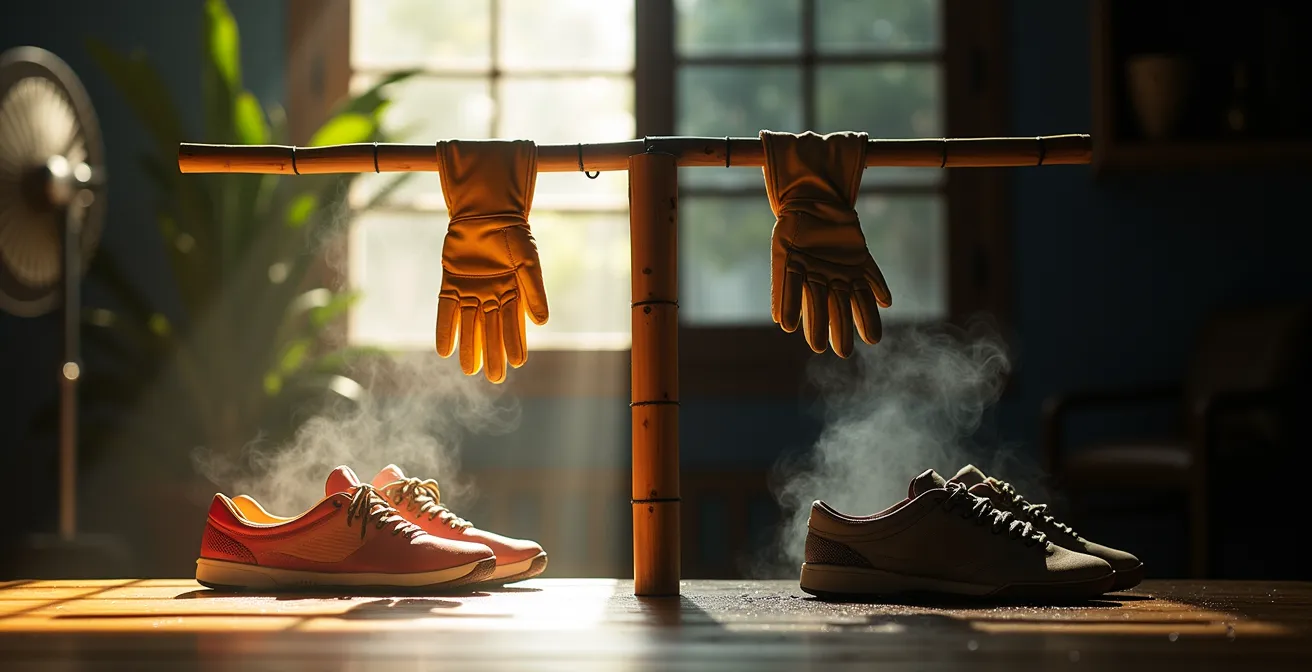
The image above illustrates the difference between a disciplined and a foolish approach. Well-maintained gear, properly aired out, is a sign of a smart fighter. A pile of damp equipment in a dark corner is a staph infection waiting to happen. Your health, and the continuation of your training, depends entirely on which side of that line you fall. Implementing a daily disinfection routine is the only way to manage the risk.
Action Plan: Daily Gear Disinfection Protocol
- Spray gloves and shin guards with an antibacterial solution immediately after every training session.
- Turn all equipment inside out and place it in front of a fan for a minimum of 4 hours to ensure it is bone dry.
- Apply antifungal powder to the inner surfaces of gloves and guards before your next use.
- Rotate between at least two sets of training gear if you are training twice a day.
- Perform a deep clean on all gear using a diluted vinegar solution on a weekly basis.
When to Skip a Session: Listening to Your Body in a Group Setting?
“Listen to your body” is the most common and most useless piece of advice given to athletes. In the high-pressure environment of a Thai camp, surrounded by fighters who seem indestructible, it’s almost impossible to follow. Your ego screams at you to keep up. The fear of being seen as weak or lazy is powerful. This is where you need a system, not a sentiment. You need objective data to make the decision for you, removing your emotions from the equation.
Overtraining isn’t just feeling tired; it’s a physiological state with measurable markers. Studies show that different types of training produce different stress responses; for example, sprint-trained athletes often show more significant inflammatory responses and cortisol changes than endurance athletes, indicating a lower tolerance for sudden spikes in training load. Your body is sending you clear signals of this stress, but you need to know how to read them. The most reliable indicators are your resting heart rate (RHR), sleep quality, and overall feeling of fatigue and motivation.
A simple, effective method used by professional athletes is the “Traffic Light” self-assessment system. You measure your RHR first thing in the morning, before you even get out of bed. You compare it to your established baseline. This, combined with a quick, honest assessment of your sleep and mood, gives you a clear, data-driven directive for the day. This removes the guesswork and the ego. An objective framework for monitoring athlete readiness is essential for preventing burnout.
Here is how you apply the system:
- GREEN: Your resting heart rate is normal, you slept well, and you feel motivated. You are cleared for full training, including high-intensity work and sparring.
- AMBER: You have mild soreness, your RHR is slightly elevated (3-9 bpm above normal), and sleep was just adequate. You are not cleared for high intensity. Stick to technical focus only, shadowboxing, or light bag work. No sparring.
- RED: Your RHR is significantly elevated (10+ bpm above normal), you slept poorly, and you feel persistent, deep fatigue. You are ordered to take a complete rest day. The only activity allowed is active recovery, like a gentle walk or stretching.
The Sparring Room Error That Gets Beginners Knocked Out
The sparring ring is where it all comes together. It’s also where a first-timer’s trip can go horribly wrong. The single biggest error a beginner makes is a cultural one: treating sparring like a fight. In a Thai gym, sparring (or “len cheng,” playing) is a conversation, not a war. Your goal is to learn, to test techniques, and to flow. Going 100% is a massive sign of disrespect. It earns you the “sparring tax”—a painful, sharp lesson from a more experienced fighter designed to put you back in your place.
You will be overwhelmed. A senior Thai fighter will move with an economy and speed you can’t comprehend. When this happens, beginners often panic and do one of two things: they shell up and become a static heavy bag, or they swing for the fences out of desperation. Both are wrong. The correct response is to communicate, both verbally and with your body language. You need a de-escalation protocol to manage the intensity before it gets out of hand.
This isn’t about weakness; it’s about showing respect and a willingness to learn. It’s how you earn the trust of your training partners and trainers, ensuring they will work *with* you, not *on* you. Having a clear set of actions to take when you feel the pressure mounting is your safety valve. Know this protocol by heart before you ever step through the ropes.
- Immediately establish a high, tight shell guard when you feel overwhelmed to protect your head.
- Use clear, simple verbal cues. A respectful “Light, please” or “Easy, easy” is universally understood.
- Actively create space. Use a long guard (a straight-arm push to the shoulder or gloves) or sharp lateral movement to break their rhythm.
- If you need a hard reset, tap your own gloves together and take a step back. This is the sign for a momentary pause.
- If a partner is consistently going too hard despite your cues, do not engage in an ego battle. Finish the round, thank them, and have a quiet word with your trainer afterward.
How to Waterproof and Mold Boots 3 Months Before Departure?
Let’s be clear: you won’t be wearing boots in a Muay Thai gym. Your “boots” are your shins. They are your primary weapon for kicking and your primary shield for blocking. Arriving in Thailand with soft, unprepared shins is the equivalent of a soldier going into battle with paper armor. The process of conditioning them—effectively molding them into durable weapons—doesn’t happen overnight. It is a slow, methodical process that should begin months before your departure. This is pre-conditioning.
The agony of shin-on-shin contact with unprepared shins is excruciating and can mentally take you out of training. The goal of shin conditioning is not to “kill the nerves,” a dangerous myth. It is to increase bone density through a process called cortical remodeling (an application of Wolff’s Law) and to deaden the superficial nerve response through repeated, gradually increasing pressure. You are building calluses on the bone itself. Rushing this process leads to bone bruises that can sideline you for weeks.
This isn’t about mindlessly kicking a steel pole. It’s a progressive, 12-week protocol designed to build density without causing injury. You start with soft pressure and gradually escalate to harder surfaces and light impact. This methodical approach ensures your shins are ready for the daily impact of pad work and partner drills. Alongside this, daily hip flexibility work is critical; without the ability to rotate your hip correctly, you’ll deliver kicks with the bony, sensitive part of your shin instead of the durable muscle and bone along the top.
Follow this protocol religiously for 12 weeks before you fly:
- Weeks 1-4: Start with a foam roller. Apply deep pressure along the entire shin muscle and bone for 5 minutes daily on each leg.
- Weeks 5-8: Progress to rolling your shins with a hard plastic bottle or PVC pipe. Introduce very light bag work, focusing on perfect form.
- Weeks 9-10: Introduce impact. Use a wooden dowel or rolling pin to lightly tap up and down the shin bone, delivering 50 light taps per shin daily.
- Weeks 11-12: If you have a partner, begin very light shin-to-shin contact drills, focusing on placement and control, not power.
- Daily: Perform a hip flexibility routine focusing on internal and external rotation to ensure you can turn your kicks over properly.
Key Takeaways
- Systemic failure from illness or infection is a greater threat than a lack of fitness; prioritize health management over raw conditioning.
- A disciplined gear rotation and hygiene protocol is non-negotiable in Thailand’s climate to prevent camp-ending skin infections.
- Use objective data like resting heart rate, not ego, to decide when to train, modify, or rest, preventing overtraining and injury.
How to Eat to Speed Up Recovery from a Muscle Tear?
Injury is a part of the game. Sooner or later, you will suffer a muscle tear, a deep bruise, or a sprain. Your ability to get back into training quickly doesn’t just depend on ice and rest; it depends heavily on what you put into your body. Nutrition is your most powerful recovery tool. The goal in the first 72 hours after an acute soft tissue injury is to aggressively manage inflammation. Chronic inflammation slows healing, increases pain, and can lead to the development of excessive scar tissue.
This means your diet needs to become a weapon against inflammation. You must ruthlessly eliminate foods that promote it and flood your system with nutrients that fight it. Processed sugars and alcohol are your worst enemies during this phase. They are highly inflammatory and will actively work against your body’s healing processes. Instead, you need to focus on whole foods packed with antioxidants and specific compounds that regulate the inflammatory response.
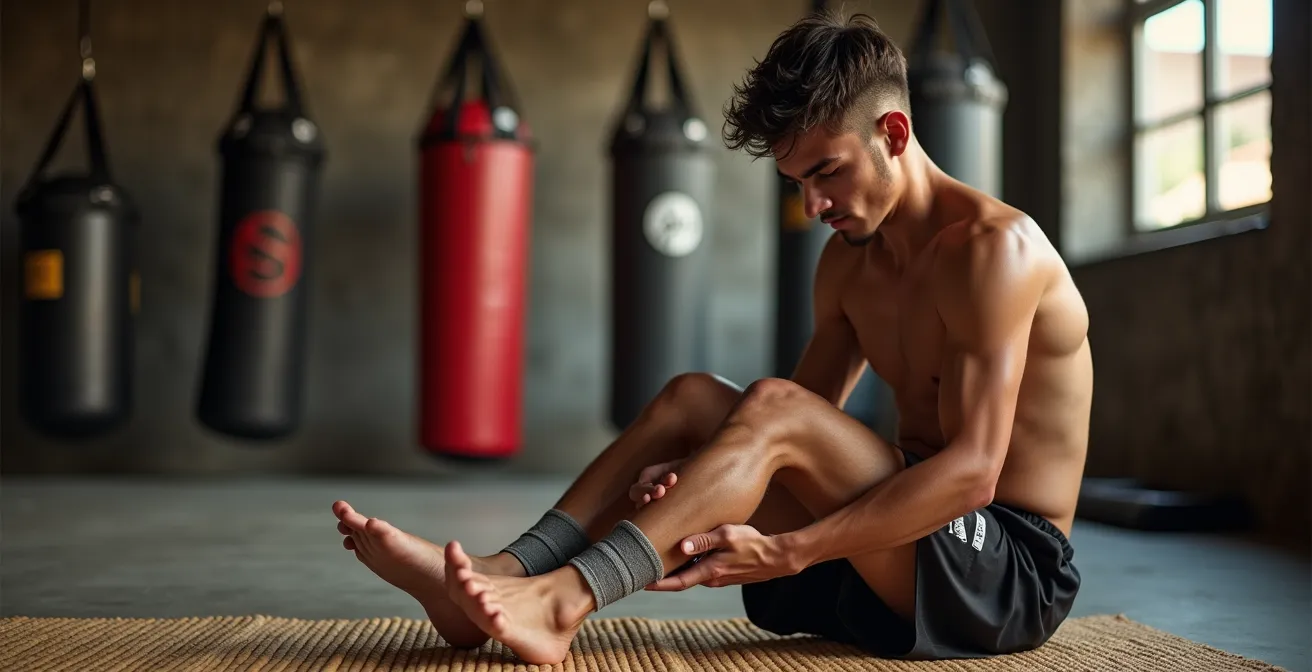
The period immediately following an injury is a critical window. What you do here determines whether you’re back on the mats in a week or nursing the same injury a month later. A targeted, anti-inflammatory nutritional protocol can dramatically accelerate healing and reduce downtime. The following is a 72-hour emergency protocol to implement immediately after a muscle tear or significant strain, based on established sports medicine research on nutritional interventions.
- Day 1-3: Eliminate all processed sugars and alcohol completely. They are the primary drivers of systemic inflammation.
- Add 2 grams of high-quality omega-3 from a fish oil supplement with each meal to help regulate inflammatory pathways.
- Include turmeric (1 teaspoon of powder) and fresh ginger (2 teaspoons, grated) in your daily diet for their potent anti-inflammatory properties.
- Consume 8-10 servings of colorful vegetables daily. Their antioxidants combat the cellular damage caused by injury.
- Supplement with 1,000mg of Vitamin C and 15mg of Zinc daily to support tissue repair and immune function.
Your trip to Thailand is a test of preparation, not just passion. Stop worrying if you’re fit enough and start asking if you’re smart enough. Build these systems, follow these protocols, and you won’t just survive—you’ll leave stronger than you ever thought possible. The work starts now.