

Being strong in the gym doesn’t guarantee you’ll be explosive on the field because athletic power isn’t about maximum force, but how *fast* you can generate it.
- Your training focus must shift from lifting heavy to lifting with explosive intent, prioritizing Rate of Force Development (RFD).
- Exercises that mimic athletic movements (like Landmine Presses) have a far greater transfer to performance than isolated lifts (like the Bench Press).
- High-rep sets kill power development; true explosive training uses low reps (1-5) with long rest periods to ensure nervous system recovery and peak output.
Recommendation: Stop chasing numbers on the bar and start measuring the velocity of your lifts. Implement contrast training by pairing a heavy compound lift with a similar explosive movement to teach your body to turn strength into speed.
You live in the squat rack. You’ve built a respectable bench press and your deadlift is solid. By every metric in the gym, you are strong. Yet, when you step onto the field, the court, or into the ring, something is missing. You’re getting out-maneuvered by athletes who look half as strong as you. You feel powerful, but you’re not explosive. This frustrating disconnect is one of the most common plateaus for dedicated athletes: the gap between gym strength and functional, athletic power.
The conventional wisdom is to simply “do more plyometrics” or “lift heavier.” But this advice misses the fundamental point. The problem isn’t a lack of strength; it’s a failure in force *expression*. True athleticism for contact sports is defined by your ability to generate maximum force in the shortest possible time. It’s not about the weight on the bar, but the velocity you can move it with. Your nervous system is trained for the slow, grinding reps of hypertrophy or max strength, not the violent, split-second contractions required for a tackle, a punch, or a jump.
But what if the key wasn’t adding more exercises, but completely re-engineering the *intent* behind them? The real solution lies in understanding and training a specific quality: the Rate of Force Development (RFD). This is the science of how quickly you can reach your peak force. It’s the difference between a slow push and an explosive shove. By focusing on RFD, you can re-wire your neuromuscular system to bridge the gap between being strong and being a powerhouse.
This guide will dissect the methods to transform your hard-earned strength into devastating athletic power. We’ll explore why traditional strength metrics fail, how to select exercises for maximum transfer, the critical rep-range mistakes to avoid, and how to structure your workouts to build an explosive, game-ready athlete.
To help you navigate this transformation, this article breaks down the essential components of building true athletic power. Explore the sections below to understand the science and application of explosive training.
Summary: From Brute Strength to Explosive Power
- Why Being Strong Doesn’t Automatically Make You Punch Harder?
- How to Slam a Med Ball to Recruit Fast-Twitch Fibers?
- Landmine Press vs. Bench Press: Which Transfers Better to Sports?
- The Rep Range Mistake That Turns Power Training into Cardio
- In What Order Should You Pair Heavy Lifts and Jumps?
- Why Poor Landing Mechanics Cause 70% of Handball Knee Injuries?
- Weighted Bat vs. Overspeed Training: Which Increases MPH Faster?
- How to Structure a Tabata Workout That Actually Burns Fat?
Why Being Strong Doesn’t Automatically Make You Punch Harder?
The answer lies in a crucial metric that most gym-goers ignore: Rate of Force Development (RFD). A powerful punch, a quick first step, or an explosive tackle all happen in milliseconds—far too fast to generate your absolute maximum strength. What matters is how much force you can summon in that tiny window of time. This is RFD. It’s the steepness of your strength curve, not just its peak. While maximal strength forms the foundation, it’s RFD that builds the skyscraper of athletic power on top of it.
Think of it like two engines: one is a massive diesel truck engine (high max strength), and the other is a Formula 1 engine (high RFD). The truck can pull an immense load, but it takes time to get going. The F1 car reaches top speed almost instantly. In sports, you need the F1 engine. Research consistently shows that the ability to apply force rapidly is what separates elite athletes from the rest. For example, studies reveal that elite sprinters show 2x greater RFD than their untrained counterparts, even if their maximal strength levels aren’t dramatically different.
This is why an athlete who can squat 400 lbs slowly might get out-jumped by someone who only squats 300 lbs but does so with explosive intent. The second athlete’s nervous system is primed to recruit motor units and muscle fibers with incredible speed. Training for RFD means focusing on the *intent to move explosively* on every single rep, often with submaximal weights, to teach your body how to unleash its power on command.
Case Study: The Power of Specificity
To see this principle in action, look at the results from strength coach Miguel Aragoncillo. He documented his journey using the French Contrast Method, a system specifically designed to improve RFD. By systematically combining heavy lifting with explosive plyometrics, he was able to increase his vertical jump from 31 inches to a staggering 37.5 inches over the course of a year. This 6.5-inch gain in an already-trained individual is a testament to the fact that targeted power training, not just getting stronger, is the key to unlocking explosive potential.
How to Slam a Med Ball to Recruit Fast-Twitch Fibers?
The medicine ball slam is one of the purest expressions of explosive power. It’s a full-body, violent movement that trains your body to channel force from the ground up and into an object—exactly what you do in contact sports. But just flopping the ball onto the ground won’t cut it. To truly recruit your high-threshold, fast-twitch muscle fibers, you need to execute each slam with maximal intent and perfect form. The goal isn’t to get tired; it’s to generate as much velocity as possible on every single rep.
The movement starts by raising the ball overhead, achieving a full extension through your hips, torso, and arms. This pre-loads the kinetic chain. The slam itself is an aggressive, coordinated snap-down, initiated by contracting your lats and core to pull the ball down while simultaneously breaking at the hips. The power comes from the violent hip hinge, not from your arms. Think of it as a standing crunch combined with a kettlebell swing in reverse. The objective is to slam the ball so hard it tries to bounce back up to your face.
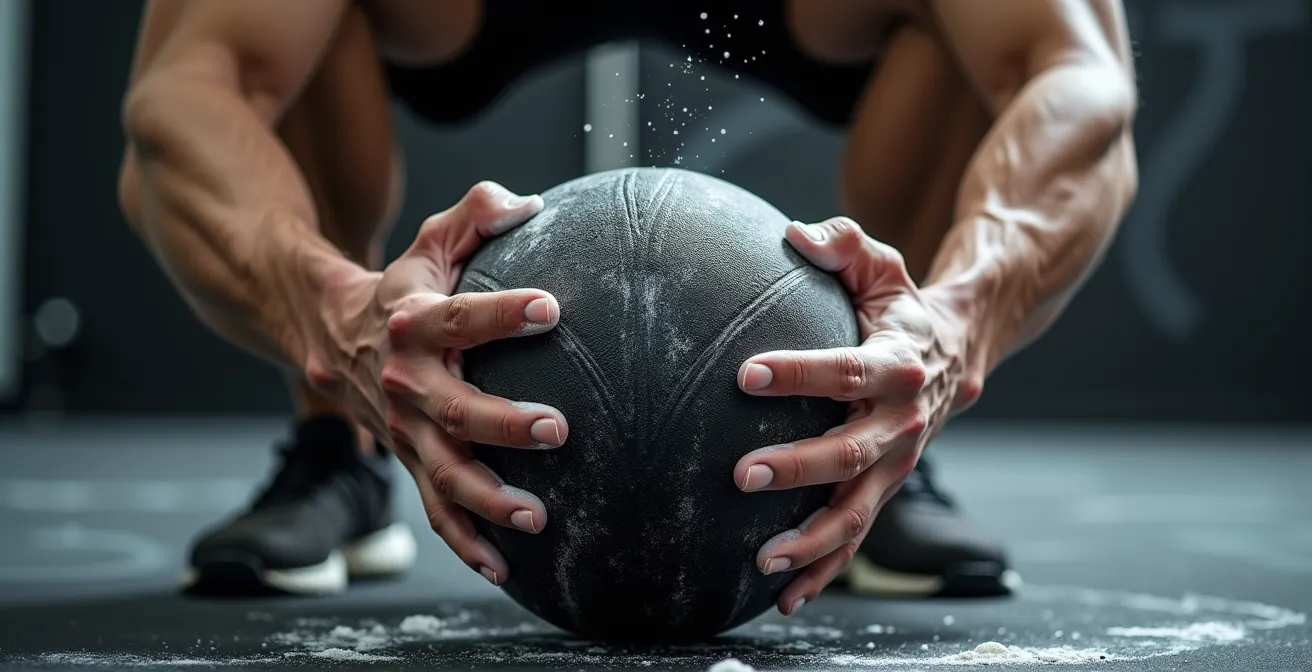
The key to making this a power-building exercise is in the programming. Since the goal is maximal velocity and nervous system recruitment, volume must be kept low. This isn’t cardio. Performance training protocols suggest that for explosive movements, keeping reps low is critical. In fact, for maximum power output, it is recommended to stay within 1-3 reps per set for optimal development. A good starting point is 5-8 sets of 3 reps, with ample rest (60-90 seconds) between sets to ensure your nervous system is fully recovered and ready to fire at 100% for the next set.
Landmine Press vs. Bench Press: Which Transfers Better to Sports?
While the bench press is the king of upper body strength in the gym, its direct transfer to the athletic field is highly debatable. The movement is horizontal, performed while lying on a stable surface, which isolates the upper body. In contrast, the Landmine Press is a standing, multi-joint movement that forces power generation from the ground up. As strength coaches Mike Over and Alex Chrysovergis noted in a SimpliFaster Performance Analysis, this difference is fundamental.
The landmine press forces power generation from the feet through the kinetic chain, while the bench press isolates the upper body from its athletic foundation.
– Mike Over and Alex Chrysovergis, SimpliFaster Performance Analysis
The Landmine Press more closely mimics the biomechanics of athletic actions like punching, blocking, or fending off an opponent. The upward and forward pressing angle, combined with the freedom of movement for the scapula and the intense demand on core stabilization, makes it a far more functional choice for athletes. The bench press builds raw pressing strength, but the landmine press teaches your body how to *use* that strength in a coordinated, athletic fashion.
Your body learns to transfer force through the entire kinetic chain—from your feet, through your hips and core, and finally out through your hands. This is the essence of athletic movement. The bench press, by providing artificial stability and removing the lower body from the equation, fails to train this crucial neuromuscular pathway. For a contact sport athlete, the choice is clear: while bench press has its place for building mass and maximal strength, the landmine press is superior for converting that strength into usable power.
This table breaks down the key differences in how each exercise contributes to athletic performance.
| Factor | Landmine Press | Bench Press |
|---|---|---|
| Kinetic Chain Activation | Ground-up power generation through entire body | Isolated upper body with artificial stability |
| Vector Specificity | Upward/forward arc mimics athletic movements | Horizontal path less sport-specific |
| Core Engagement | Dynamic stabilization under load | Minimal core requirement due to bench support |
| Transfer to Contact Sports | High – mimics blocking, tackling angles | Moderate – limited functional carryover |
The Rep Range Mistake That Turns Power Training into Cardio
One of the biggest programming errors athletes make is treating power workouts like bodybuilding sessions. They perform sets of 8, 10, or 12 reps on explosive movements, chasing a “burn” or metabolic fatigue. This is a critical mistake. True power is a function of the nervous system’s ability to fire at maximum capacity, and this ability is incredibly short-lived. Your body’s most immediate and powerful energy source is the ATP-PC system, which provides fuel for all-out, explosive efforts.
The problem? This system is exhausted very quickly. Detailed sports science research confirms that you only have about 8-10 seconds of fuel for maximal intensity work before power output begins to drop significantly. Once you push past this point, you’re no longer training for power; you’re training for muscular endurance. Your movement velocity slows, your form degrades, and your nervous system learns to pace itself rather than explode. You are effectively turning a power session into a cardio workout, accumulating fatigue that blunts the very explosive adaptation you’re trying to create.
To train for power effectively, every single rep must be performed with the highest possible quality and velocity. This means low reps (typically 1-5), and, crucially, long rest periods (2-5 minutes) between sets to allow the ATP-PC system and the Central Nervous System (CNS) to fully recover. A better approach for maintaining power across a set is using cluster sets. Instead of doing a continuous set of 5 reps, you perform 1 rep, rest for 20-30 seconds, perform another rep, and so on. This keeps the quality of each individual rep brutally high.
Action Plan: Implement Cluster Sets for Power Maintenance
- Replace traditional 1×5 reps with 5 sets of 1 rep (a 5×1 cluster set).
- Rest for 20-30 seconds between each single repetition within the cluster.
- Monitor bar speed or jump height; end the set when your velocity drops by more than 10-20% from your best rep.
- Allow for full recovery of 3-5 minutes between each complete cluster set to ensure ATP regeneration.
- Focus on the intent to move explosively on every rep; the neurological component is as vital as the physical lift.
In What Order Should You Pair Heavy Lifts and Jumps?
The strategy of pairing a heavy strength movement with a similar explosive, plyometric movement is known as contrast training. This method leverages a physiological phenomenon called Post-Activation Potentiation (PAP). In simple terms, lifting a heavy load excites your nervous system, “waking up” more muscle fibers. When you immediately follow that with an explosive movement like a jump, your body is primed to produce more force, resulting in a higher or more powerful jump than you could achieve otherwise. The heavy lift potentiates the explosive one.
The correct order is non-negotiable for leveraging PAP: the heavy lift MUST come first. For example, you would perform a heavy set of back squats (e.g., 3-5 reps at 85% of your 1RM), rest briefly (30 seconds to 2 minutes), and then immediately perform a set of explosive box jumps or vertical jumps (e.g., 3-5 reps). Reversing the order would simply pre-fatigue your muscles before the heavy lift, defeating the entire purpose. The goal is to use the heavy lift to supercharge the nervous system for the explosive work that follows.
A more advanced version of this is the French Contrast Method, which chains four exercises together: a heavy compound lift, a plyometric jump, a weighted explosive movement, and an accelerated plyometric. An example complex would be:
- Back Squats (heavy)
- Hurdle Hops (plyometric)
- Dumbbell Squat Jumps (weighted explosive)
- Band-Assisted Jumps (accelerated)
This layered approach targets different points on the force-velocity curve within a single set, creating a potent stimulus for power development. The effectiveness of this sequencing is not just theoretical. A 6-week study documented in the NSCA journal showed that athletes using the French Contrast Method saw significant gains across the board. The protocol resulted in improvements in their back squat (6.2%), trap bar deadlift (7.7%), static jump height (11%), and countermovement jump (8.5%). These results powerfully demonstrate that the *order* and *pairing* of exercises are critical for turning strength into explosive power.
Why Poor Landing Mechanics Cause 70% of Handball Knee Injuries?
It’s a stark reality in dynamic sports like handball, basketball, and volleyball: the jump gets all the glory, but the landing causes the injury. While the “70% of knee injuries” figure is a widely cited statistic in sports medicine to highlight the scale of the problem, the underlying mechanism is clear. Most non-contact ACL tears and other knee injuries occur during the deceleration phase—specifically, when landing from a jump or making a sharp cut. An athlete who can’t properly absorb force is a ticking time bomb.
Poor landing mechanics are often characterized by knee valgus, where the knees collapse inward upon impact. This places tremendous stress on the ligaments of the knee, particularly the ACL. This collapse is typically a sign of weak hip abductors and external rotators, like the gluteus medius, which are responsible for stabilizing the femur. Instead of the powerful hip muscles absorbing the impact, the force is shunted directly into the knee joint and its passive structures. The body is an incredible kinetic chain, but when a link in that chain fails, the weakest point is exposed.
Therefore, training to jump higher is only half the battle. Athletes must dedicate specific training time to learning how to land. This involves “greasing the groove” of the proper motor pattern: landing softly on the balls of the feet, with hips back, chest up, and knees tracking directly over the toes. The goal is to make a silent landing, which is an audible cue that you are absorbing force with your muscles, not jarring your joints. This eccentric strength—the ability to control and absorb force—is not just crucial for injury prevention; it’s also the foundation for the next explosive movement in the stretch-shortening cycle. A better landing leads to a more powerful subsequent jump or cut.
Action Plan: A Progressive Landing Protocol
- Start with Depth Drops: Step off a low box (6-12 inches) and focus only on a silent, stable landing. Do not jump. Hold the landing position for 3 seconds.
- Progress to Altitude Landings: Gradually increase the height of the box as you master the landing, reinforcing the motor pattern under greater force.
- Train the Amortization Phase: Once landings are solid, progress to rebound jumps. Focus on minimizing the time your feet are on the ground while maintaining perfect form.
- Address Knee Valgus: Incorporate targeted strengthening for the glute medius, such as banded lateral walks, clamshells, and single-leg Romanian deadlifts.
- Practice in all planes: Sports are chaotic. Practice landing from forward, lateral, and rotational jumps to prepare for game-like situations.
Weighted Bat vs. Overspeed Training: Which Increases MPH Faster?
The debate between using a heavier-than-normal implement (overload) versus a lighter one (overspeed) to improve throwing or swinging velocity is a classic coaching dilemma. The answer isn’t that one is universally better, but that they address different weaknesses along the force-velocity curve. An athlete’s profile determines which method will yield faster results. The key is to identify whether the athlete is “strong but slow” or “fast but weak.”
An athlete who is strong but lacks speed needs to train the velocity end of the curve. This is where overspeed training comes in. By using a lighter implement (e.g., a bat that is 90% of the normal weight), the athlete can move their body faster than they normally would. This teaches the central nervous system to fire more rapidly, improving the “speed” part of the power equation. It overclocks the neuromuscular system for higher velocity.
Conversely, an athlete who is naturally quick but lacks the underlying strength to produce high force needs to train the force end of the curve. For them, weighted implement training (overload) is the answer. Using a slightly heavier implement (e.g., 110-120% of normal weight) forces the body to recruit more muscle fibers and generate greater force during the movement. This builds the specific strength that can later be converted into velocity. The Driveline Baseball program famously showed how alternating between heavy/slow dynamic effort days and light/fast speed days produced superior bat speed improvements, proving the value of training both ends of the spectrum.
This table provides a simple framework for choosing the right method based on the athlete’s needs.
| Athlete Profile | Recommended Method | Loading Parameters |
|---|---|---|
| Strong but Slow | Overspeed Training | Underloaded implements (90% normal weight) |
| Fast but Weak | Weighted Implement | 110-120% normal implement weight |
| Balanced Profile | Optimal Load Training | Load that maximizes power output (typically 30-60% 1RM) |
Key Takeaways
- True athletic power is measured by Rate of Force Development (RFD), not just maximal strength.
- Train for power with low reps (1-5) and long rest periods to maximize Central Nervous System output and avoid turning workouts into cardio.
- Functional exercises like the Landmine Press have better carryover to sports than isolated lifts like the Bench Press because they train the entire kinetic chain.
How to Structure a Tabata Workout That Actually Burns Fat?
Here’s the hard truth: if your goal is to develop explosive power, you should not be doing Tabata workouts. The protocol—20 seconds of all-out work followed by 10 seconds of rest, repeated 8 times—is a phenomenal tool for improving cardiovascular capacity (VO2 Max) and metabolic conditioning. It is, however, the polar opposite of what’s required for power development. As noted by Dr. Bryan Mann, a leading expert on velocity-based training, this structure is fundamentally at odds with power principles.
The Tabata protocol’s short rest periods are designed for VO2 Max and are diametrically opposed to the long rest periods needed for CNS recovery and peak power development.
– Bryan Mann, PhD, CSCS, NCAA Velocity Based Training Guidelines
The 10-second rest period is brutally insufficient for your nervous system and ATP-PC energy system to recover. After the first one or two intervals, your power output plummets. You are no longer training explosiveness; you’re training your ability to sustain work in a fatigued state. This trains endurance, not power. For a contact sport athlete, confusing these two training adaptations is a critical error. You’re teaching your body to be slow and gritty, not fast and explosive.
So, how do you structure a high-intensity session that *does* build power? The answer is to flip the work-to-rest ratio. Instead of maximizing fatigue, you want to maximize quality. A far superior alternative is the EMOM (Every Minute On the Minute) format, specifically programmed for power. In this setup, you perform a small number of explosive reps at the top of each minute and use the remainder of that minute to rest. For example, you might do 3 powerful kettlebell swings or 2 box jumps, which takes about 5-10 seconds. You then have 50-55 seconds of complete rest before the next minute begins. This ensures that every single rep is performed with maximal velocity and perfect form, directly training your RFD and fast-twitch fibers without accumulating debilitating fatigue.
Action Plan: Power-Oriented EMOM Protocol
- Choose one explosive exercise (e.g., Kettlebell Swings, Box Jumps, Med Ball Slams).
- At the start of each minute, perform 2-3 reps with maximal explosive intent.
- Use the remaining 50-55 seconds of the minute for complete rest and CNS recovery.
- Continue for a set number of minutes (e.g., 10-15 minutes).
- Focus entirely on movement quality and power output. If your velocity drops, the session is over.
Now that you understand the principles, it’s time to apply them. Start by auditing your current program and replacing any high-rep “power” work with low-rep, high-quality sets and implementing contrast training to bridge the gap between your strength and your speed.